- Animals
- ›Chordates
- ›Vertebrates
- ›Mammals
- ›Therians
- ›Placental Mammals
- ›Primates, Rodents, and Allies
- ›Rodents
- ›Ctenohystricans
- ›Hystricognaths
- ›Degus, Hutias, Tuco-tucos, and Allies
- ›Spiny Rats and Hutias
- ›Hutias
- ›Ground Hutias
- ›Capromys
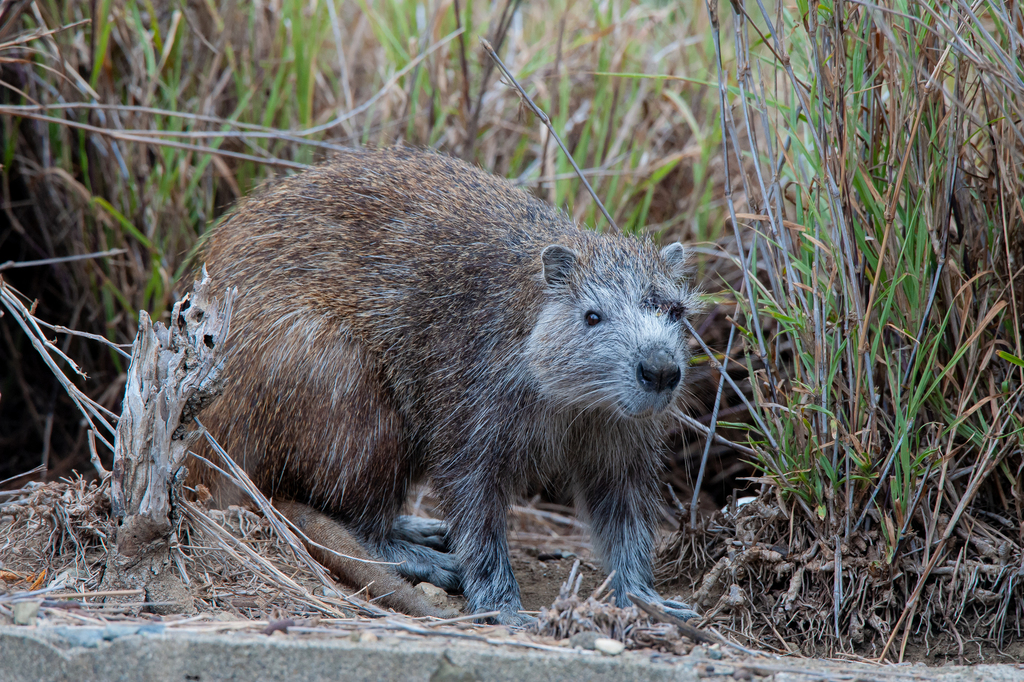
Desmarest's Hutia
Capromys pilorides
Desmarest's hutia or the Cuban hutia (Capromys pilorides) is a stout, furry, rat-like mammal found only on Cuba and nearby islands. Growing to about 60 cm (2 ft), it normally lives in pairs and feeds on leaves, fruit, bark and sometimes small animals. It is the largest living hutia (subfamily Capromyinae), a group of rodents native to the Caribbean that are mostly endangered or extinct. Desmarest's hutia remains widespread throughout its range, though one subspecies (C. p. lewisi) native to the nearby Cayman Islands went extinct shortly after European colonization in the 1500s.
From the article Desmarest's hutia on Wikipedia (CC BY-SA), quoted section by section
Description
The Desmarest's hutia has a head-and-body length of 31–60 cm (12–24 in), a tail that is 14–29 cm (5.5–11.4 in) long, and weighs 2.8–8.5 kg (6.2–18.7 lb). It has thick, coarse fur which extends to the tip of the tail. The colour of the body fur varies from black to brown, with a light sand colour and red also seen. The body is stocky and the legs short. It moves with a slow, waddling gait, but can perform a quick hop when pursued. The feet have five toes with large claws which assist the animal in climbing. The stomach is divided into three compartments by constrictions in the gut and is among the most complex of any rodent. Its karyotype has 2n = 40 and FN = 64.
Range & habitat
The Desmarest's hutia is found in a wide range of habitats. In northern Cuba, populations tend to be centred on areas where there are abundant mangroves, while southern populations tend to favour a more terrestrial habitat. They are abundant in Guantánamo Province, particularly around the Guantanamo Bay Naval Base. In the mountainous areas of eastern Cuba, numbers of Desmarest's hutia are decreasing.
The Desmarest's hutia is found only in Cuba, but is widespread throughout its range. They are found on the main island, Isla de la Juventud, the Sabana archipelago, the Doce Lagunas archipelago and many of the other islands and cays of the Cuban archipelago. An extinct subspecies, C. p. lewisi, formerly lived in the Cayman Islands before it was wiped out shortly after European colonization. This subspecies may have been the subject of a report by Francis Drake when he visited the islands, in which he spoke of "little beast-like cats" and "coneys" throughout the area.
Wikipedia: “Habitat and distribution”
What it does
Desmarest's hutias normally live in pairs, but can be found individually or in small groups. They are diurnal and do not burrow, so during the night they rest in hollows in rocks or trees. They are omnivorous but eat mostly bark, leaves and fruit. Occasionally they will take small vertebrates such as lizards. Both males and females scent mark their territory with urine. They breed throughout the year with a gestation period of between 110 and 140 days (normally around 120 to 126 days), although peak breeding season is in June/July. They normally produce between one and three young, weighing an average of 230 g (8.1 oz). The young are precocial, with fur, fully open eyes and the ability to walk. They are weaned at around five months and reach sexual maturity at around ten months. In captivity they live for eight to eleven years.
Wikipedia: “Behaviour and reproduction”
Listen
Looking for field recordings…
Where it lives
Recorded sightings
—
geo-referenced records in GBIF, from museums, herbaria and field observers.
Drag the globe to turn it. Dots are where records exist, not a range map; darker means more records.
In the stacks
Searching the stacks…
Every page naming Capromys pilorides in the Biodiversity Heritage Library →
This page is assembled live from iNaturalist, GBIF, Wikipedia, the Source Library and the Internet Archive. It is not yet part of the hand-edited codex. iNaturalist taxon 43769.