- Plants
- ›Vascular Plants
- ›flowering plants
- ›Dicots
- ›pinks, cactuses, and allies
- ›Old World pitcher plants
- ›Nepenthes
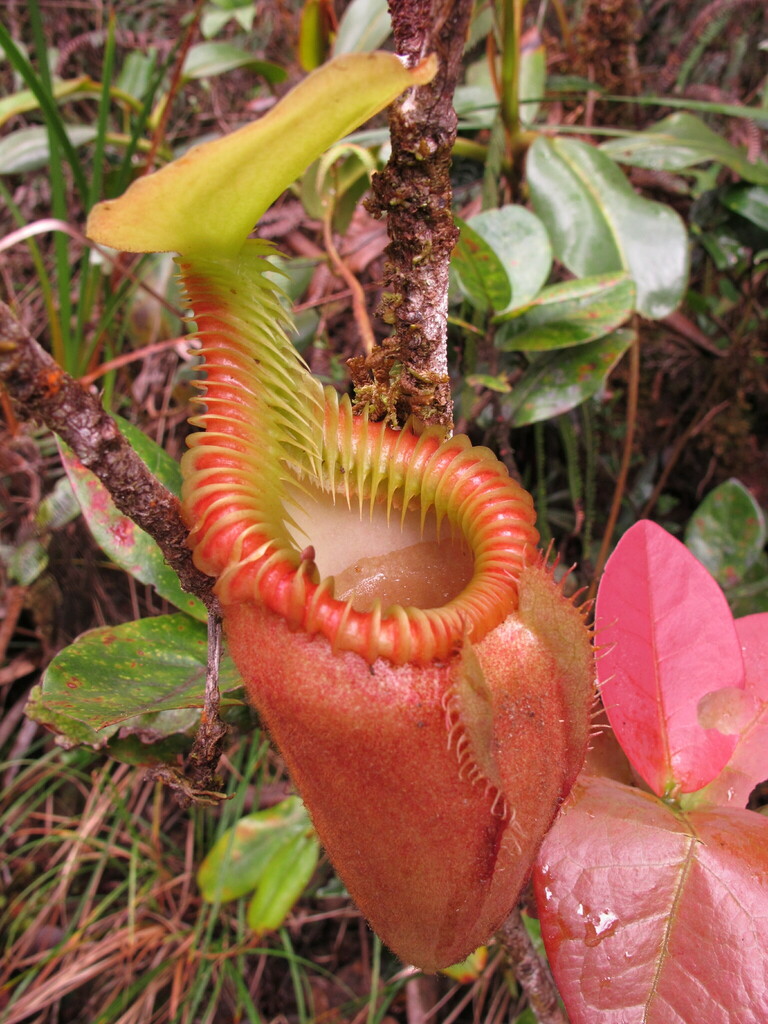
Nepenthes villosa
Nepenthes villosa , or the villose pitcher-plant, is a tropical pitcher plant endemic to Mount Kinabalu and neighbouring Mount Tambuyukon in northeastern Borneo. It grows at higher elevations than any other Bornean Nepenthes species, occurring at elevations of over 3,200 m (10,500 ft). Nepenthes villosa is characterised by its highly developed and intricate peristome, which distinguishes it from the closely related N. edwardsiana and N. macrophylla.
The specific epithet villosa is Latin for "hairy" and refers to the dense indumentum of this species.
From the article Nepenthes villosa on Wikipedia (CC BY-SA), quoted section by section
Description
Nepenthes villosa is a weak climber, rarely exceeding 60 cm (24 in) in height, although the stem may grow to 8 m (26 ft) in length and 10 mm (0.4 in) in diameter. Internodes are cylindrical and up to 10 cm (4 in) long. Leaves are coriaceous and petiolate. The lamina is spathulate to oblong and may be up to 25 cm (10 in) long and 6 cm (2.4 in) wide. The apex of the lamina is emarginate. The petiole is canaliculate, up to 10 cm (3.9 in) long, and bears an amplexicaul sheath. One to three longitudinal veins are present on either side of the midrib. Tendrils may reach 50 cm (20 in) in length.
Lower and upper pitchers are very similar. They are urceolate to ovate in shape. The pitchers grow up to 25 cm (10 in) high and 9 cm (3.5 in) wide. A pair of fringed wings (≤15 mm wide) runs down the front of the pitcher, although it may be reduced to ribs in aerial traps. The pitcher mouth is oblique and elongated into a neck at the rear. The glands on the inner surface are overarched and occur at a density of 200 to 1,300 per square cm (30 to 200 per square in). The peristome is cylindrical in cross section and up to 20 mm (0.8 in) wide. It bears well developed teeth and ribs. The lid or operculum is cordate and has a pointed apex. It has a pair of prominent lateral veins. …
What it does
Nepenthes villosa is endemic to the upper slopes of Mount Kinabalu and neighbouring Mount Tambuyukon in Sabah, Borneo. It generally grows at 2,300–3,240 m above sea level, the highest elevation of all Bornean Nepenthes species; only N. lamii from New Guinea is found at greater elevations. On Mount Kinabalu, N. villosa is common along the Mesilau Trail (between Pondok Magnolia and the meeting point with the old summit trail) and almost all the way up to the Laban Rata rest house; a particularly large population has been reported at around 3047 m. On Mount Tambuyukon, an altitudinal inversion has been noted, whereby N. villosa is more common at much lower elevations of 1600–1900 m, being replaced by N. rajah towards the summit. The exposed, uppermost slopes of Mount Tambuyukon can become very hot during the day and this might explain the inability of N. villosa to colonise them. Plants from Mount Tambuyukon generally produce slightly more elongated pitchers. Nepenthes villosa often grows in mossy forest and sub-alpine forest dominated by species of the genera Dacrydium and Leptospermum, particularly Leptospermum recurvum. It has also been recorded growing among shrubs, grass, and boulders in open areas. Here the soil may become relatively dry, although relative humidity is usually close to 100% as the slopes are often enveloped in clouds. …
Wikipedia: “Ecology”
How it is grown
In 2004, professional horticulturist Robert Sacilotto published a summary of measured tolerances of six highland Nepenthes species, including N. villosa, based on experiments conducted between 1996 and 2001. Many of the N. villosa plants in cultivation today originate from a particularly vigorous tissue culture clone introduced by Phill Mann of Australia and later sold by the Sri Lankan-based plant nursery, Borneo Exotics.
Wikipedia: “In cultivation”
In human culture
Nepenthes villosa was formally described in 1852 by Joseph Dalton Hooker. The description was published in Icones plantarum and accompanied by an illustration. The species was first collected in 1858 by Hugh Low when he made his second ascent of Mount Kinabalu together with Spenser St. John. In an issue of Curtis's Botanical Magazine published in 1858, an illustration of an upper pitcher of N. veitchii was incorrectly identified as N. villosa by J. D. Hooker's father, William Jackson Hooker. That year, N. villosa was also covered in Flore des Serres et des Jardins de l'Europe by Louis van Houtte, in which the same illustration was reproduced along with the incorrect identification. In 1859, N. villosa was again described and illustrated in J. D. Hooker's treatment of the genus published in The Transactions of the Linnean Society of London.[note a] The illustration and description were reproduced in Spenser St. John's Life in the Forests of the Far East, published in 1862. B. H. Danser treated N. edwardsiana in synonymy with N. villosa in his seminal monograph "The Nepenthaceae of the Netherlands Indies", published in 1928. The work included a revised Latin diagnosis and botanical description of N. villosa.[note b] Danser listed four herbarium specimens that he identified as belonging to N. villosa. These include two collected by George Darby Haviland from Mount Kinabalu in 1892. …
Wikipedia: “Botanical history”
Where it lives
Recorded sightings
—
geo-referenced records in GBIF, from museums, herbaria and field observers.
Drag the globe to turn it. Dots are where records exist, not a range map; darker means more records.
In the stacks
Searching the stacks…
Every page naming Nepenthes villosa in the Biodiversity Heritage Library →
This page is assembled live from iNaturalist, GBIF, Wikipedia, the Source Library and the Internet Archive. It is not yet part of the hand-edited codex. iNaturalist taxon 441253.