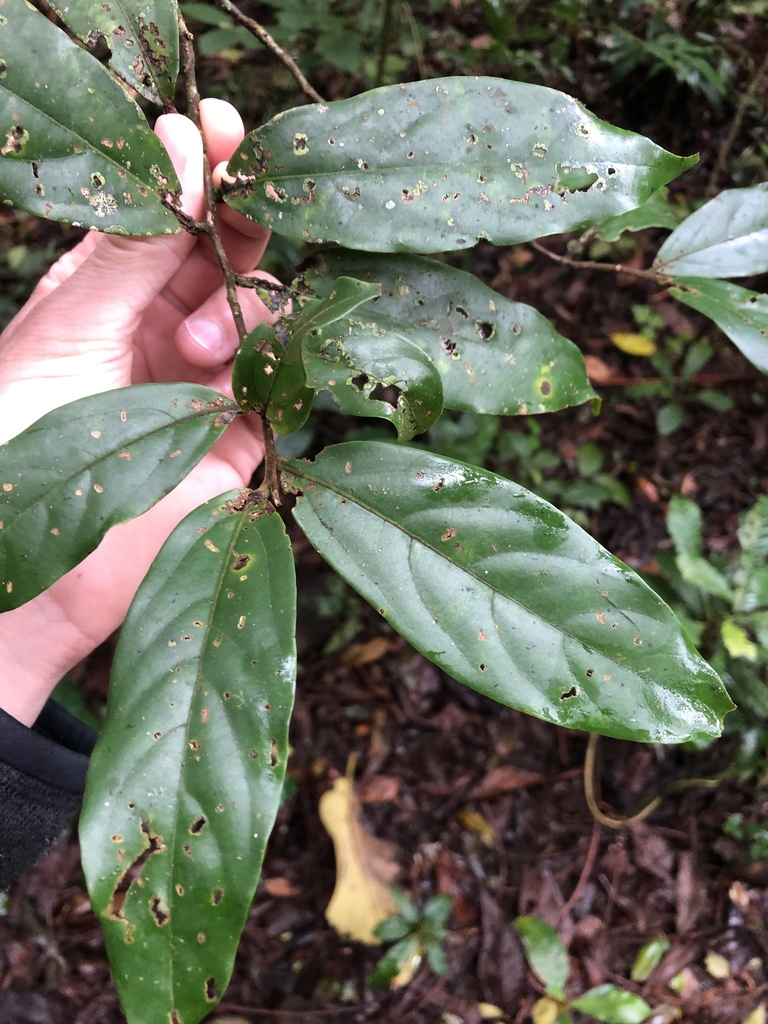
Ocotea monteverdensis
Ocotea monteverdensis (Spanish: aguacatillo, quizarrá blanco, quizarrá amarillo) is a critically endangered tree species in the family Lauraceae, endemic to the cloud forests of Costa Rica. It plays an important ecological role as a food source for several frugivorous birds, including the three-wattled bellbird, which disperses its seeds. The species has declined due to habitat loss, fragmentation, and low regeneration rates.
From the article Ocotea monteverdensis on Wikipedia (CC BY-SA), quoted section by section
Range & habitat
Ocotea monteverdensis is endemic to Costa Rica, where it is only found in cloud forest environments at elevations of approximately 1,000 to 1,500 meters above sea level. It is found primarily on the Pacific slope of the Cordillera de Tilaran. Recent estimates put the number of extant mature trees at 870. Of these, 760 are within the Monteverde area, and another 100 trees are found in a fragmented population around the Orosí Volcano complex near Nicaragua. Estimates suggest that the population has reduced by at least 95% over the past 180 years.
Wikipedia: “Population and distribution”
What it does
The fruit of O. monteverdensis is eaten by many tropical species, including birds and animals. These include the Black guan (Chamaepetes unicolor), the Resplendant quetzal (Pharomachrus mocinno), and especially the Three-wattled bellbird (Procnias tricarunculatus), which plays an important role in seed distribution of O. monteverdensis. The oilbird, Steatornis caripensis, is also known to feed on O. monteverdensis. The bellbird, in particular, plays a key role in the life cycle of O. monteverdensis. It exhibits a strong preference for consuming the fruit. After consumption, the bird regurgitates the seed from its perch, which tends to be on dead branches. The increased level of sunlight increases the likelihood that seedlings will be viable.
Wikipedia: “Ecology”
Where it lives
Recorded sightings
—
geo-referenced records in GBIF, from museums, herbaria and field observers.
Drag the globe to turn it. Dots are where records exist, not a range map; darker means more records.
In the stacks
Searching the stacks…
Every page naming Ocotea monteverdensis in the Biodiversity Heritage Library →
This page is assembled live from iNaturalist, GBIF, Wikipedia, the Source Library and the Internet Archive. It is not yet part of the hand-edited codex. iNaturalist taxon 441348.