- Plants
- ›Vascular Plants
- ›flowering plants
- ›Dicots
- ›Legumes, Milkworts, and Allies
- ›Legumes
- ›Faboideae
- ›Dalbergieae
- ›Pterocarpus
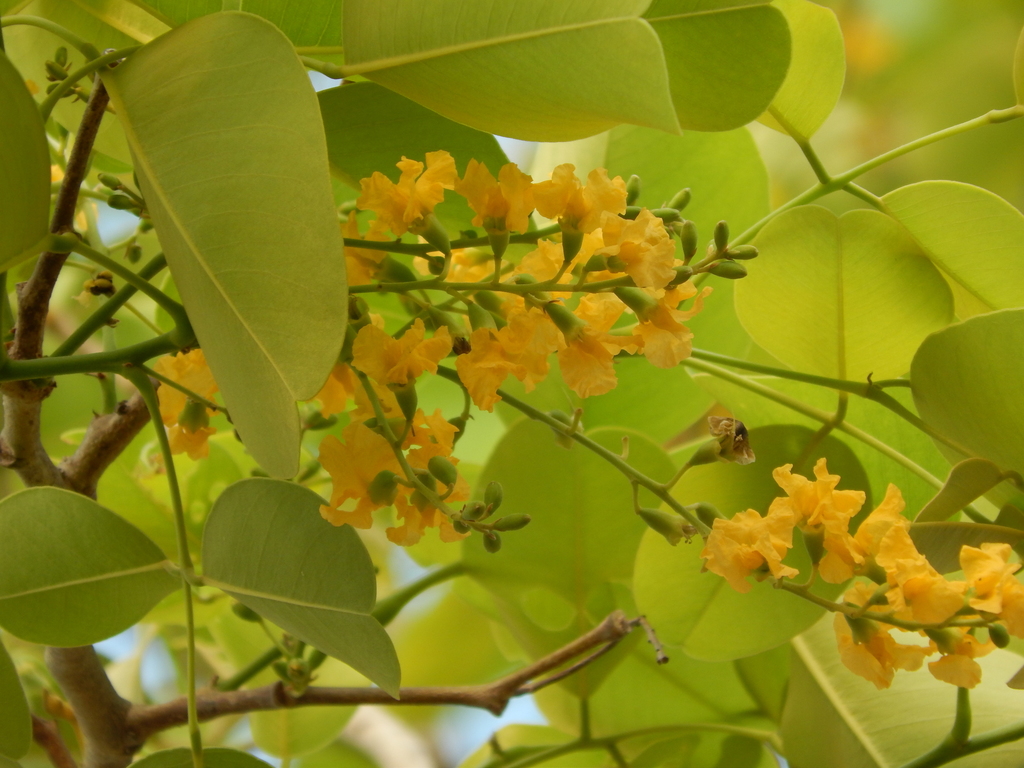
red sanders
Pterocarpus santalinus
Pterocarpus santalinus, with the common names red sanders, red saunders, Yerra Chandanam, Chenchandanam, red sandalwood, Rakta Chandana, and rakto chandon, is a species of Pterocarpus endemic to the southern Eastern Ghats mountain range of South India. It is known for its red colour and has been used for furniture, musical instruments, and traditional herbal medicine. Because of the high market value for its timber, the species has been overexploited, and illegal trade remains a problem. It is listed as endangered on the IUCN Red List. It should not be confused with the aromatic Santalum sandalwood trees native to southern India.
From the article Pterocarpus santalinus on Wikipedia (CC BY-SA), quoted section by section
Description
Pterocarpus santalinus is a light-demanding small tree, growing to 8 metres (26 ft) tall with a trunk 50–150 cm (20–59 in) diameter. It is fast-growing when young, reaching 5 metres (16 ft) tall in three years, even on degraded soils. It is not frost tolerant, being killed by temperatures of −1 °C (30 °F). The leaves are alternate, 3–9 cm (1.2–3.5 in) long, trifoliate with three leaflets. The flowers are produced in short racemes. The fruit is a pod 6–9 cm (2.4–3.5 in) long containing one or two seeds.
In medicine
Pterocarpus santalinus is used in traditional herbal medicine as an antipyretic, anti-inflammatory, anthelmintic, tonic, hemorrhage, dysentery, aphrodisiac, anti-hyperglycaemic and diaphoretic.
Wikipedia: “Medicinal values”
Where it lives
Recorded sightings
—
geo-referenced records in GBIF, from museums, herbaria and field observers.
Drag the globe to turn it. Dots are where records exist, not a range map; darker means more records.
In the stacks
Searching the stacks…
Every page naming Pterocarpus santalinus in the Biodiversity Heritage Library →
This page is assembled live from iNaturalist, GBIF, Wikipedia, the Source Library and the Internet Archive. It is not yet part of the hand-edited codex. iNaturalist taxon 442817.