- Plants
- ›Vascular Plants
- ›flowering plants
- ›Dicots
- ›Legumes, Milkworts, and Allies
- ›Legumes
- ›Faboideae
- ›Sesbanieae
- ›Sesbania
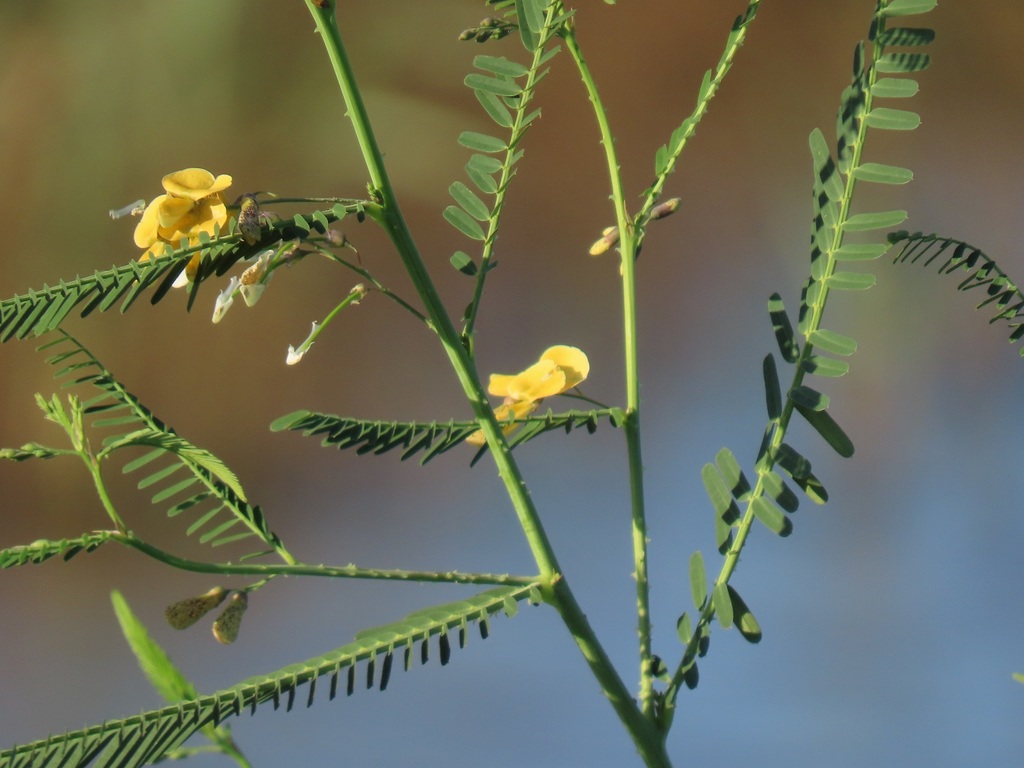
Sesbania bispinosa
The legume Sesbania bispinosa, also known as Sesbania aculeata (Willd.) Pers., is a small tree in the genus Sesbania.
From the article Sesbania bispinosa on Wikipedia (CC BY-SA), quoted section by section
Description
It is an annual shrub which can grow to seven metres in height but usually only reaches one to two metres. It sends out fibrous, pithy stems with long leaves and bears purple-spotted yellow flowers. It produces pods which contain light brown beans.
Range & habitat
It is native to Asia and North Africa, is most common in tropical Africa where it grows as a common noxious weed, and has been introduced to the Americas. It can grow on saline soil. S. bispinosa is adapted to wet, heavy soil but apparently adapts easily to drought-prone or sandy regions. It is cultivated widely in India and it is grown in rice paddies in Vietnam for use as firewood.
Wikipedia: “Distribution and habitat”
At the table
The plant has a great number of uses, including as green manure, rice straw, wood and fodder.
It can be used like industrial hemp for rope, fish nets, sackcloth and sailcloth. Its fibers are similar to those of birch trees and show promise as a source of paper fiber. The foliage makes a good fodder for livestock and the beans can be fed to fowl. The plant has been also used as a famine food by people. Natural gum from the plant is useful as a thickening agent. Like other legumes, it can be planted to improve the soil via nitrogen fixation. It makes a good firewood.
Culinary. The yellow flowers of S. aculeata are eaten as a vegetable in Southeast Asia. They are much smaller than the more popular white flowers of Sesbania grandiflora, but similar in shape. Still, they are appreciated as food in Thai and Vietnamese cuisine. In the Thai language the flowers are called ดอกโสน (dok sanō). They are used in Thai cuisine both cooked and raw, they can also be used to make omelettes and sweets.
Wikipedia: “Uses”
In human culture
The flower is the provincial flower of Phra Nakhon Si Ayutthaya Province, Thailand.
Wikipedia: “In culture”
Where it lives
Recorded sightings
—
geo-referenced records in GBIF, from museums, herbaria and field observers.
Drag the globe to turn it. Dots are where records exist, not a range map; darker means more records.
In the stacks
Searching the stacks…
Every page naming Sesbania bispinosa in the Biodiversity Heritage Library →
This page is assembled live from iNaturalist, GBIF, Wikipedia, the Source Library and the Internet Archive. It is not yet part of the hand-edited codex. iNaturalist taxon 443513.