- Animals
- ›Arthropods
- ›Hexapods
- ›Insects
- ›Winged and Once-winged Insects
- ›Flies
- ›Brachyceran Flies
- ›Cyclorrhaphan Flies
- ›Schizophoran Flies
- ›Acalyptrate Flies
- ›Kelp, Marsh, Thick-headed Flies and Allies
- ›Dryomyzidae
- ›Dryomyza
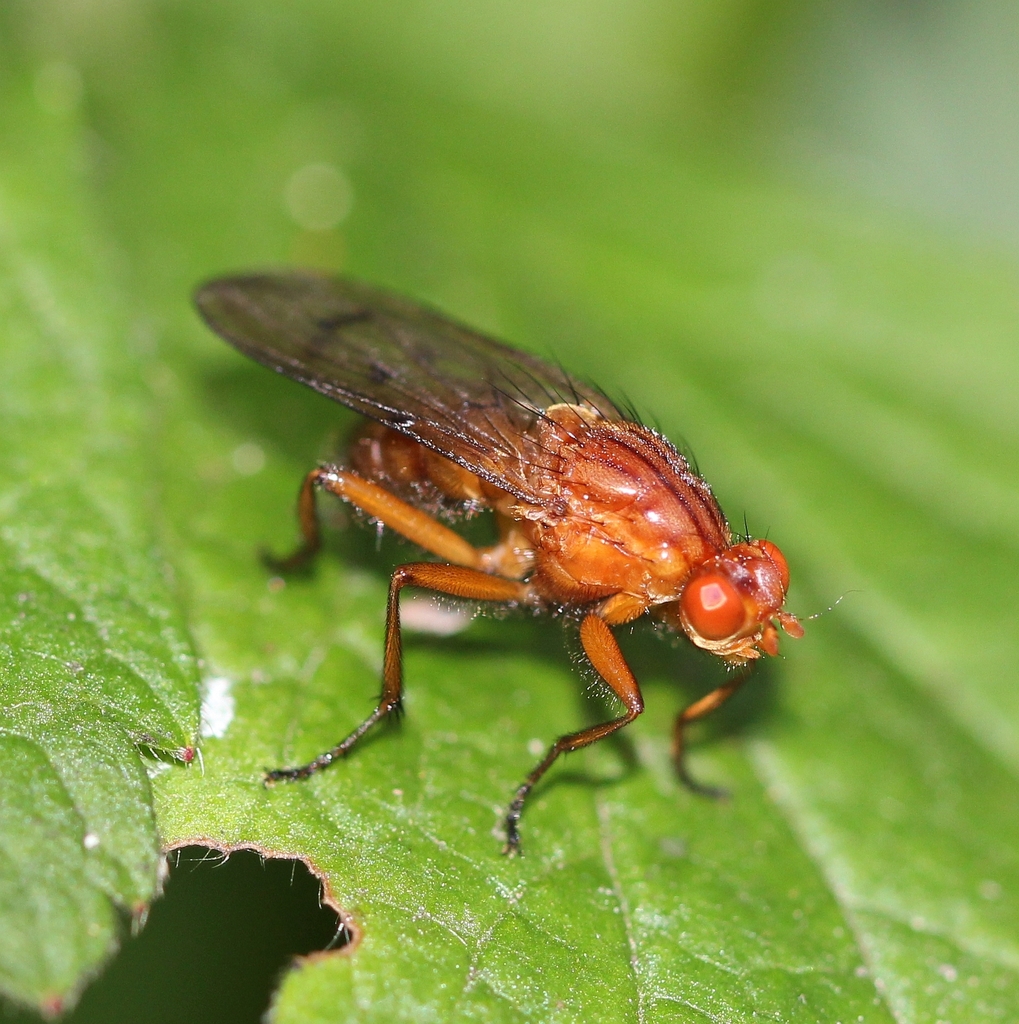
Hooded Dryomyza
Dryomyza anilis
Dryomyza anilis is a common fly from the family Dryomyzidae. The fly is found through various areas in the Northern hemisphere and has brown and orange coloration with distinctive large red eyes. The life span of the fly is not known, but laboratory-reared males can live 28–178 days. D. anilis has recently been placed back in the genus Dryomyza, of which it is the type species. Dryomyzidae were previously part of Sciomyzidae but are now considered a separate family with two subfamilies.
Male D. anilis engage in territorial behavior, guarding carcasses to attract potential mates. Males also guard females, and conflicts over females are frequent. Females typically mate with multiple males. Mating occurs through several rounds of copulation and egg-laying. During mating, males engage in a series of "tapping" rituals where they use their claspers to tap the female's genitals, increasing the chance of them fertilizing the female's eggs. Females lay several batches of eggs on carcasses, fungi, and excrement as well as other substrates.
From the article Dryomyza anilis on Wikipedia (CC BY-SA), quoted section by section
Description
D. anilis adults are medium-sized, ranging in overall length from 7–14 mm, but are typically 12 mm long. Their coloration is light-brown and orange with large red eyes. Generally, the species can be separated from other species of Dryomyzidae by their nearly-bare arista (apical bristle), covered lunule (a crescent-shaped mark, found around the wing margins), and developed prostigmatic and prescutellar bristles. Dryomyzidae are characterized by closely spaced first antennal segments, a protruding oral margin, a strap-shaped or oral prosternum that is not joined to the propleura, and a lack of costal spines. D. anilis have short posterior spiracular tubes, lack hooks on their posterior spiracular plates, and have well-developed tubercles on segment 12 only. The fly's life span is between 28 and 178 days in the laboratory.
Taxonomy. Adult morphology indicates that Dromyzidae, Helcomyzidae, and Helosciomyzidae are more closely related to each other than they are to Sciomyzoidea. Therefore, though Dryomyzidae were previously part of Sciomyzidae, the family is now considered separate and has two subfamilies: Dryomyzinae and Helcomyzidae. There are two genera, Droymyza with ten species and Oedoparena with two species that are presently recognized. Moreover, as compared to other Dryomyza species found in the eastern United States (Dryope decipita and Dryomyza simplex), D. …
Range & habitat
D. anilis is Holarctic, present in Canada and many northern states of the United States in the Nearctic realm. The fly is also widespread in the Palearctic realm from the United Kingdom to Japan. Within the United Kingdom, the fly is common and widespread in England and Wales, but is less common in Scotland. D. anilis are typically most prevalent in the wild from May to September. Adult flies are found in moist, shady habitats among low-growing vegetation and excrement. Adult habitats have been found in human excrement, fox and pheasant carrion, and malodorous stinkhorn fungi. Eggs have been found in human excrement, and larvae have been found in pheasant carrion. D. anilis can develop from egg to pupa on dead animal matter but not on decaying plant matter. Experimentally placed larvae were unable to attain maturity when grown on rotting grass, decaying pumpkin flesh, decaying lettuce, or cow manure. They did attain maturity when grown on hamburger, dead earthworms, dead crane flies, dead polygrid snails, a dead milkweed caterpillar, a dead slug, and rotting agaric mushrooms.
Wikipedia: “Distribution”
What it does
D. anilis can survive on food sources ranging from insects and vertebrates to rotting fungi. Pharyngeal ridges in the skeletons of larvae suggest that larvae derive nutrition from micro-organisms in the rotting organic food source. These ridges selectively sift through their food supply, ensuring that only nutritious food enters. Larvae that feed on living tissue do not have these pharyngeal ridges. The short incubation period of the fly (around 24 hours) may provide a competitive advantage in exploiting limited resources. No predators or parasites of D. anilis have yet been studied, but experimentally several larvae of Mydaea urbana were able to destroy a large population of D. anilis on human excrement.
Conservation. D. anilis serve as saprophages in the ecosystem. D. anilis, together with Calliphora terraenovae, were found using Pacific salmon carcasses as a food source and egg-laying substrate for D. anilis in the coastal North Pacific. Therefore, there is concern that continued decline in salmon populations could threaten D. anilis and other salmon-dependent communities.
== References ==
Wikipedia: “Ecology”
Listen
Looking for field recordings…
Where it lives
Recorded sightings
—
geo-referenced records in GBIF, from museums, herbaria and field observers.
Drag the globe to turn it. Dots are where records exist, not a range map; darker means more records.
In the stacks
Searching the stacks…
Every page naming Dryomyza anilis in the Biodiversity Heritage Library →
This page is assembled live from iNaturalist, GBIF, Wikipedia, the Source Library and the Internet Archive. It is not yet part of the hand-edited codex. iNaturalist taxon 447009.