- Plants
- ›Vascular Plants
- ›flowering plants
- ›Dicots
- ›myrtles, evening primroses, and allies
- ›myrtle family
- ›Myrtoideae
- ›Chamelaucieae
- ›Alutinae
- ›Aluta
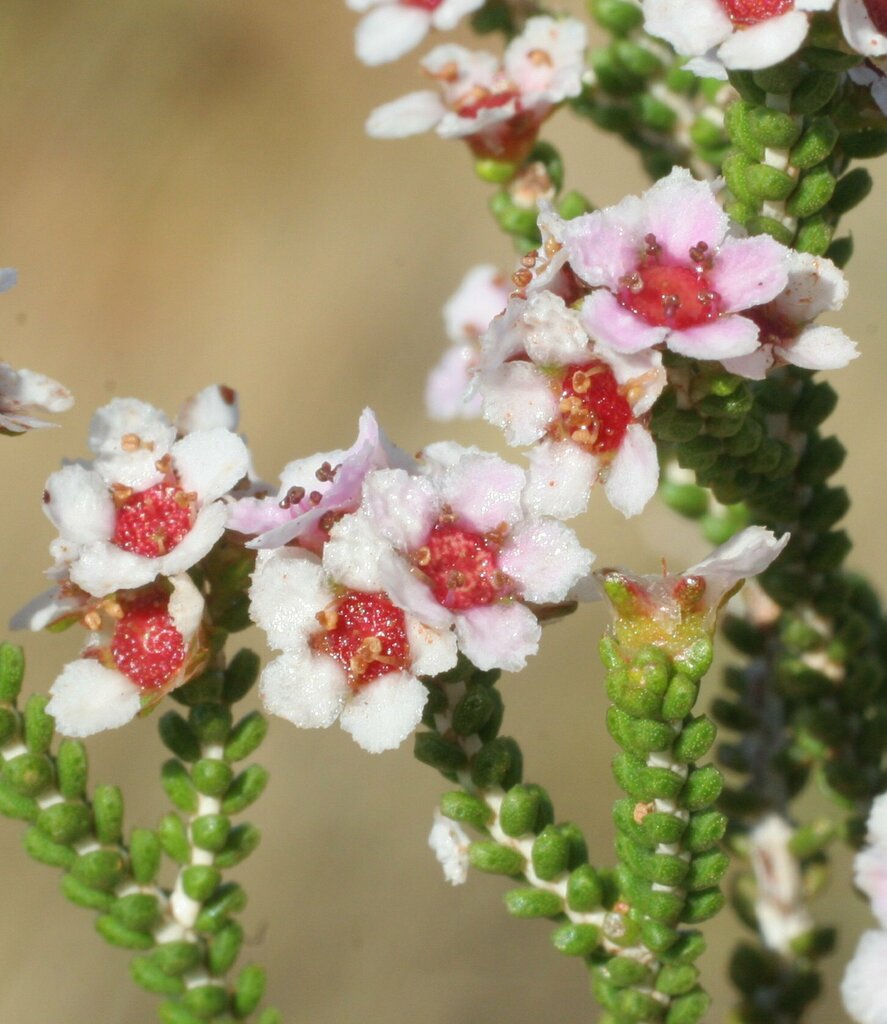
Desert heath myrtle
Aluta maisonneuvei
Aluta maisonneuvei commonly known as Desert Heath Myrtle, is a flowering plant in the family Myrtaceae. It is woody shrub with small leaves and pink to whitish flowers and grows in Western Australia, South Australia and the Northern Territory.
From the article Aluta maisonneuvei on Wikipedia (CC BY-SA), quoted section by section
Description
Aluta maisonneuvei is a dense, woody shrub 0.3–1.5 m (1 ft 0 in – 4 ft 11 in) high, sometimes spreading to 1.5 m (4 ft 11 in) wide, branches usually arising from the ground at an angle. Leaves are small, crowded, sessile, up to 2 mm (0.079 in) long, oblong or roundish in rows of four along the stem. Flowers are whitish-pink, 5 petalled, up to 2 mm (0.079 in) in diameter with a red or pink central disc. Flowering occurs from early winter to early spring and the fruit compressed, globular shaped and 1.5–2 mm (0.059–0.079 in) long.
Range & habitat
Desert Heath Myrtle grows on red sandplains, near sand dunes and yellow clayey soils in South Australia, Western Australian and the Northern Territory.
== References ==
Wikipedia: “Distribution and habitat”
Where it lives
Recorded sightings
—
geo-referenced records in GBIF, from museums, herbaria and field observers.
Drag the globe to turn it. Dots are where records exist, not a range map; darker means more records.
In the stacks
Searching the stacks…
Every page naming Aluta maisonneuvei in the Biodiversity Heritage Library →
This page is assembled live from iNaturalist, GBIF, Wikipedia, the Source Library and the Internet Archive. It is not yet part of the hand-edited codex. iNaturalist taxon 447017.