- Plants
- ›Vascular Plants
- ›flowering plants
- ›Dicots
- ›Buttercups, Poppies, and Allies
- ›Poppy Family
- ›Fumitory subfamily
- ›Corydaleae
- ›Corydalis
- ›Corydalis
- ›Incisae
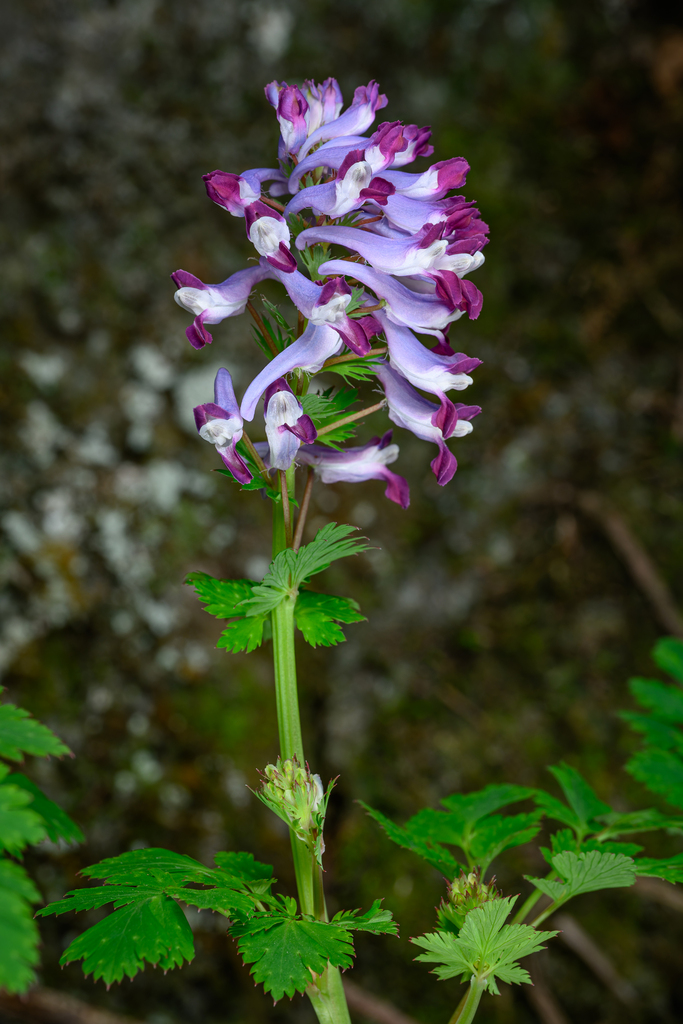
Incised Fumewort
Corydalis incisa
Corydalis incisa, incised fumewort, is an annual or biennial herbaceous species of plant in the poppy family. It is also known as purple keman or murasa-kike-man. Some authorities report it in the family Fumariaceae. The wildflower is native to Japan, Korea, Taiwan, and China, found in forests, clearings, and irrigation channels.
From the article Corydalis incisa on Wikipedia (CC BY-SA), quoted section by section
Description
Corydalis incisa grows up to 2 feet (0.61 m) tall. The life cycle begins in spring when seeds germinate and grow into small rosettes supported by a tiny tuber. The leaves are compound and divided into 3 leaflets, and again into another 3 sub-leaflets that are lobed to serrated. The leaves go dormant for the summer and re-emerge directly from the tuber in the fall. They are evergreen throughout winter. Stems emerge in February and blooming occurs from March through early May. There are about 10 to 16 flowers per raceme. The fruits, which are oblong, pod-shaped capsules, form quickly. The first seeds disperse about three weeks after the first flowers. By early summer, the mature plants are dead. Corydalis incisa can be found in waterways, rock walls, disturbed areas, and "mesic and alluvial habitats".
Where it lives
Recorded sightings
—
geo-referenced records in GBIF, from museums, herbaria and field observers.
Drag the globe to turn it. Dots are where records exist, not a range map; darker means more records.
In the stacks
Searching the stacks…
Every page naming Corydalis incisa in the Biodiversity Heritage Library →
This page is assembled live from iNaturalist, GBIF, Wikipedia, the Source Library and the Internet Archive. It is not yet part of the hand-edited codex. iNaturalist taxon 447077.