- Plants
- ›Vascular Plants
- ›flowering plants
- ›Dicots
- ›carrots, ivies, and allies
- ›carrot family
- ›Saniculoideae
- ›Saniculeae
- ›Astrantia
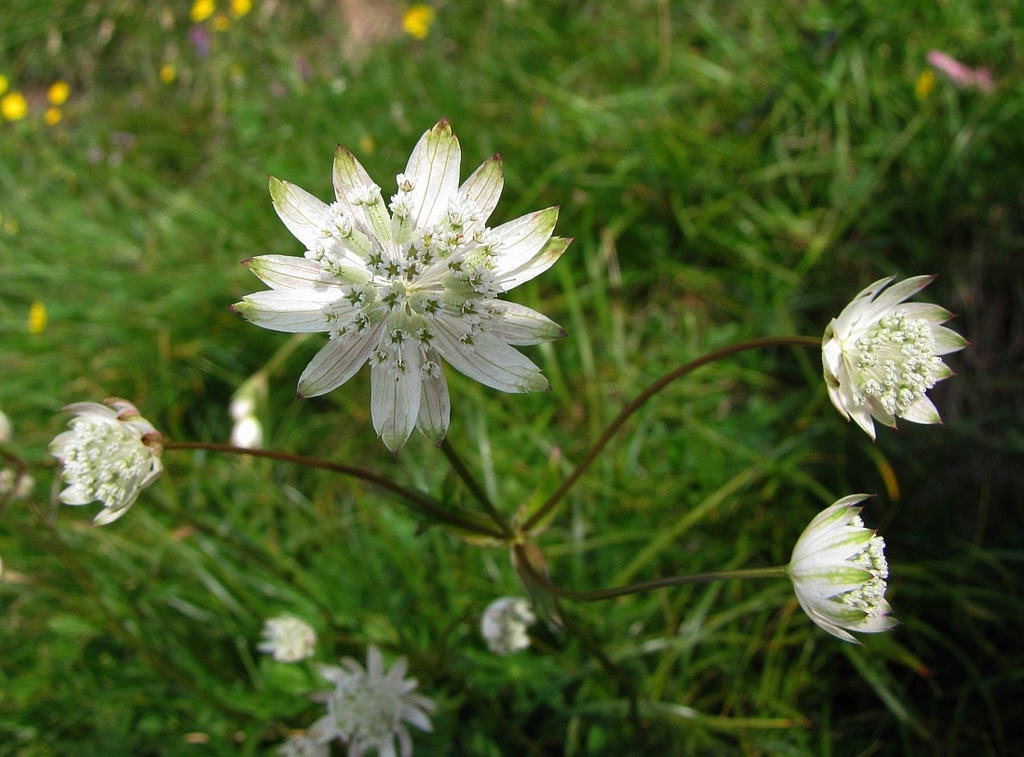
Bavarian masterwort
Astrantia bavarica
Astrantia bavarica, common name masterwort, is a species of flowering plant in the family Apiaceae, native to Eastern alps. Growing to 30 cm (12 in) tall by 30 cm (12 in) broad, it is an herbaceous perennial, much used in gardens.
From the article Astrantia bavarica on Wikipedia (CC BY-SA), quoted section by section
Description
Astrantia bavarica reaches on average 30 centimetres (12 in) of height. The stem is erect and glabrous, with little branches and few leaves. The basal leaves have a long petiole 10–20 centimetres (3.9–7.9 in), 3 to 7 lobes and toothed segments. Size: 8–15 centimetres (3.1–5.9 in). The cauline leaves are generally two, sessile, amplexicaul and lanceolate-shaped with a trilobed apex. The inflorescence is umbrella-shaped, with 2–3 centimetres (0.79–1.18 in) of diameter. The floral bracts are numerous (10 - 20), 10–18 millimetres (0.39–0.71 in) long, greenish-white with acuminate apex. The small flowers are greenish-white (with pink undertones). The central ones are hermaphrodite, while the external ones are male. The flowering period extends from April through to November. It has a RHS Hardiness Rating: H7.
Range & habitat
Astrantia bavarica is native to Europe, and found within Germany, Italy, Austria, Slovenia, and the eastern Alps. They are common in mountain woodlands and scrubland, clearings and close to the streams, usually on calcareous soils, at an altitude of 2,300 metres (7,500 ft) above sea level.
Wikipedia: “Distribution and habitat”
What it does
Astrantia bavarica is an entomophilous plant, mainly pollinated by beetles, but also by other insects. This perennial plant reproduces itself also by means of buds present at the ground level. It can also be grown from seed as well.
Wikipedia: “Reproduction”
In human culture
The specific epithet bavarica, meaning "from bavaria". Bavaria is a state in Germany, which geographically distinguishes this species from its smaller relative Astrantia minor and from its larger relatives Astrantia major and Astrantia maxima. Astrantia bavarica was described by Friedrich Wilhelm Schultz in 1858, and published in Flora Vol.41 (issue 11) on page 161.
Wikipedia: “Etymology”
Where it lives
Recorded sightings
—
geo-referenced records in GBIF, from museums, herbaria and field observers.
Drag the globe to turn it. Dots are where records exist, not a range map; darker means more records.
In the stacks
Searching the stacks…
Every page naming Astrantia bavarica in the Biodiversity Heritage Library →
This page is assembled live from iNaturalist, GBIF, Wikipedia, the Source Library and the Internet Archive. It is not yet part of the hand-edited codex. iNaturalist taxon 447968.