- Plants
- ›Vascular Plants
- ›flowering plants
- ›Dicots
- ›Mallows, Rock Roses, and Allies
- ›Mallow and Hibiscus Family
- ›Linden subfamily
- ›Tilia
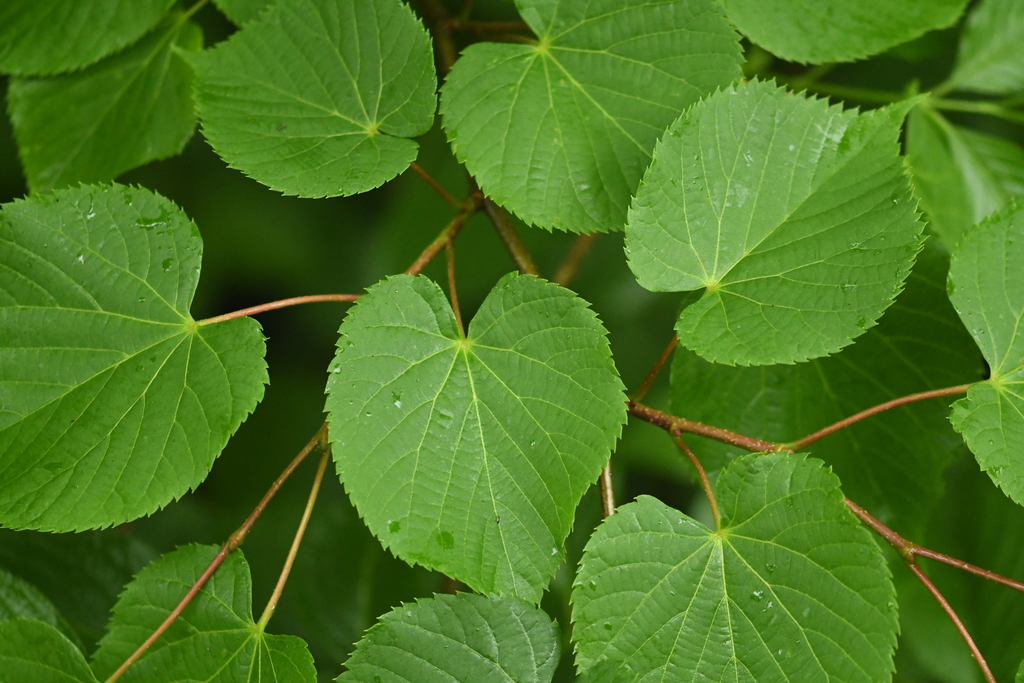
Japanese lime
Tilia japonica
Tilia japonica, the Japanese lime or Japanese linden, is a species of Tilia native to eastern China and Japan, preferring to grow in mountains up to 2000 m. It superficially resembles the better-known Tilia cordata, the small-leaved lime, and was originally described as Tilia cordata var. japonica. It differs from T. cordata in having 164 chromosomes instead of 82, and by some subtle differences in leaf and flower morphology. T. japonica inflorescences consistently have 5 staminodes, which is a reliable trait distinguishing it from T. cordata and T. amurensis. Recent studies indicate T.japonica to play an important role in maintaining the ectomycorrhizal networks in local forests it grows in Japan.
From the article Tilia japonica on Wikipedia (CC BY-SA), quoted section by section
At the table
Tilia japonica is grown as an ornamental tree. Its 'Ernest Wilson' cultivar has gained the Royal Horticultural Society's Award of Garden Merit. Its wood was used for furniture, and due to its straight grain is still occasionally used for veneers. Like other lindens, it is a source for a premium honey. It is the official tree of the city of Nagano, Japan. Tilia japonica's innermost bark, known as bast, was used by the Ainu for clothing, attus.
== References ==
Wikipedia: “Cultivation and uses”
Where it lives
Recorded sightings
—
geo-referenced records in GBIF, from museums, herbaria and field observers.
Drag the globe to turn it. Dots are where records exist, not a range map; darker means more records.
In the stacks
Searching the stacks…
Every page naming Tilia japonica in the Biodiversity Heritage Library →
This page is assembled live from iNaturalist, GBIF, Wikipedia, the Source Library and the Internet Archive. It is not yet part of the hand-edited codex. iNaturalist taxon 448063.