- Plants
- ›Vascular Plants
- ›flowering plants
- ›monocots
- ›Agaves, Orchids, Irises, and Allies
- ›iris family
- ›Iridoideae
- ›Irideae
- ›Iris
- ›Iris
- ›Iris
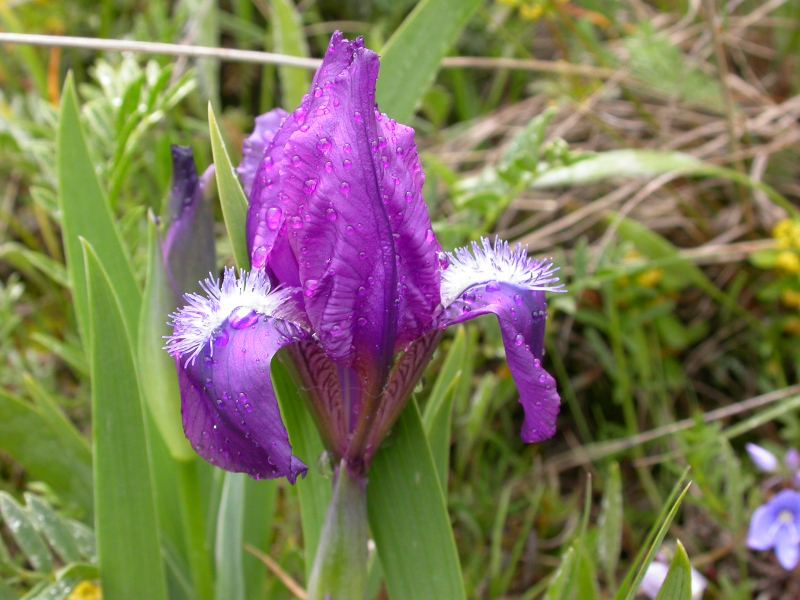
Iris furcata
Iris furcata, the forked iris, is a plant species in the genus Iris, it is also in the subgenus Iris. It is a rhizomatous perennial, from
the Caucasus Mountains, in the countries of Moldavia and the southern Ukraine. It has short, narrow, sword-shaped leaves. A slender stem, that branches beyond the midpoint, holding small purple, deep purple, blue-violet, light blue or violet flowers. It is cultivated as an ornamental plant in temperate regions. It is often regarded as a synonym of Iris aphylla, but it has chromosomal and morphological differences, so it may considered to be a parent species instead.
From the article Iris furcata on Wikipedia (CC BY-SA), quoted section by section
Description
Iris furcata is similar in form and flower colour to Iris aphylla. Apart from the difference in stems, in Iris furcata it branches from near to the middle of the stem, where as Iris aphylla does not branch. It has a short, creeping rhizome, that is 2 cm long and fibrous. They creep across the surface of the ground. It has short, linear, ensiform (sword shaped) leaves. The slender, leaves can grow up to 20 cm (8 in) long. and between 0.5 and 1 cm wide. Normally, about 15mm wide. They more slender than Iris aphylla. It has a slender stem, or peduncle, that can grow up to between 15–50 cm (6–20 in) tall. It has branched stem, that branches usually from above the middle of the stem. The stem is shorter and more slender than Iris aphylla. The stem has green, inflated, ovate or oblong, spathes (leaves of the flower bud), that sometimes has purple veins. The stems (and the many branches) hold between flowers in early spring, or late spring and early summer, or May. The flowers are smaller than Iris aphylla, about 3–4 cm (1–2 in) long. They come in shades of purple, deep purple, blue-violet, light blue or violet. Like other irises, it has 2 pairs of petals, 3 large sepals (outer petals), known as the 'falls' and 3 inner, smaller petals (or tepals), known as the 'standards'. The falls have an obovate blade and narrow claw. In the centre of the fall is a beard. …
Range & habitat
It is found in the Caucasus mountains, between the Black Sea and the Caspian Sea. Within (the former southern Russian states,) countries of Moldovia and Ukraine. It has also been found in Lazistan in Georgia, with Iris taochia, It is found in the Caucasus with other mountain flora including Anemone fasciculata, Anemone raminculoides, Caltha popypetala, Veratium lobelianum, Palsatilla armena, Corydalis persica, Fritilaria caucasica, Betonica grandiflora, Prunus spinosa, Sedum pilosum, Sempervivum transcaucasicum, Malus orientalis and Pyrus caucasicus.
Wikipedia: “Range”
Toxicity
Like many other irises, most parts of the plant are poisonous (rhizome and leaves), and if mistakenly ingested can cause stomach pains and vomiting. Handling the plant may cause skin irritation or an allergic reaction.
How it is grown
It is cold hardy. Can also tolerate conditions in St. Petersburg, Russia. It prefers to grow in well-drained soil, and can tolerate alkaline soils. It can also be grown in peat soils. It prefers to be kept dry during summer. The iris is prone to virus in damp conditions. It also prefers to be situated in positions in light shade. It can be grown in rockeries. It is prone to slug or snail damage. It was grown in Dorpat, Russia in 1820, then in 1838 in the Imperial Botanical Garden of St. Petersburg. It was grown in the Botanical Garden of Moscow in 1948. It is also cultivated in Stavropol. It is also grown in the Nezahat Gökyiğit Botanic Garden in Turkey. It is mostly grown by collectors and iris enthusiasts.
Hybrids and cultivars. Iris furcata was used in iris breeding programmes, to create smaller sized irises and better branching.
Wikipedia: “Cultivation”
Where it lives
Recorded sightings
—
geo-referenced records in GBIF, from museums, herbaria and field observers.
Drag the globe to turn it. Dots are where records exist, not a range map; darker means more records.
In the stacks
Searching the stacks…
Every page naming Iris furcata in the Biodiversity Heritage Library →
This page is assembled live from iNaturalist, GBIF, Wikipedia, the Source Library and the Internet Archive. It is not yet part of the hand-edited codex. iNaturalist taxon 451858.