- Animals
- ›Arthropods
- ›Hexapods
- ›Insects
- ›Winged and Once-winged Insects
- ›Ants, Bees, Wasps, and Sawflies
- ›Narrow-waisted Wasps, Ants, and Bees
- ›Ants, Bees, and Stinging Wasps
- ›Bees and Apoid Wasps
- ›Bees
- ›Honey Bees, Bumble Bees, and Allies
- ›Apine Bees
- ›Bombini
- ›Bombus
- ›Alpinobombus
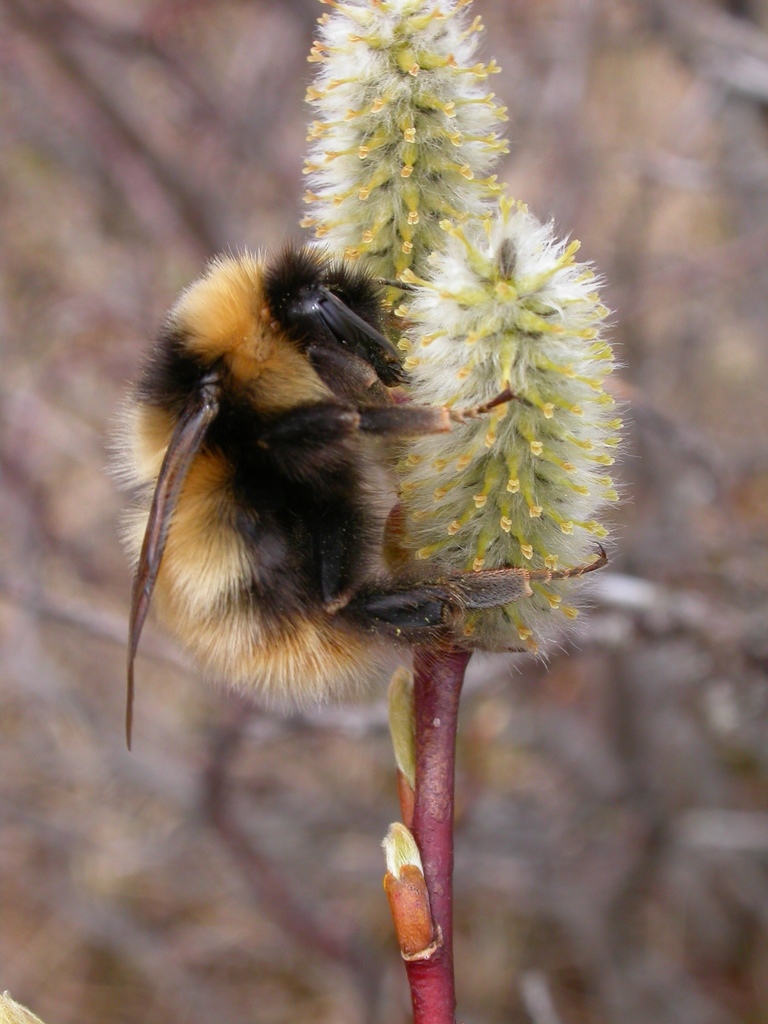
Polar Bumble Bee
Bombus polaris
Bombus polaris is a common Arctic bumblebee species. B. polaris is one of three bumblebees that live above the Arctic Circle. The others are its social parasites Bombus hyperboreus and Bombus natvigi. B. polaris is a social bee that can survive at near freezing temperatures. It has developed multiple adaptations to live in such cold temperatures. B. polaris has a thicker coat of hair than most bees, utilizes thermoregulation, and makes insulated nests.
From the article Bombus polaris on Wikipedia (CC BY-SA), quoted section by section
Range & habitat
This bumblebee has a wide circumpolar distribution, found in Canada, Arctic Alaska, Arctic islands (Devon Island, Ellesmere Island, Baffin Island and Greenland), northern Scandinavia and across Arctic Russia (Nenets, Yamalo-Nenets, Sakha and Chukotka). As of 2015, B. polaris is common and is not listed as endangered. Bombus polaris is an alpine species. They exclusively live at the summits of mountains. This clear separation between alpine species and subalpine species may be due to superior competition from the subalpine species, leading to a suboptimal habitat occupation of the alpine species. An alternative explanation is that the alpine bee species possess both the ability and body type to survive the colder temperatures, which naturally separates the two types of bees into distinct ecological territories. Alpine species usually have a larger body length in comparison to subalpine species.
Wikipedia: “Distribution and habitat”
At the table
Large zygomorphic flowers of Pedicularis are dependent on B. polaris. B. polaris works the spikes of Pedicularis upwards from the bottom. Through this behavior, the adaption of gustatory organs to sugar is offset by the increasing concentration of sugars in the nectar up the spike. This behavior is also significantly related to pollination.
Wikipedia: “Food”
In human culture
The colony begins in the summer in June. The colony is only able to survive for two or three months until winter hits again. All workers, drones, and most females die with the colony. The queen's first brood after the start of the colony will develop into worker bees – small sterile females who will enlarge the nest, forage, and tend to the next generation of bees. Worker bees will die along with the colony at the beginning of winter. The young queen is the sole survivor of her colony after 9 months of hibernation during the winter. In the Arctic, only one queen per colony on average will survive the winter to renew the next life cycle. The colony only has one or two months to complete the social cycle of two generations. When winter returns, the queen dies with her progeny. The queen's second brood in late summer include male drones and fertile females who are candidates for next year's queen. The drone's sole function is to fertilize the females, but most females will die along with the drones at the beginning of winter.
Wikipedia: “Life history and survivorship curves”
Listen
Looking for field recordings…
Where it lives
Recorded sightings
—
geo-referenced records in GBIF, from museums, herbaria and field observers.
Drag the globe to turn it. Dots are where records exist, not a range map; darker means more records.
In the stacks
Searching the stacks…
Every page naming Bombus polaris in the Biodiversity Heritage Library →
This page is assembled live from iNaturalist, GBIF, Wikipedia, the Source Library and the Internet Archive. It is not yet part of the hand-edited codex. iNaturalist taxon 452396.