- Animals
- ›Arthropods
- ›Hexapods
- ›Insects
- ›Winged and Once-winged Insects
- ›Ants, Bees, Wasps, and Sawflies
- ›Narrow-waisted Wasps, Ants, and Bees
- ›Ants, Bees, and Stinging Wasps
- ›Bees and Apoid Wasps
- ›Bees
- ›Mason, Leafcutter, Carder, and Resin Bees
- ›Megachilinae
- ›Megachilini
- ›Megachile
- ›Chelostomoides
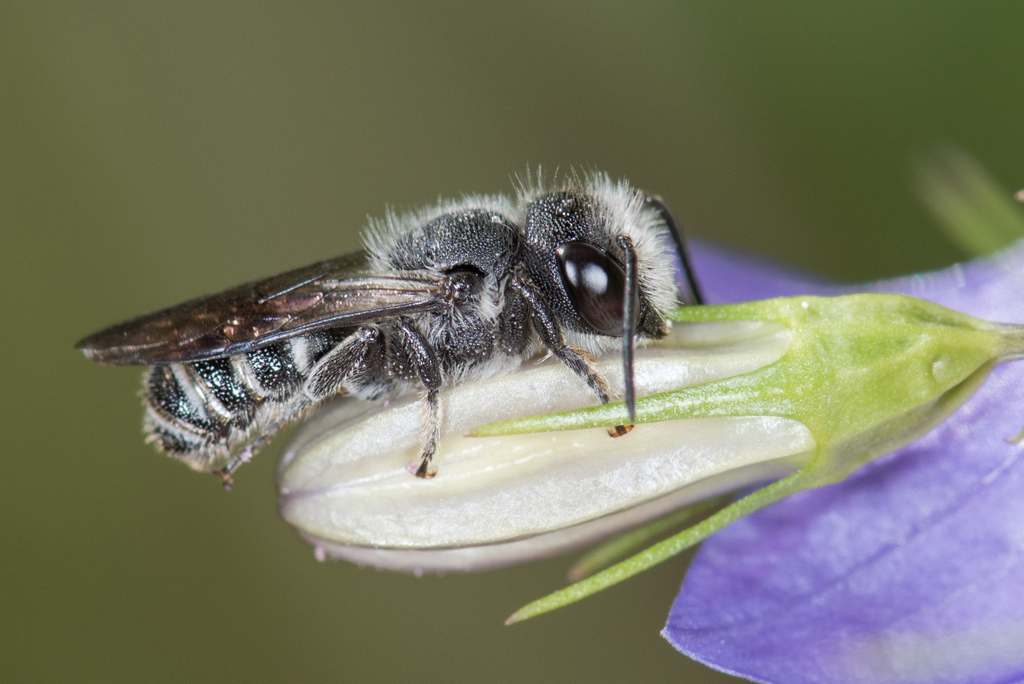
Bellflower Resin Bee
Megachile campanulae
Megachile campanulae, known as the bellflower resin bee, is a species of bee in the family Megachilidae. Described in 1903, these solitary bees are native to eastern North America. Studies in 2013 placed them among the first insect species to use synthetic materials for making nests. They are considered mason bees, which is a common descriptor of bees in several families, including Megachilidae. Within the genus Megachile, frequently also referred to as leafcutter bees, M. campanulae is a member of the subgenus Chelostomoides, which do not construct nests from cut leaves, but rather from plant resins and other materials. Females lay eggs in nests constructed with individual cell compartments for each egg. Once hatched, the eggs progress through larval stages and subsequently will overwinter as pupae. The bees are susceptible to parasitism from several other bee species, which act as brood parasites. They are medium-sized bees and the female adults are typically larger than the males. They are important pollinators of numerous native plant species throughout their range.
From the article Megachile campanulae on Wikipedia (CC BY-SA), quoted section by section
Description
M. campanulae are medium-sized bees. Anatomically, they have a head, a middle section called a mesosoma, and a posterior section called a metasoma. The mesosoma is formed by fusion of the first abdominal segment or propodeum with the thorax. They have both compound eyes and simple eyes (ocelli), similar to many other insects. The mandibles in these resin gathering bees are characteristically lacking cutting edges found in the closely related leafcutters. The males are smaller than the females. The body segments are covered in various aspects with fine short hair called pubescence. The hairs are of varying length, texture, and color on different aspects of the male and female bees. Morphologically, M. campanulae most resemble Megachile angelarum. There are also marked similarities in appearance between M. campanulae and M. exilis. The males of M. exilis have characteristically dilated and hollowed out front tarsal leg segments. The tarsi in M. campanulae are not modified and are otherwise unremarkable.
Females. M. campanulae females measure 10–12 millimeters (0.39–0.47 in) in length. Although they resemble M. angelarum, the white banding (fascia) at the apex of the 5th tergal segment found on M. angelarum is absent in M. campanulae. Females can also be recognized by parallel sided metasoma.
Head. …
Wikipedia: “Morphology and identification”
Range & habitat
The range of M. campanulae covers a broad expanse of the eastern North American continent. They are native to southern Ontario. The range extends from this southeastern Canadian province, through the New England states to Florida. The range extends west, as far as Minnesota, Nebraska and Texas. A few reports of sightings further west are noted, including presence in Colorado and Montana.
Wikipedia: “Distribution and habitat”
What it does
As a member of the subgenus Chelostomoides, M. campanulae are mason bees. This means that they use plant resins, mud, and pebbles for nest construction. Typically the females build small nests in pre-existing holes in trees, fences, or plant stems. They will also nest in artificial "nest-traps" or "bee-blocks." They build the nests as a long single column of cells, along a tube. The deepest cells are constructed first, at which point the female lays a single egg sequentially in each cell. The cells are partitioned and sealed using some combination of the construction materials described above. Pollen, sometimes mixed with nectar, provisioned in the cell will nourish the larvae when hatched. The bees are polylectic, meaning the larvae are fed from a variety of pollen sources. Subsequently, after a few stages of molting, the larvae spin cocoons and pupate. They will overwinter as pupae. After several months, the bees will emerge in the adult form. Males typically emerge in advance of females. They will die shortly after mating. The female bees survive for another few weeks, during which time they build new nests and gather provisions. Adult bees are active from April to September throughout most of the range. In Florida, that have been collected as early as February and as late as November. …
Wikipedia: “Life cycle and behavior”
Listen
Looking for field recordings…
Where it lives
Recorded sightings
—
geo-referenced records in GBIF, from museums, herbaria and field observers.
Drag the globe to turn it. Dots are where records exist, not a range map; darker means more records.
In the stacks
Searching the stacks…
Every page naming Megachile campanulae in the Biodiversity Heritage Library →
This page is assembled live from iNaturalist, GBIF, Wikipedia, the Source Library and the Internet Archive. It is not yet part of the hand-edited codex. iNaturalist taxon 452985.