- Animals
- ›Arthropods
- ›Hexapods
- ›Insects
- ›Winged and Once-winged Insects
- ›True Bugs, Hoppers, Aphids, and allies
- ›Plant-parasitic Hemipterans
- ›Aphids and Allies
- ›Aphidoidea
- ›Aphids
- ›Aphidinae
- ›Macrosiphini
- ›Macrosiphoniella
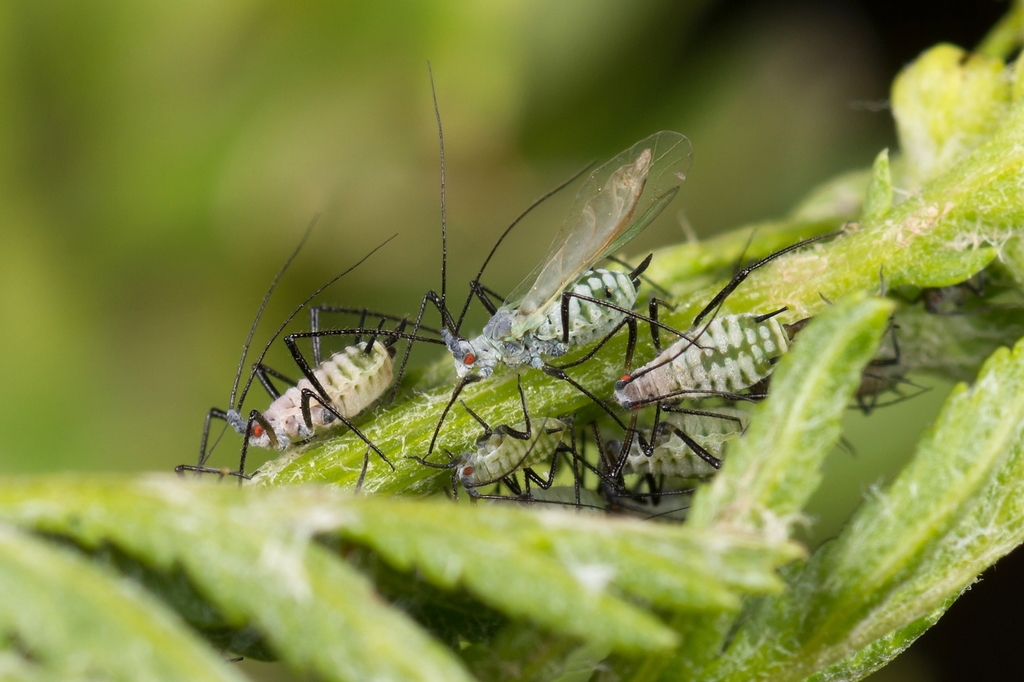
Tansy Aphid
Macrosiphoniella tanacetaria
Aphids are small sap-sucking insects in the family Aphididae of the order Hemiptera. Common names include greenfly and blackfly, although individuals within a species can vary widely in color. The group includes the fluffy white woolly aphids. A typical life cycle involves flightless females giving live birth to female nymphs—who may also be already pregnant, an adaptation scientists call telescoping generations—without the involvement of males. Maturing rapidly, females breed profusely so that the number of these insects multiplies quickly. Winged females may develop later in the season, allowing the insects to colonize new plants. In temperate regions, a phase of sexual reproduction occurs in the autumn, with the insects often overwintering as eggs.
The life cycle of some species involves an alternation between two species of host plants, for example between an annual crop and a woody plant. Some species feed on only one type of plant, while others are generalists, colonizing many plant groups. About 5,000 species of aphid have been described, all included in the family Aphididae. Around 400 of these are found on food and fiber crops, and many are serious pests of agriculture and forestry, as well as an annoyance for gardeners. So-called dairying ants have a mutualistic relationship with aphids, tending them for their honeydew and protecting them from predators.
From the article Aphid on Wikipedia (CC BY-SA), quoted section by section
Description
Most aphids have soft bodies, which may be green, black, brown, pink, or almost colorless. Aphids have antennae with two short, broad basal segments and up to four slender terminal segments. They have a pair of compound eyes, with an ocular tubercle behind and above each eye, made up of three lenses called triommatidia. They feed on sap and plant fluids using piercing-sucking mouthparts called stylets, enclosed in a sheath called a rostrum, which is formed from modifications of the mandible and maxilla of the insect mouthparts. They have long, thin legs with two-jointed, two-clawed tarsi. The majority of aphids are wingless, but winged forms are produced at certain times of year in many species. Most aphids have a pair of cornicles (siphunculi), abdominal tubes on the dorsal surface of their fifth abdominal segment, through which they exude droplets of a quick-hardening defensive fluid containing triacylglycerols, called cornicle wax. Other defensive compounds can also be produced by some species. Aphids have a tail-like protrusion called a cauda above their rectal apertures. They have lost their Malpighian tubules. When host plant quality becomes poor or conditions become crowded, some aphid species produce winged offspring (alates) that can disperse to other food sources. The mouthparts or eyes can be small or missing in some species and forms.
Wikipedia: “Anatomy”
Range & habitat
Aphids are distributed worldwide, but are most common in temperate zones. In contrast to many taxa, aphid species diversity is much lower in the tropics than in the temperate zones. They can migrate great distances, mainly through passive dispersal by winds. Winged aphids may also rise up in the day as high as 600 m where they are transported by strong winds. For example, the currant-lettuce aphid, Nasonovia ribisnigri, is believed to have spread from New Zealand to Tasmania around 2004 through easterly winds. Aphids have also been spread by human transportation of infested plant materials, making some species nearly cosmopolitan in their distribution.
Wikipedia: “Distribution”
What it does
Many aphid species are monophagous (that is, they feed on only one plant species). Others, like the green peach aphid (Myzus persicae), feed on hundreds of plant species across many families. About 10% of species feed on different plants at different times of the year. A new host plant is chosen by a winged adult by using visual cues, followed by olfaction using the antennae; if the plant smells right, the next action is probing the surface upon landing. The stylus is inserted and saliva secreted, the sap is sampled, the xylem may be tasted and finally, the phloem is tested. Aphid saliva provides lubrication and protection for the stylus during penetration, and may inhibit phloem-sealing mechanisms and has pectinases that ease penetration. Non-host plants can be rejected at any stage of the probe, but the transfer of viruses occurs early in the investigation process, at the time of the introduction of the saliva, so non-host plants can become infected. Aphids usually feed passively on sap of phloem vessels in plants, as do many other hemipterans such as scale insects and cicadas. Once a phloem vessel is punctured, the sap, which is under pressure, is forced into the aphid's food canal. Occasionally, aphids also ingest xylem sap, which is a more dilute diet than phloem sap as the concentrations of sugars and amino acids are 1% of those in the phloem. …
Wikipedia: “Diet”
In human culture
The name aphid is from Carl Linnaeus's modern Latin, most likely from misreading the Middle Greek κόρῐς, koris, 'bug' as αφῐς, aphis.
Wikipedia: “Etymology”
Listen
Looking for field recordings…
Where it lives
Recorded sightings
—
geo-referenced records in GBIF, from museums, herbaria and field observers.
Drag the globe to turn it. Dots are where records exist, not a range map; darker means more records.
In the stacks
This page is assembled live from iNaturalist, GBIF, Wikipedia, the Source Library and the Internet Archive. It is not yet part of the hand-edited codex. iNaturalist taxon 454489.