- Animals
- ›Arthropods
- ›Hexapods
- ›Insects
- ›Winged and Once-winged Insects
- ›Beetles
- ›Water, Rove, Scarab, Long-horned, Leaf, and Snout Beetles
- ›Elateriform Beetles
- ›Click, Firefly, and Soldier Beetles
- ›Click Beetles
- ›Elaterinae
- ›Agriotini
- ›Agriotina
- ›Agriotes
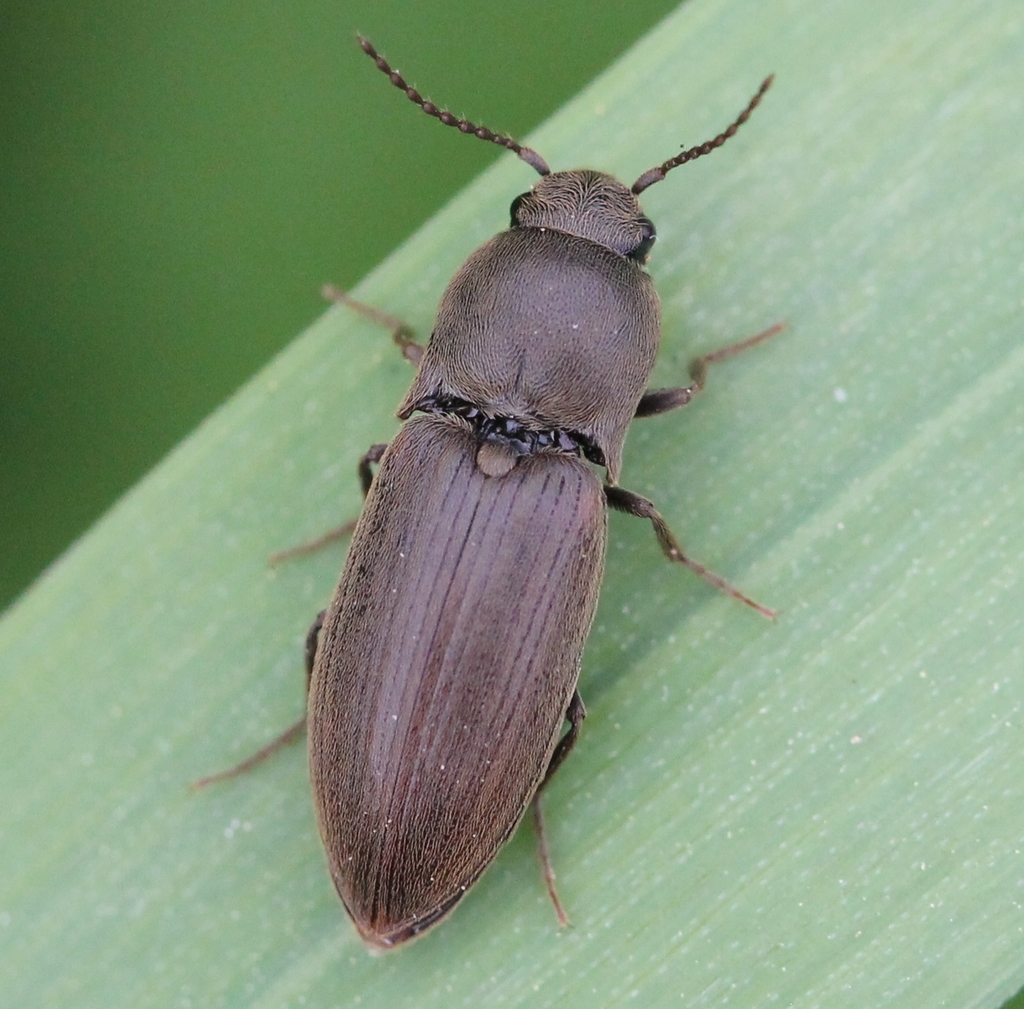
Dusky Wireworm
Agriotes obscurus
Agriotes obscurus, commonly known as dusky wireworm or obscure click beetle, is a species from the family Elateridae that is native and widely distributed in central and northern Europe. It is also present in parts of northern Asia and has been accidentally introduced into western Canada around 1900. It is now established in British Columbia (Canada) and Washington State (U.S.A.), with the risk of spreading to other parts of North America. The larvae (wireworms) are agricultural pests and attack the tubers, seeds and roots of numerous crops like potatoes, beets, cereals, sunflower, vegetables and ornamentals. The larvae also feed on the roots of some grasses and various other plants. For example, in Austria A. obscurus larvae often feed on the roots of common yarrow (Achillea millefolium). For minimizing the harmful effects of pesticides on the environment, an integrated approach is recommended for managing A. obscurus in agricultural fields. Primarily, this involves monitoring the pest populations with pheromone or larval traps. If damaging numbers are detected, non-pesticide management measures should be preferred like crop rotation or timing tillage and irrigation in a way so that the eggs and young larvae are desiccated in the top layer of the soil. The adult beetles are dark brown to black and about 8-10 mm long. They can be distinguished from other species of Agriotes by the morphology of the pronotum, the longitudinal ridges on the elytra and their coloration.
From the article Agriotes obscurus on Wikipedia (CC BY-SA), quoted section by section
Description
Compared to other Agriotes species, the adult beetles of Agriotes obscurus are of medium size and 7–10 mm long. They can be identified by the following combination of features:
Pronotum clearly wider than long, its sides strongly curved. The whole thorax strongly and densely punctured. Elytra relatively short with narrow longitudinal ridges arranged in pairs, the distal part wedge-shaped. Color dark brown to black with elytra, legs and antennae often lighter. However, the whole insect may also be of the same color. The antennae are slightly longer than head and thorax combined. Agriotes obscurus is similar to A. sputator and to A. lineatus, two other common species in Europe which are also agricultural pests, but in both species the pronotum is slightly longer than wide. Compared to A. obscurus, the pronotum of A. sputator is also wider near the head and has less curved, almost parallel sides. A. lineatus can be easily separated from A. obscurus and A. sputator by its striped elytra. Molecular identification of A. obscurus adults and larvae is also possible. The morphological features of A. obscurus larvae are very similar to those of A. lineatus and it is difficult to separate the larvae of both species. The shape of the abdominal spiracles has been described as most consistently different in both species, being longer than wide and narrowing posteriorly in A. obscurus.
Range & habitat
Linnaeus gave "Europe" as habitat when he described Elater obscurus, the basionym of Agriotes obscurus. The type localities given for three other species which are now regarded as synonyms of this species (see the taxobox above) are: Denmark, Germany and Europe. A. obscurus is native to Europe and to parts of Asia. It is most common in central Europe like France, regions in and around the Alps, the U.K., Germany, Poland, Scandinavia and the Baltic states. In Europe, the total distribution range extends from parts of Spain and Italy in the south-west to the U.K., Norway and Finland in the north, to Ukraine and western Russia in the east and to Serbia, Montenegro, Bulgaria and Romania in the south-east. In Asia, it is found in some northern and central parts including Armenia, Azerbaijan, northern Kazakhstan, parts of Siberia, northern Mongolia, northern China and Korea. Around 1900, Agriotes obscurus was accidentally introduced into western Canada, possibly with the soil of hop plants. In the province of British Colombia it is now wide-spread and common on Vancouver Island and in Fraser Valley on the Canadian mainland. It is also spreading into neighboring parts of the U.S.A. During a survey in 1997, A. obscurus was recorded in Washington State, just across the border from British Colombia. Further surveys in 2004 and 2005 indicated that A. …
Wikipedia: “Distribution”
Listen
Looking for field recordings…
Where it lives
Recorded sightings
—
geo-referenced records in GBIF, from museums, herbaria and field observers.
Drag the globe to turn it. Dots are where records exist, not a range map; darker means more records.
In the stacks
Searching the stacks…
Every page naming Agriotes obscurus in the Biodiversity Heritage Library →
This page is assembled live from iNaturalist, GBIF, Wikipedia, the Source Library and the Internet Archive. It is not yet part of the hand-edited codex. iNaturalist taxon 456218.