- Animals
- ›Arthropods
- ›Hexapods
- ›Insects
- ›Winged and Once-winged Insects
- ›Beetles
- ›Water, Rove, Scarab, Long-horned, Leaf, and Snout Beetles
- ›Cucujiform Beetles
- ›Cucujoidea
- ›Pleasing Fungus Beetles
- ›Erotylinae
- ›Tritomini
- ›Triplax
- ›Triplax thoracica
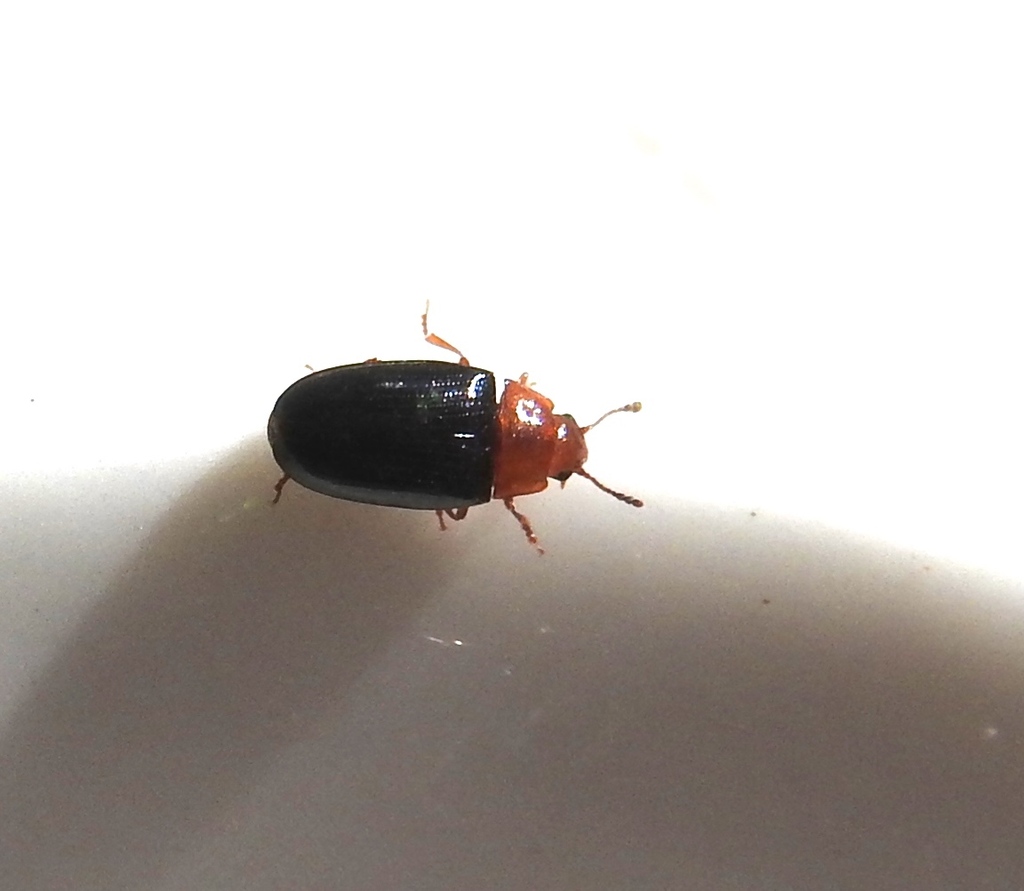
Triplax californica
Triplax californica is a North American species of small pleasing fungus beetle (family Erotylidae). It is placed in subfamily Tritominae (formerly Triplacinae), or – in taxonomic arrangements that prefer a more comprehensive subfamily Erotylinae – in tribe Tritomini of the Erotylinae.
This species is probably one of the "breast-plated" pleasing fungus beetles of the Triplax thoracica cryptic species complex. This large group, other than T.thoracica and T.californica, also includes T.cuneata, T.dissimulator, T.errans, T.flavicollis, T.frosti, T.lacensis, T.mesosternalis, T.microgaster, T.puncticeps and T.wehrlei.
From the article Triplax californica on Wikipedia (CC BY-SA), quoted section by section
Description
Adults of this beetle are about 2.7-5.1 mm long and 1.3-2.4 mm wide. Their elongated body has smoothly curving sides, and bears barely visible thin and short pale hairs. Their coloration is more washed-out and dusky than most of their crisply orange-and-black relatives. Southwestern populations (T.c.californica) resemble their congeners in coloration, with a reddish head and prothorax and usually also a red hue on the scutellum and the base of the elytra, which are otherwise black and not very shiny. As usual for the members of the "breast-plated" species complex, T.californica has orange legs and antenna bases; beyond the first two segments, the antennae are dark red, with a black "club" at the end. The coxae of the middle and hind legs, the base of the prosternum, the mesopleural sternites and the tip of the abdomen are dark reddish-brown. The northeastern populations (T.c.antica) are usually almost entirely dusky brownish-black with light reddish-brown head and legs. The red wash to the elytra bases is comparatively more pronounced than in T.c.californica, and may extend halfway to the wingtip. …
Range & habitat
T.californica is almost endemic to the USA west of the Rocky Mountains. However, its range extends northwards into southern British Columbia (Canada), southwards into northernmost Mexico, and east along the US-Canadian border across the Rocky Mountains to southern Saskatchewan and Nebraska (though its presence in the Plains States is sparse). Two different phenotypes exist within T.californica adults, a northeastern dusky and a southwestern brighter and clearly bicolored one. As noted above, they were once ranked as distinct species, but intergrade over a long but fairly narrow stretch across the western Rocky Mountains (where the species does not seem common, however). The bulk of the populations are well distinct, and they are thus ranked as subspecies today:
Triplax californica antica LeConte, 1861 – southeastern British Columbia south to eastern Washington, Oregon, Nevada and Utah, eastwards sparsely to Saskatchewan, Nebraska, Colorado and New Mexico. Triplax californica californica LeConte, 1854 – California and into surrounding US States, north to southwestern British Columbia; barely extends into Mexico in the Colorado River Delta region south of California-Arizona border. To the east, records become scarce; in the northeast, T.c.antiqua ranges at least to Redfield, Saskatchewan, at the northern end of the Great Plains just a few dozen miles south of the Aspen parkland …
Wikipedia: “Distribution and subspecies”
What it does
T.c.antiqua is mostly active between late May to late August, but most common in June/July. On the Washington-Oregon border south of College Place, Washington, it was found as early as March 20, and at Webb, Idaho, it was collected on March 28. At Fallon, Nevada, individuals of antiqua- and californica-phenotypes were found on a December 17. T.c.californica can occasionally be found year-round in the south of its range; in Pinehurst in Contra Costa County, California, it was collected on a January 3, and in San Francisco on a December 20.
This beetle eats Agaricomycetes tree fungi as larva and adults. Like its closest relatives, its preferred food is oyster mushrooms (Pleurotus; Agaricales: Pleurotaceae) such as the common Pleurotus ostreatus. But its food spectrum seems to be wider than in some other "breast-plated" pleasing fungus beetles: Large numbers of adults – reproducing or recently hatched? – were found on other Agaricales fungi such as golden pholiota (Pholiota aurivella, Strophariaceae) and an undetermined Lentinellus (Auriscalpiaceae). In addition, a small number of individuals has been recorded from an unspecified "Polyporus" – i.e. …
Wikipedia: “Ecology”
Listen
Looking for field recordings…
Where it lives
Recorded sightings
—
geo-referenced records in GBIF, from museums, herbaria and field observers.
Drag the globe to turn it. Dots are where records exist, not a range map; darker means more records.
In the stacks
Searching the stacks…
Every page naming Triplax californica in the Biodiversity Heritage Library →
This page is assembled live from iNaturalist, GBIF, Wikipedia, the Source Library and the Internet Archive. It is not yet part of the hand-edited codex. iNaturalist taxon 456467.