- Plants
- ›Vascular Plants
- ›flowering plants
- ›Dicots
- ›proteas, lotuses, planes, and allies
- ›Protea family
- ›Singlet Proteas
- ›Nutseed Proteoid Clade
- ›Cape Nutseed Proteoids
- ›Leucospermum
- ›Diastelloidea
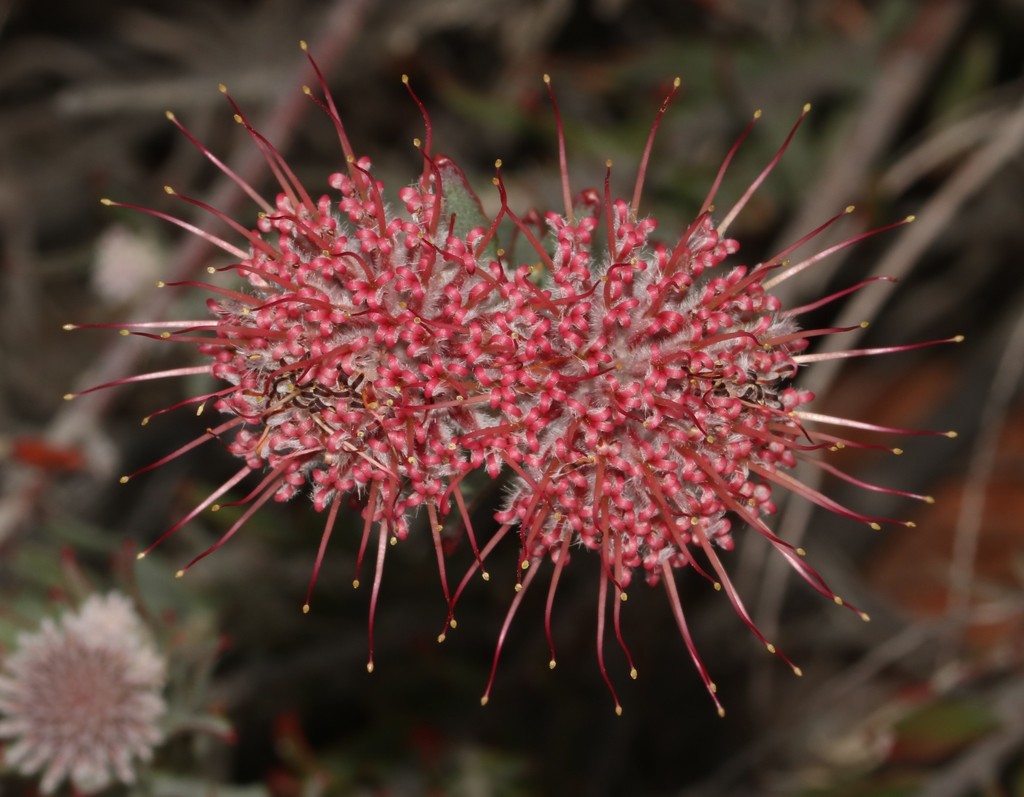
Arid Pincushion
Leucospermum calligerum
Leucospermum calligerum is a softly hairy shrub, with wand-like branches, entire ovate leaves that have a bony tip of about 25 × 6 mm (1 × ¼ in), and globular heads of 2–3½ cm (0.8–1.4 in) in diameter, with two to six together near the tip of the branches and flowering in turn, that consist of 4-merous flowers, initially cream-colored, later pink, with the petals curled and the styles 2–2½ cm (0.8–1.0 in) long, sticking out like pins from a cushion. It is called arid pincushion or common louse pincushion in English and rooiluisie in Afrikaans. Well-scented flowers can be found from July to January. It naturally occurs in fynbos in the Northern Cape and Western Cape provinces of South Africa.
From the article Leucospermum calligerum on Wikipedia (CC BY-SA), quoted section by section
Description
Leucospermum calligerum is a shrub of ½–2 m (1½–6 ft) high and up to 3 m (9.8 ft) in circumference, with a single main stem at its foot, wand-shaped stems, branching at wide angles, initially horizontal or directly rising up, generally 23–30 centimetres (0.75–0.98 ft) long, 3–5 mm (0.12–0.20 in) thick when flowering, covered in minute soft crinkly hairs and also with longer soft straight or curvy hairs. Its simple, tough, leathery, grey to olive-colored, oval to long-oval leaves are set alternately, overlapping or more scattered along the branches, and have a blunt or pointy thickened tip, sometimes with two or three very small teeth, with a rounded or narrowing base, 1.8–3.2 cm (0.71–1.26 in) long, and 4¼–8½ mm (0.17–0.33 in) wide, often with distinct veins, greyish due to minute soft crinkly hairs and sometimes with longer soft straight or bend hairs, often felty when young. The hemisphere-shaped flower heads are nearly seated or sit on a stalk of up to 3 cm (1.2 in) long, mostly with two to six together, rarely individually, near the end of the branches. Older clusters of flower heads can be overtopped by young growth and then appear to be placed along a branch. …
Range & habitat
L. calligerum is one of the more widely distributed species of Leucospermum and can be found from the Gifberg near Vanrhynsdorp and the Lokenberg south of Nieuwoudtville in the north, to Albertinia in the south east. It grows on hot, dry and well drained sandy flats and steep rocky slopes, mostly weathered Table Mountain sandstone, but also on conglomerates of Cape Granite and Malmesbury Shale, between 15–1,200 m (49–3,937 ft) elevation. They are limited to locations that receive between 25–50 cm (9.8–19.7 in) of rain during the winter and less than 75 cm (30 in) on average per year.
Wikipedia: “Distribution and habitat”
What it does
The arid pincushion is visited by birds such as the orange-breasted sunbird Anthobaphes violacea and the Cape sugarbird Promerops cafer, and insects such as beetles, bees and flies. Birds are expected to be the most effective pollinators for non-creeping Leucospermum species. Seeds are ripe about two months after flowering. Attached to each seed is a fleshy ant bread, that is attractive to ants. The ants collect the seeds, take them underground to their nests and eat the ant bread (a seed dispersion strategy called myrmecochory). Plants seldom survive the fires that occur naturally in the fynbos every decade or two. When afterwards the rain carries specific chemicals that are created by the fire underground, the seeds germinate and the species is so "resurrected".
Wikipedia: “Ecology”
Where it lives
Recorded sightings
—
geo-referenced records in GBIF, from museums, herbaria and field observers.
Drag the globe to turn it. Dots are where records exist, not a range map; darker means more records.
In the stacks
Searching the stacks…
Every page naming Leucospermum calligerum in the Biodiversity Heritage Library →
This page is assembled live from iNaturalist, GBIF, Wikipedia, the Source Library and the Internet Archive. It is not yet part of the hand-edited codex. iNaturalist taxon 460162.