- Animals
- ›Molluscs
- ›Gastropods
- ›Vetigastropods
- ›Trochida
- ›Top Snails, Turban Snails, and Allies
- ›Tegulidae
- ›Tegula
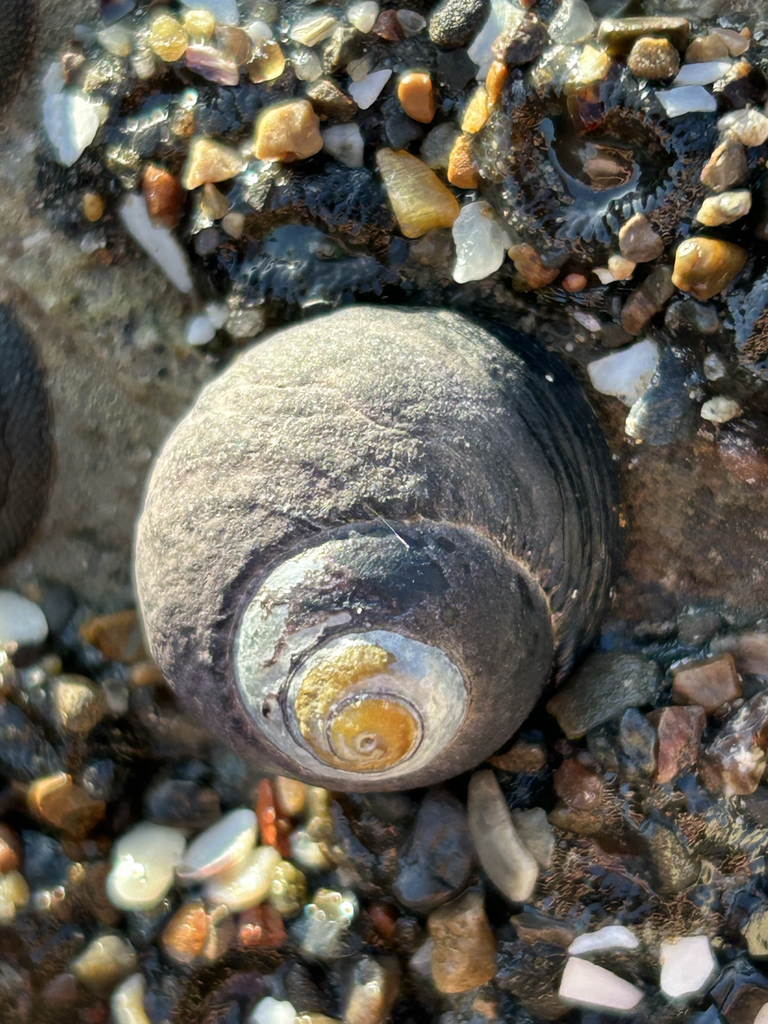
Black Tegula
Tegula funebralis
The black turban snail or black tegula, scientific name Tegula funebralis, is a species of medium-sized marine sea snail in the family Tegulidae. This Eastern Pacific Ocean species was previously known as Chlorostoma funebralis....
From the article Tegula funebralis on Wikipedia (CC BY-SA), quoted section by section
Description
Most adults have shells which are 20 to 50 mm (or about an inch, to an inch and three quarters) in diameter. Adults weigh anywhere from 2 to 20 grams. Individuals can live anywhere from 7 to 30 years; studies have shown that individuals inhabiting the more northern portions of the organism's range are larger and live longer on average than organisms inhabiting the southern portions. In 1971, a new sense organ was discovered in this marine snail. Chemoreceptor organs were found near the base on the border of the leaflets of the ctenidium (comb-like respiratory gills), one on each leaflet. They form a light swelling near the base of the leaflet with a pocket lying within the swelling. Together they are termed a "bursicle".
Range & habitat
Black turban snails are found along the Pacific coast of North America from British Columbia to Baja California, where they are one of the most abundant snail species. Studies have recorded densities of up to 1,400 individuals per m2 near Monterey, California. Local densities are influenced by many factors, including abundance of food, predators, and suitable habitat. This species inhabits rocky intertidal zones, between low and high tide lines. Juveniles are found mostly under rocks and among coarse sands. Empty black turban snail shells are often utilized by another common intertidal animal, the hermit crab.
Wikipedia: “Distribution and habitat”
What it does
Tegula funebralis is primarily herbivorous. Food for T. funebralis can be categorized as either rock encrusting algae, macroscopic algae, or organic detritus. Studies into the macroscopic algal preferences of T. funebralis revealed a strong preference for Nereocystis luetkana and Macrocystis integrifolia. Macroscopic algae species preferred by T. funebralis are similar in that they are non-calcareous, non-filamentous, and softer in comparison to other macroscopic algae in the region. These species do not grow in the intertidal, so they are only available to T. funebralis as drift material.
Wikipedia: “Diet”
Where it lives
Recorded sightings
—
geo-referenced records in GBIF, from museums, herbaria and field observers.
Drag the globe to turn it. Dots are where records exist, not a range map; darker means more records.
In the stacks
Searching the stacks…
Every page naming Tegula funebralis in the Biodiversity Heritage Library →
This page is assembled live from iNaturalist, GBIF, Wikipedia, the Source Library and the Internet Archive. It is not yet part of the hand-edited codex. iNaturalist taxon 460365.