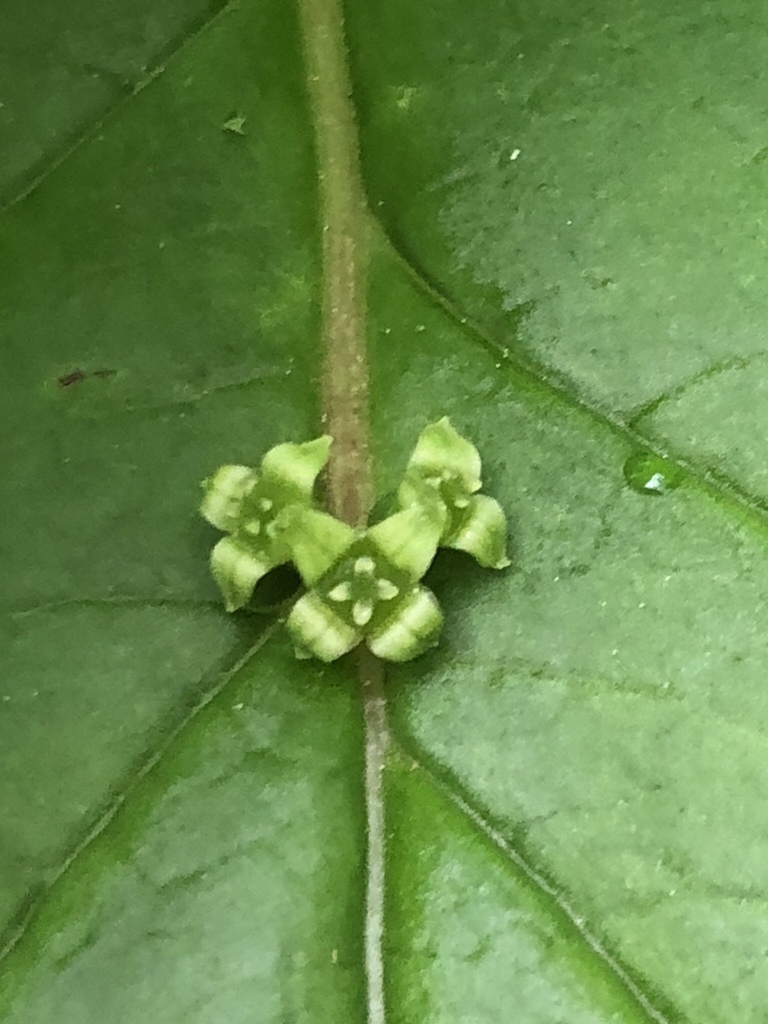
Helwingia japonica
Helwingia japonica, the Japanese helwingia, is a species of flowering plant in the family Helwingiaceae. It is native to South-East Asia.
From the article Helwingia japonica on Wikipedia (CC BY-SA), quoted section by section
Description
Helwingia japonica is a dioecious shrub with height varying between 1 and 2 metres (3.3 and 6.6 ft), and may spread 1–1.5 metres (3.3–4.9 ft), with leaves of 6–12 centimetres (2.4–4.7 in) in length. The lateral and midvein are concave, and the leaves' colors are green. Flowers grow from the center of the leaf midribs, taking the shape of a simple umbel inflorescence. In male specimens, 3–10 small green or purplish-green flowers grow but only 3–5 will open simultaneously. The female plants have 1–3 flowers. Flowering takes place between April and May, and fruiting is from August to September.
Range & habitat
Helwingia japonica is found in moist rich soil in forests and thickets in hills and low mountains at elevations of 100–3,400 metres (330–11,150 ft) in Japan, Bhutan, South Korea, Myanmar, and in multiple Chinese provinces.
Wikipedia: “Range”
What it does
The Helwingia japonica is a dioecious plant, meaning that male and female sexual functions occur on separate plants. In the male plant, the flowers have a small calyx with 3–5 stamens and one long pedicel. The female plant has a short pedicel and one pistil, with 3–5 stigma branches and an inferior ovary that has 3–5 ovules, but no stamens. For reproduction to take place, it requires pollination. The female plants flowers will then turn into fruits. The fruits are small black or red berries.
Wikipedia: “Reproduction”
At the table
The plants are edible. The young leaves are used for culinary purposes, such as being cooked with rice or boiled. The flowers can also be eaten. One source mentions the use of the plant for medical purposes, such to activate blood circulation, remove blood stasis, help with urination pain, and the use of the fruit to relieve stomach aches.
Wikipedia: “Uses”
How it is grown
They can be grown in places that are moist with good drainage, such as in partially shaded areas. It can tolerate temperatures as low as −7 °C (19 °F). The plant requires low maintenance, but to produce fruit, it requires both male and female plants. Mature seed can be collected from fruit be put to storage or sowed after being rinsed and left to dry.
Wikipedia: “Cultivation”
Where it lives
Recorded sightings
—
geo-referenced records in GBIF, from museums, herbaria and field observers.
Drag the globe to turn it. Dots are where records exist, not a range map; darker means more records.
In the stacks
Searching the stacks…
Every page naming Helwingia japonica in the Biodiversity Heritage Library →
This page is assembled live from iNaturalist, GBIF, Wikipedia, the Source Library and the Internet Archive. It is not yet part of the hand-edited codex. iNaturalist taxon 461024.