- Plants
- ›Vascular Plants
- ›flowering plants
- ›Dicots
- ›Mints, Plantains, Olives, and Allies
- ›Mint Family
- ›Callicarpoideae
- ›Callicarpa
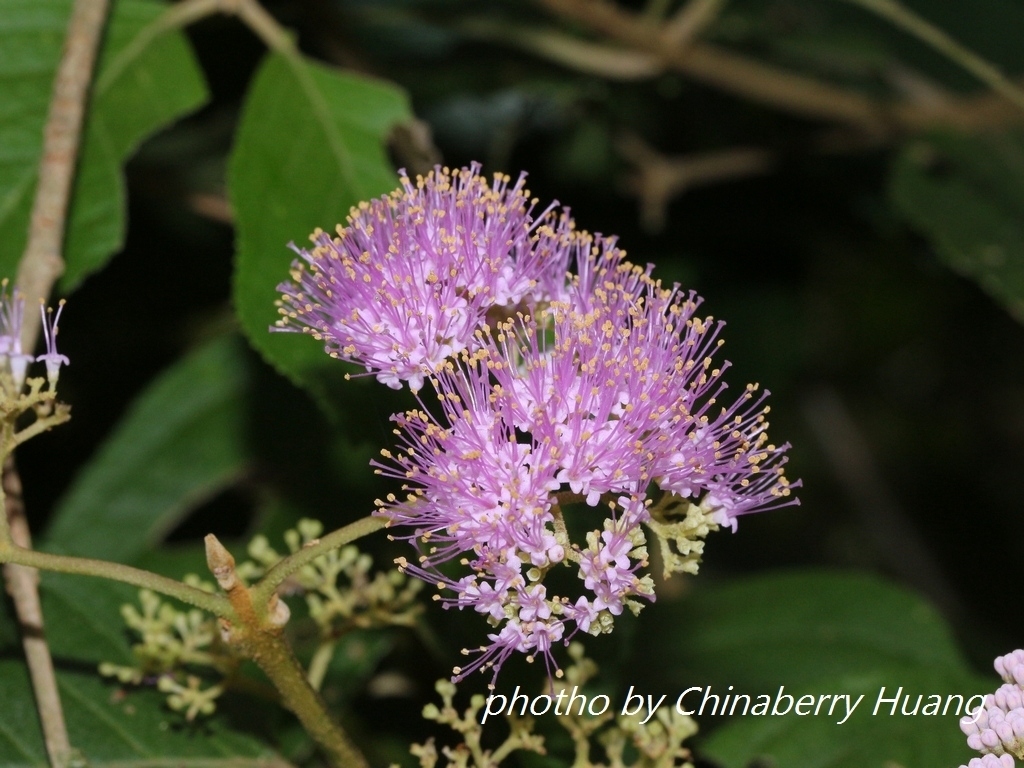
Formosan Beautyberry
Callicarpa formosana
Callicarpa pedunculata, commonly known as beautyberry or velvet-leaf, is a species of plant in the mint and sage family Lamiaceae. It is native to tropical areas from northeast India and southeast China, through the Philippines and New Guinea to eastern Australia. It was first described by Scottish botanist Robert Brown in 1810.
From the article Callicarpa pedunculata on Wikipedia (CC BY-SA), quoted section by section
Description
C. pedunculata is a shrub growing up to 4 m high. The twigs, the petioles and the underside of the leaf blade have a covering of stalked stellate hairs, while the upper surface of the leaf has a covering of stellate and simple hairs which become sparse when older. The Leaf blades are about 6-18 x 3-6 cm, and there are small, pale yellow, glands on the underside of the leaf. The bottom part of the leaf has smooth margins but the remainder is toothed. The inflorescences are 2 to 3 cm long, and sometimes inserted a little above leaf axil. The flowers have stalks which are 0.5 to 1 mm long, while the calyx 1 to 1.5 mm long, and the purple or mauve corolla is 2 to 3 mm long. The fruit are whitish to purple drupes.
At the table
It is grown as an ornamental shrub. The fruit is astringent and too acidic to be eaten by people.
== References ==
Wikipedia: “Uses”
Where it lives
Recorded sightings
—
geo-referenced records in GBIF, from museums, herbaria and field observers.
Drag the globe to turn it. Dots are where records exist, not a range map; darker means more records.
In the stacks
Searching the stacks…
Every page naming Callicarpa formosana in the Biodiversity Heritage Library →
This page is assembled live from iNaturalist, GBIF, Wikipedia, the Source Library and the Internet Archive. It is not yet part of the hand-edited codex. iNaturalist taxon 461502.