- Plants
- ›Vascular Plants
- ›flowering plants
- ›Dicots
- ›Buttercups, Poppies, and Allies
- ›barberry family
- ›Berberidoideae
- ›Berberideae
- ›Berberis
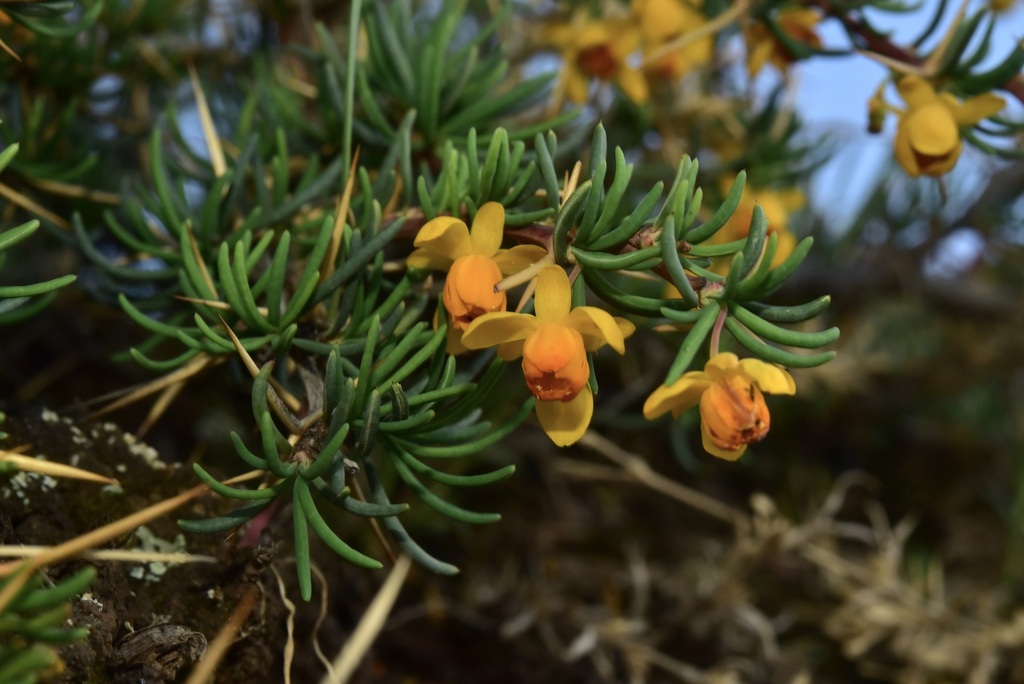
Berberis empetrifolia
Berberis empetrifolia, sometimes called heath barberry, is a low, somewhat spiny shrub belonging to the barberries in the family Berberidaceae. The local names in Chile are zarcilla, monte negro and uva de la cordillera. It has small narrow entire leaves, and small yolk-colored flowers and later globose blue-black berries. The species is native to south of 30ºS in Argentina and Chile, where it grows on sunny, often gravelly soils, and is sometimes planted as an ornamental elsewhere in temperate climates.
From the article Berberis empetrifolia on Wikipedia (CC BY-SA), quoted section by section
Description
Heath barberry is a low (up to ½ m high and over 1 m wide in the wild) shrub. The mature twigs have a warm brown color, with 3-branched, flattened, light brown spines (1-1½ cm long) under each short side shoot. The thick, narrow leaves are semi-deciduous, linear in shape (1–2 cm long), somewhat bluish-green, with entire, rolled-under margins, and pointed, often purplish tips that may later die-down to a light brown. The flowers are radially symmetrical (about ½ cm), occur late in spring individually or in small umbels, are yolk yellow hinting towards orange. As in other Berberis species, the tepals are set in four whorls of three to five and equal in shape and color, so it is difficult to separate sepals from petals. The filament has a tooth on each side near its upper end, where the anther is attached. The fruit is a globose, blue-black berry of about 7 mm in diameter.
Range & habitat
Heath barberry occurs is southern Argentina and Chile, up to subalpine or alpine heights in the Andes among rocks and grows largest in stable scree.
Wikipedia: “Distribution and habitat”
What it does
Berberis empetrifolia is adapted to tough microclimates, and typically grows in such places as the stormy beaches of the southern islands and inlets of Chile, the constant drying winds of Patagonia such as in Aysen, and rocky Andes slopes. The berries are eaten by wildlife, such as the lizard Liolaemus belii. Research has shown the seeds to be adapted to digestion as both germination speed and total final rate are higher after passing through the gut, and this is possibly caused by abrasion of a waxy layer from the seed in the gut. This does not only lead to dispersal over a wider area, but also do these lizards defecate often on bare soil, which improves the chances of survival of the seedlings.
Wikipedia: “Ecology”
Where it lives
Recorded sightings
—
geo-referenced records in GBIF, from museums, herbaria and field observers.
Drag the globe to turn it. Dots are where records exist, not a range map; darker means more records.
In the stacks
Searching the stacks…
Every page naming Berberis empetrifolia in the Biodiversity Heritage Library →
This page is assembled live from iNaturalist, GBIF, Wikipedia, the Source Library and the Internet Archive. It is not yet part of the hand-edited codex. iNaturalist taxon 461583.