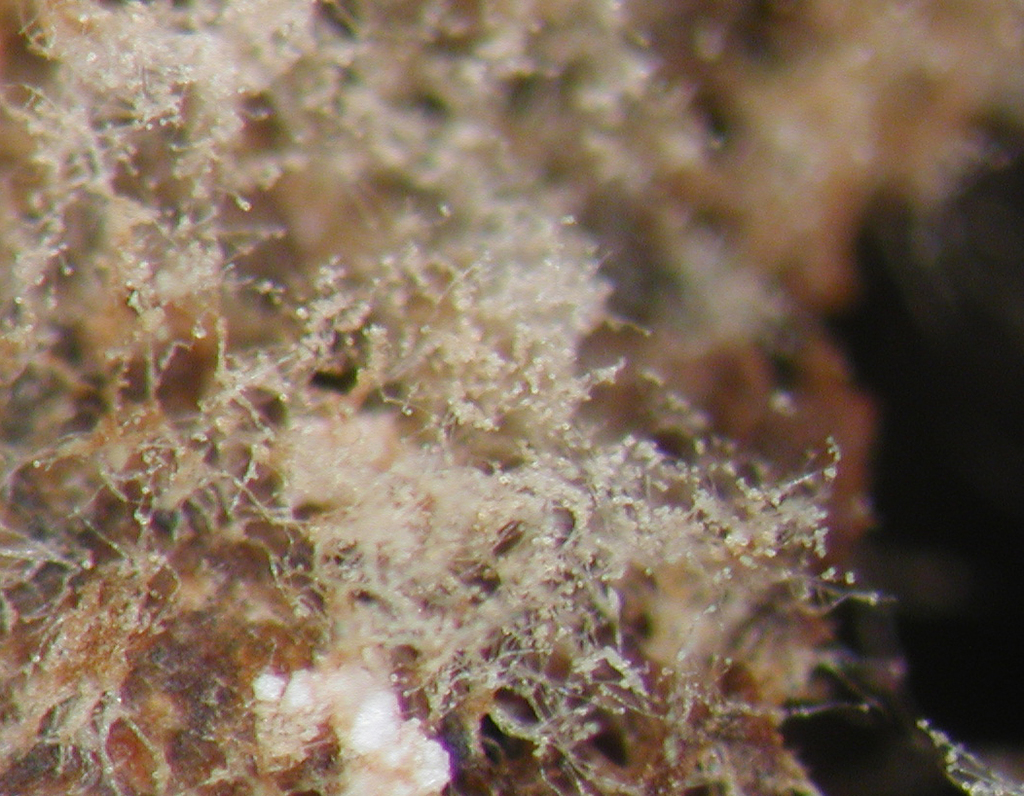
Rhinotrichella globulifera
Rhinotrichella globulifera is a fungicolous ascomycete fungus known primarily from its asexual state. It has most often been recorded growing on the fruiting bodies of other fungi, particularly polypores, although it has also been found on plant remains.
The species produces long erect conidiophores bearing approximately spherical, pale ochre conidia. Records compiled in 2011 indicated its presence in Europe, Asia and North America. In 2026, molecular data from R. globulifera were used in the description and comparison of a second species, Rhinotrichella carpini.
From the article Rhinotrichella globulifera on Wikipedia (CC BY-SA), quoted section by section
Description
Sporulating colonies are loose and tufted. Young growth is white, becoming pale ochre or yellowish brown with age. The vegetative hyphae are branched, septate, smooth and thin-walled, generally 2–5 μm wide and occasionally reaching about 7.5 μm. The conidiophores are erect, straight and septate. Ukrainian specimens examined by Akulov measured about 350–650 μm long. They are usually unbranched, although one or two branches may develop near the base. Their width decreases from approximately 6–8 μm at the base to 3–5 μm toward the apex. The fertile region is cylindrical and somewhat curved, commonly 150–180 μm long. Continued sympodial growth during conidium production may extend it to around 400 μm. Its surface bears numerous pointed conidiogenous denticles about 1–1.5 μm long. The conidia develop both apically and laterally. They are pale ochre, thick-walled and globose to nearly globose, with a smooth to finely ornamented surface. Akulov recorded diameters of 8–10 μm, occasionally reaching 12 μm. Material compared in 2026 had conidia approximately 9–12 μm in diameter and a smooth to finely verruculose surface.
Wikipedia: “Morphology”
What it does
Most published collections of R. globulifera have been associated with fruiting bodies of wood-decaying fungi. Reported substrates include Fomes fomentarius, Inonotus dryadeus and Ganoderma tsugae. Akulov reported the species from Ukraine for the first time in 2011. The collections occurred on several fungal substrates, including a fruit body of Ganoderma applanatum, decaying fruit bodies of Oxyporus latemarginatus, an aethalium of a Fuligo species, and fruit bodies of Nemania serpens. Earlier culture observations found that the fungus could be isolated from polypore fruit bodies that appeared externally undamaged. This led to the suggestion that it may begin growing internally within its fungal substrate before producing visible surface growth. The proposal concerns its possible mode of development and does not represent a demonstrated complete life cycle. Records reviewed in 2011 included Georgia, the Netherlands, European Russia, Ukraine, France and the Czech Republic, as well as Japan, the United States and Canada.
Wikipedia: “Fungicolous ecology”
Where it lives
Recorded sightings
—
geo-referenced records in GBIF, from museums, herbaria and field observers.
Drag the globe to turn it. Dots are where records exist, not a range map; darker means more records.
In the stacks
Searching the stacks…
Every page naming Rhinotrichella globulifera in the Biodiversity Heritage Library →
This page is assembled live from iNaturalist, GBIF, Wikipedia, the Source Library and the Internet Archive. It is not yet part of the hand-edited codex. iNaturalist taxon 462149.