- Fungi Including Lichens
- ›Ascomycete Fungi
- ›Sac Fungi and Lichens
- ›Common Lichens
- ›Shield Lichens, Sunburst Lichens, Rosette Lichens, and Allies
- ›shield lichens, rim lichens, and allies
- ›bushy lichens, sea-fog lichens, and allies
- ›Biatora
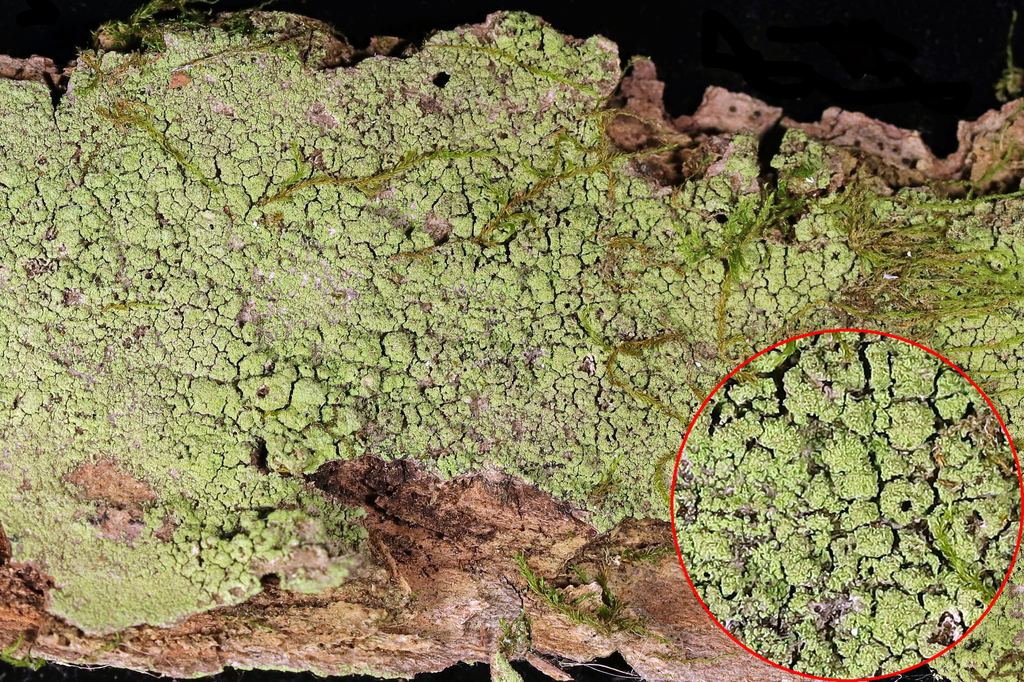
Biatora pontica
Biatora pontica is a species of corticolous (bark-dwelling), leprose lichen in the family Ramalinaceae. It is a widely distributed species, having been recorded in Africa, Asia, Europe, and North America.
From the article Biatora pontica on Wikipedia (CC BY-SA), quoted section by section
Description
The thallus of Biatora pontica is formed from areoles, or small rounded areas. These areoles, in the non-sorediate parts, can either be embedded within or superficially connected to the substrate. Their colour can range from a verdant green to yellowish-grey, and each areola can reach up to 1.2 mm in diameter. Bright green to yellowish-grey soralia (groups of reproductive structures) characterise this lichen, initially taking on a punctiform, or point-like shape. These soralia gradually merge over time. The presence of apothecia, or fruiting bodies where sexual reproduction occurs, is relatively rare in Biatora pontica. These biatorine (typical to the genus Biatora), rounded, and sessile structures vary from 0.5 to 0.7 mm in diameter. A true exciple, or the rim surrounding the apothecium, is typically visible in younger apothecia only and is colourless when examined in section. The disc, located at the centre of the apothecium, takes on a shade varying from dark grey-ochre to brown-grey and is flat to slightly convex in structure. The underlying layer, or hypothecium, is mainly colourless, with fragments showcasing pigments of Pontica-blue and Pontica-red. The hymenium, or tissue layer containing the asci (spore-bearing cells), either bears no colour or is bright olive, measuring approximately 40 μm in height. Each ascus of the Biatora type carries eight spores. …
Range & habitat
Biatora pontica is widely distributed in Europe, having been recorded in Austria, Italy, Norway, Poland, Russia, and Slovenia. It also occurs in Africa, Asia, and North America.
== References ==
Wikipedia: “Habitat and distribution”
Where it lives
Recorded sightings
—
geo-referenced records in GBIF, from museums, herbaria and field observers.
Drag the globe to turn it. Dots are where records exist, not a range map; darker means more records.
In the stacks
Searching the stacks…
Every page naming Biatora pontica in the Biodiversity Heritage Library →
This page is assembled live from iNaturalist, GBIF, Wikipedia, the Source Library and the Internet Archive. It is not yet part of the hand-edited codex. iNaturalist taxon 462463.