- Fungi Including Lichens
- ›Ascomycete Fungi
- ›Sac Fungi and Lichens
- ›Common Lichens
- ›wart lichens, script lichens, and allies
- ›Dictyocatenulata
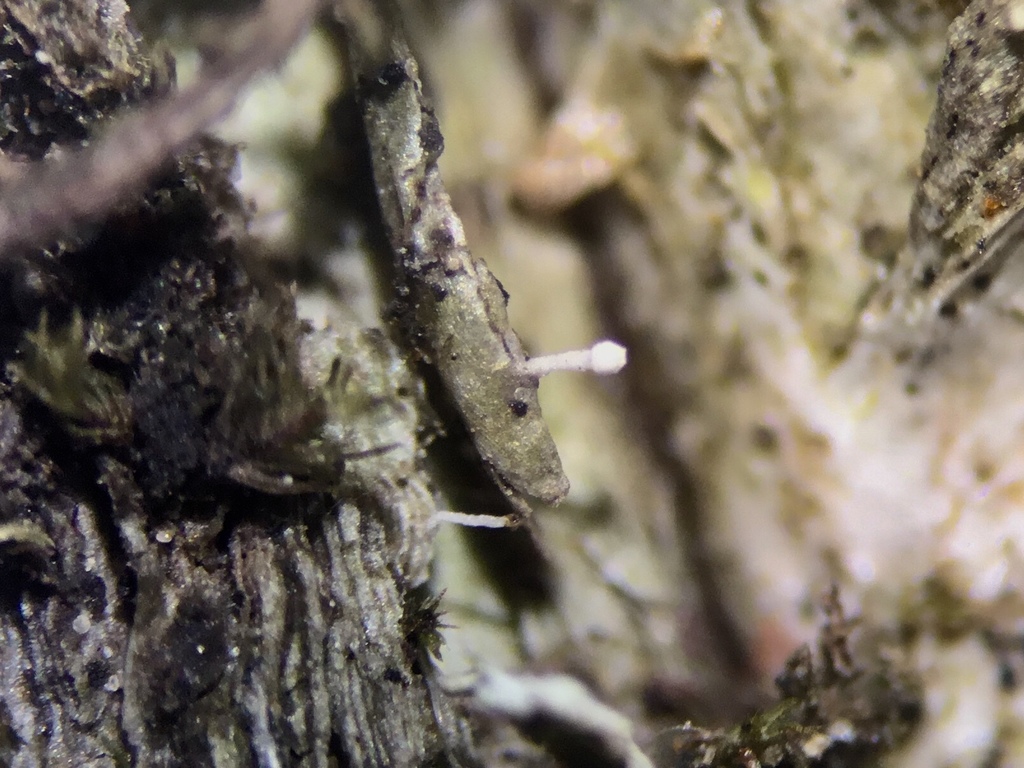
Dictyocatenulata alba
Dictyocatenulata is a fungal genus of uncertain classification in the subclass Ostropomycetidae. It contains the single species Dictyocatenulata alba. Originally described in 1967 as a bark-dwelling fungus, it was later recognised as a lichen in 2004. The genus is characterised by its unique reproductive structures called synnemata, which are upright, stem-like formations that produce spores. D. alba has a widespread distribution, found in North and Central America, Asia, and Europe, typically growing on tree bark in humid forests. Recent molecular studies suggest that Dictyocatenulata may be closely related to the genus Thelenella, potentially representing an asexual stage of unknown Thelenella species. This lichen is distinguished by its thin, greenish thallus (body) and its spores, which are divided into many cells and arranged in chains, features that give the genus its name.
From the article Dictyocatenulata on Wikipedia (CC BY-SA), quoted section by section
Description
The thallus of Dictyocatenulata alba is spread out in a thin, smooth layer that is greyish-green when dry and dark green when wet. It forms a continuous, matt surface and lacks a distinct outer skin (cortex), making it very thin and irregular in development. The photosynthetic partner (photobiont) within the lichen is from the Trentepohlia genus of green algae. These algal cells are small, measuring 7–12 μm, and are often embedded within the substrate the lichen is growing on. The reproductive structures of Dictyocatenulata are specialised formations called synnemata, which are tall, upright spore-producing structures. These structures often emerge either from a smooth white disc of superficial mycelium or directly from the bark, depending on environmental conditions. These can range in height from almost invisible (0 μm) to as tall as 1.5 mm (1500 μm). In the original description, the synnemata were characterised as white, reaching up to 1,200 μm in height, with a width of up to 150 μm at the base, narrowing to about 50 μm just below the heads. The synnemata are typically unbranched, but occasionally they may branch in the middle, dividing into two to five parts. The stalk (stipe) of the synnemata is smooth and cream-coloured, with a diameter of 25 to 175 μm. At the top of the stalk is the fertile zone, which produces conidia (asexual spores). …
Range & habitat
Dictyocatenulata alba has a widespread distribution across several continents. It has been reported from North America (Canada and the United States), Central America (Cuba and Panama), Asia (India and Japan), and Europe. The species was first reported in Europe in 2008, where it appears to be widespread and locally common in Central and Eastern Europe, but seemingly rare or possibly absent in Western Europe. In Europe, D. alba is typically found in humid broad-leaved and mixed forests, often in valleys near streams. It grows primarily on the smooth bark of various trees, with a preference for certain species: Acer pseudoplatanus (Sycamore maple), Betula (birch species), Fagus sylvatica (European beech), and Quercus (oak species). The lichen is frequently observed at the shaded base of tree stems, suggesting a preference for more humid and sheltered microhabitats. While primarily bark-dwelling (corticolous), D. alba has also been collected twice on rocks, indicating some flexibility in its substrate preferences. Dictyocatenulata alba often forms extensive patches and is not typically intermingled with other lichen species. …
Wikipedia: “Habitat and distribution”
Where it lives
Recorded sightings
—
geo-referenced records in GBIF, from museums, herbaria and field observers.
Drag the globe to turn it. Dots are where records exist, not a range map; darker means more records.
In the stacks
Searching the stacks…
Every page naming Dictyocatenulata alba in the Biodiversity Heritage Library →
This page is assembled live from iNaturalist, GBIF, Wikipedia, the Source Library and the Internet Archive. It is not yet part of the hand-edited codex. iNaturalist taxon 462819.