- Fungi Including Lichens
- ›Ascomycete Fungi
- ›Sac Fungi and Lichens
- ›Common Lichens
- ›wart lichens, script lichens, and allies
- ›wart lichens, water lichens, and allies
- ›Coccotremataceae
- ›Gyalectaria
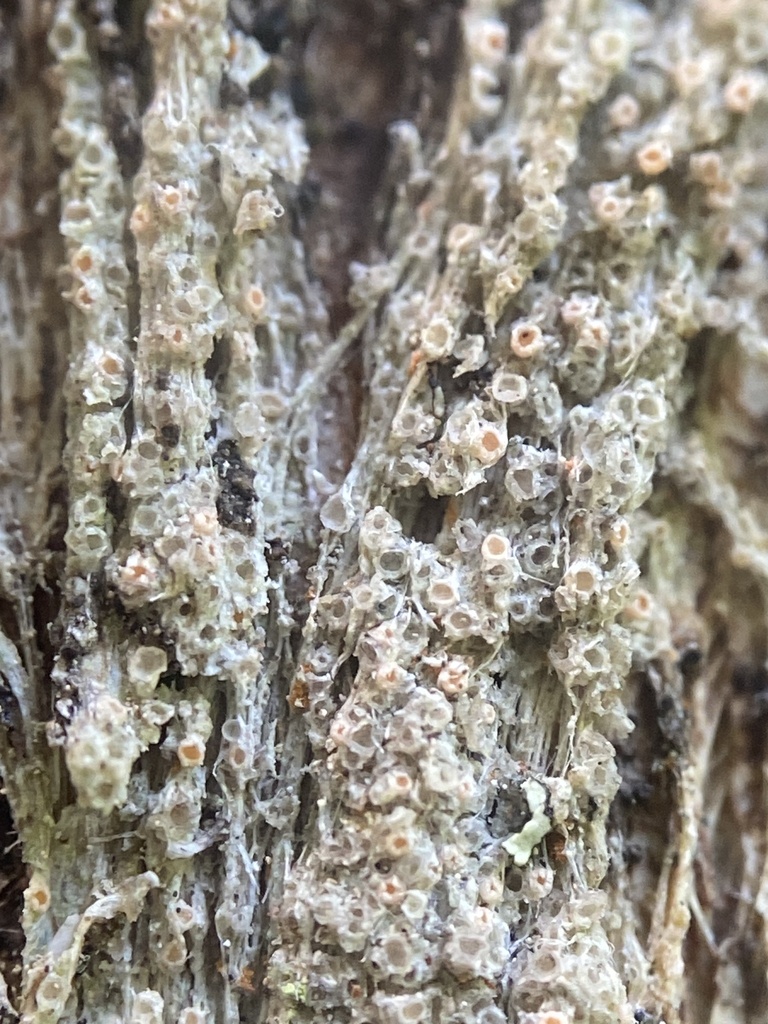
Gyalectaria diluta
Gyalectaria diluta is a species of crustose lichen in the family Coccotremataceae, first found in inland rainforests of British Columbia. This pale, crust-forming lichen grows on the bark of conifer trees in very humid old-growth forests, where it forms small patches that bleach the underlying bark to whitish or pale green-grey colours. It is found from British Columbia to Montana and Idaho, typically growing on smooth bark of young cedar saplings beneath mature forest canopies that have remained undisturbed for centuries.
From the article Gyalectaria diluta on Wikipedia (CC BY-SA), quoted section by section
Description
Gyalectaria diluta grows as a thin, crust-forming lichen that bleaches the underlying bark to pale green-grey or whitish tones. The crust breaks into tiny, smooth polygons (areoles only 0.2–0.3 mm across) that soon fuse into patches as large as about 6 × 2 cm. Viewed in section, the thallus is stratified: a firm outer cortex 10–40 μm thick overlies a layer of densely packed green algal cells (photobiont) 20–100 μm deep; no darker hypothallus is present. The algal partner consists of jelly-sheathed, angular cells roughly 10–14 μm wide. Standard spot tests are negative (C−), indicating the absence of gyrophoric acid; thin-layer chromatography shows an as yet unidentified substance instead. Reproduction takes place in countless wart-like swellings (verrucae) that cover older parts of the crust at densities up to 119 per square centimetre. Each verruca usually houses a single tiny apothecium 0.20–0.36 mm in diameter whose disc is sunk below the surface, later rupturing the wart and exposing a flat to shallowly concave salmon-to-pale-yellow centre framed by the thallus itself. Around the disc lies a distinct, waxy pseudo-excipular rim up to 65 μm thick whose inner tissue stains bright blue in iodine after potassium pre-treatment, revealing starch-like compounds. …
Range & habitat
The lichen is restricted to very humid, late-successional conifer forests. It has been recorded on the bark of western hemlock (Tsuga heterophylla), western redcedar (Thuja plicata), Douglas-fir (Pseudotsuga menziesii), and occasionally on decorticated logs where it may mingle with Absconditella lignicola and Lichinodium sirosiphoideum. Although capable of colonising a range of substrates, it occurs most reliably on the smooth bark of young redcedar saplings growing beneath an old-growth canopy. Known sites form a loose arc through the inland temperate rain-forest belt: fourteen localities in British Columbia, one in northern Idaho and one in north-western Montana. Elevations range from sea level along the rugged mid-coast to about 1,000 m (3,300 ft) in the Selkirk and Cabinet Mountains. All stands share a persistently moist microclimate and have escaped large-scale disturbance for centuries, suggesting the species is sensitive to canopy removal and prolonged drying.
== References ==
Wikipedia: “Habitat and distribution”
Where it lives
Recorded sightings
—
geo-referenced records in GBIF, from museums, herbaria and field observers.
Drag the globe to turn it. Dots are where records exist, not a range map; darker means more records.
In the stacks
Searching the stacks…
Every page naming Gyalectaria diluta in the Biodiversity Heritage Library →
This page is assembled live from iNaturalist, GBIF, Wikipedia, the Source Library and the Internet Archive. It is not yet part of the hand-edited codex. iNaturalist taxon 463042.