- Fungi Including Lichens
- ›Ascomycete Fungi
- ›Sac Fungi and Lichens
- ›Common Lichens
- ›Shield Lichens, Sunburst Lichens, Rosette Lichens, and Allies
- ›shield lichens, rim lichens, and allies
- ›Stereocaulaceae
- ›Lepraria
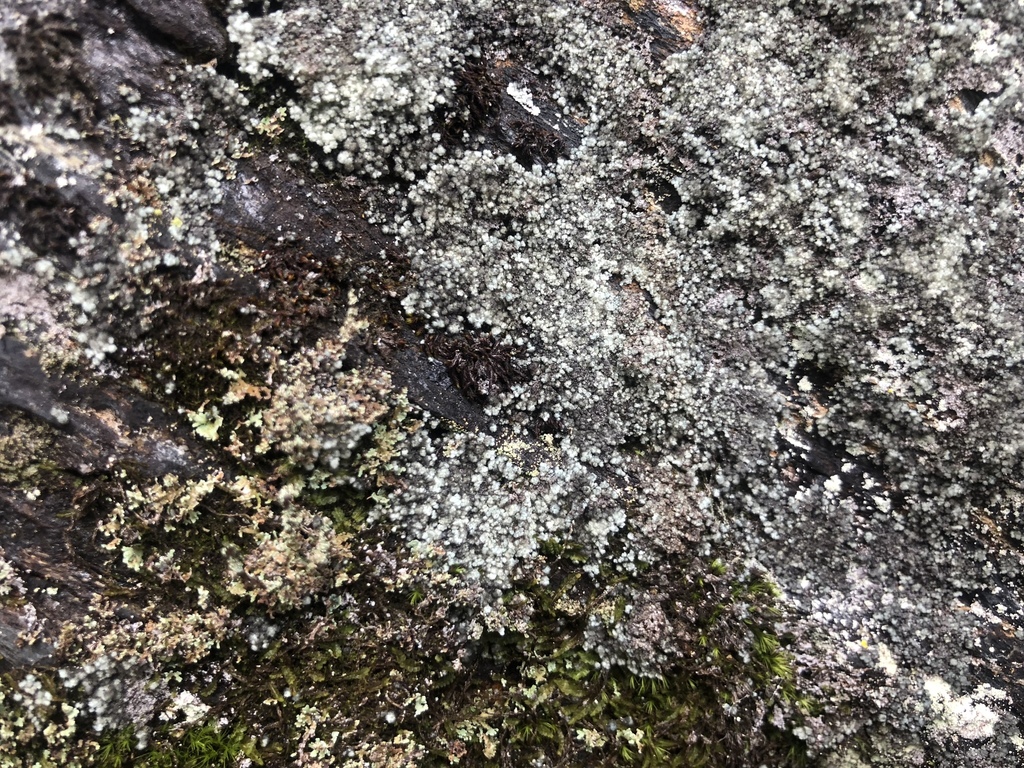
Appalachian Dust Bunnies
Lepraria lanata
Lepraria lanata is a species of leprose lichen in the family Stereocaulaceae. It occurs in the eastern United States, where it grows most on rock surfaces, and occasionally on soil or mosses.
From the article Lepraria lanata on Wikipedia (CC BY-SA), quoted section by section
Description
This species is distinguished by its unique woolly appearance, where all soredia (reproductive propagules) are aggregated into distinctive clusters called consoredia, reaching up to 1 mm in size. These consoredia are surrounded by a characteristic loose network of branching and interconnecting fungal threads (hyphae), which, while forming an extensive mesh, typically do not project outward. The hyphae may be colourless or develop brown pigmentation in their outer portions. The thallus (lichen body) has a diffuse margin without lobes and lacks a medulla (inner layer). The color of the thallus ranges from whitish to more or less brownish to bluish-gray. Spot tests are K+ (yellow), C−, KC−, P−, and UV−.
Range & habitat
The species occurs primarily on rock surfaces, with occasional records from soil or mosses. It can be found in both dry and somewhat wet overhanging areas and rock walls. Lepraria lanata is known only from montane regions of eastern United States, at elevations ranging from 1,120 to 1,990 m (3,670 to 6,530 ft).
== References ==
Wikipedia: “Habitat and distribution”
Where it lives
Recorded sightings
—
geo-referenced records in GBIF, from museums, herbaria and field observers.
Drag the globe to turn it. Dots are where records exist, not a range map; darker means more records.
In the stacks
Searching the stacks…
Every page naming Lepraria lanata in the Biodiversity Heritage Library →
This page is assembled live from iNaturalist, GBIF, Wikipedia, the Source Library and the Internet Archive. It is not yet part of the hand-edited codex. iNaturalist taxon 463351.