- Fungi Including Lichens
- ›Ascomycete Fungi
- ›Sac Fungi and Lichens
- ›Common Lichens
- ›wart lichens, script lichens, and allies
- ›Trapeliales
- ›Trapeliaceae
- ›Placopsis
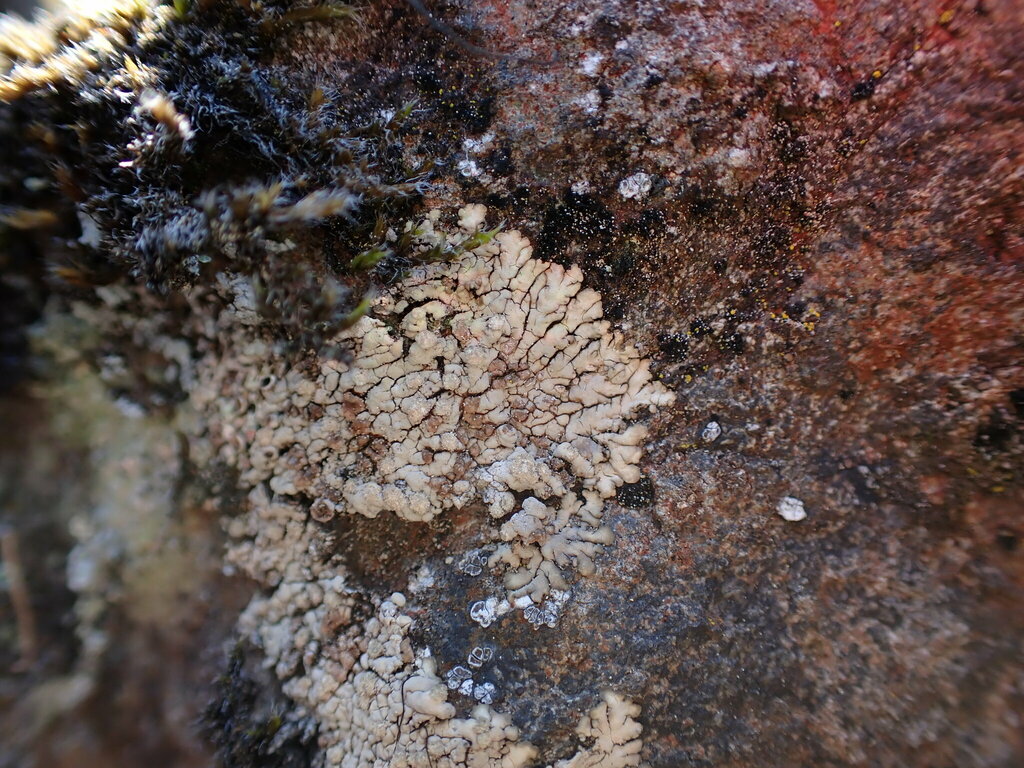
Placopsis fusciduloides
Placopsis fusciduloides is a species of lichen in the family Trapeliaceae. It was described by David J. Galloway from New Zealand, after he recognised that some specimens filed under other names (especially P. gelida) represented an undescribed taxon; additional material was later matched to the same species from British Columbia (Canada) and Bolivia. It was subsequently documented from Chile and Argentina in southern South America.
From the article Placopsis fusciduloides on Wikipedia (CC BY-SA), quoted section by section
Description
The lichen forms neat, flat rosettes closely attached to rock, usually 1–3 cm across but sometimes larger, and it can become thicker and more swollen when it spreads over mosses. The upper surface is typically olive- to brown-toned and appears faintly "frosted" because it is evenly dusted with a thin, powdery (pruina). It is sorediate, producing pale greenish-white to white, powdery propagules (soredia) in round to irregular patches (soralia); these often erode and merge, leaving conspicuous pale, excavated areas edged by a narrow raised rim. Many thalli also develop scattered cephalodia (small, wart-like structures housing cyanobacteria, usually Scytonema), which are smooth when young but become ridged and cracked with age. Sexual fruiting bodies are uncommon but distinctive when present: small, sessile apothecia with a rose-pink to reddish disc, sometimes dusted with a pale pruina. Chemical tests and thin-layer chromatography show that it produces several lichen substances, dominated by gyrophoric acid and usually also cryptostictic acid; smaller amounts of lecanoric acid are present, along with trace to minor quantities of hiascic acid and 5-O-methylhiascic acid, and occasionally 2'-O-methylhiascic, stictic, and connorstictic acids. It can be separated from lookalikes that have been lumped into P. …
Range & habitat
In New Zealand, P. fusciduloides is a mostly alpine species recorded from subalpine to high-alpine sites, ranging from Mount Taranaki in the North Island south to near Borland Saddle in the South Island, at roughly 610–2,000 m elevation. It typically grows in exposed upland habitats on rock outcrops, peaty soil, or mossy ground in open subalpine grassland and alpine herbfield. In southern South America, however, it also occurs at much lower elevations (about 30–1,000 m), where it has been found on coastal rocks and on inland rock surfaces in scrub and grassland.
== References ==
Wikipedia: “Habitat and distribution”
Where it lives
Recorded sightings
—
geo-referenced records in GBIF, from museums, herbaria and field observers.
Drag the globe to turn it. Dots are where records exist, not a range map; darker means more records.
In the stacks
Searching the stacks…
Every page naming Placopsis fusciduloides in the Biodiversity Heritage Library →
This page is assembled live from iNaturalist, GBIF, Wikipedia, the Source Library and the Internet Archive. It is not yet part of the hand-edited codex. iNaturalist taxon 463789.