- Fungi Including Lichens
- ›Ascomycete Fungi
- ›Sac Fungi and Lichens
- ›Common Lichens
- ›Shield Lichens, Sunburst Lichens, Rosette Lichens, and Allies
- ›Sunburst Lichens and Allies
- ›sunburst lichens, firedots, and allies
- ›Xanthorioideae
- ›Polycauliona
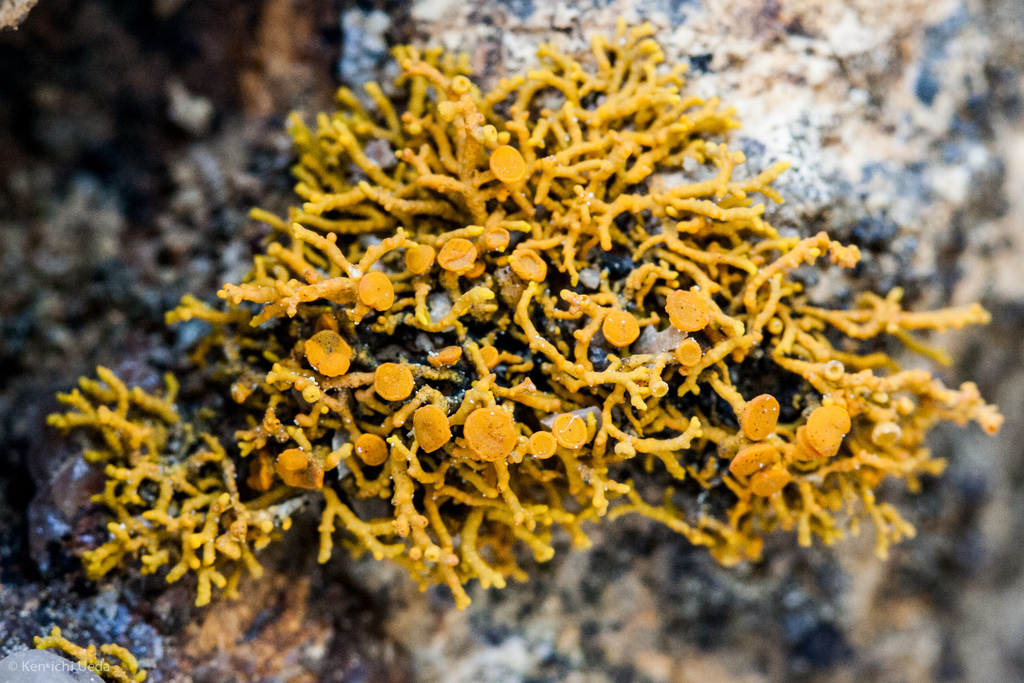
Coral Firedot Lichen
Polycauliona coralloides
Polycauliona coralloides, the coral firedot lichen, is a species of small fruticose (bushy), saxicolous (rock-dwelling) lichen in the family Teloschistaceae. First formally described in 1866, it was later shuffled to a few different genera in its taxonomic history before ending up in Polycauliona, a genus resurrected from taxonomic obscurity in the molecular phylogenetics era. The lichen occurs on seaside rocks in the intertidal spray zone of California and northwestern Mexico. The species is readily recognized due to its distinctive coral-like form–its thallus grows as a tangle of orange, filamentous branches.
From the article Polycauliona coralloides on Wikipedia (CC BY-SA), quoted section by section
Description
Polycauliona coralloides is a dwarf-fruticose lichen that forms dense to loose cushions up to 2 cm (13⁄16 in) in diameter and 8 mm (5⁄16 in) in height. Its branches are terete, dichotomous (or at least somewhat so) and can be erect, arched, or almost prostrate; they measure about 0.4 mm in diameter and are round and bumpy. The thallus is yellow to orange-yellow and may have pseudocyphellae in small depressions. Initially, P. coralloides forms elongated thallus lobes that adhere closely to the substrate, but over time, it evolves into a distinctly subfruticose thallus. Apothecia are fairly common, zeorine, and can be at the ends of branches or long them. Their disk color is slightly darker than that of the thallus. The spores are polaribilocular and ellipsoid, with a very thin septum. Chemically, the species is characterized by the presence of parietin as the major pigment, along with small amounts of emodin, teloschistin, parietinic acid, and fallacinal. The thallus and apothecia react K+ (purple), while the medulla shows negative reactions to standard chemical spot tests.
Similar species. Polycauliona coralloides is often confused with Xanthoria cf. candelaria and Caloplaca thamnodes. X. cf. candelaria differs by having flat lobes with an upper and lower surface and is mostly sorediate, which C. coralloides never is. C. …
Range & habitat
Polycauliona coralloides is a strictly littoral species, found close to the seashore, predominantly on hard rocks and mainly on vertical surfaces. It typically grows in the lower part of the supralittoral zone within a narrow vertical range. The species often occupies locations closer to the shore than Caloplaca rosei and Caloplaca brattiae and avoids sites exposed to bird manuring. As might be expected for a littoral species, it is quite tolerant to sea salt. The distribution of P. coralloides extends from northern Baja California, Mexico, to northern Oregon. Its presence further south is possible, but not likely further north due to unsuitable habitats in these regions. It has also been documented in Channel Islands National Park. Stigmidium hesperium is a lichenicolous fungus, first described in 2009, that parasitises Polycauliona coralloides. Infection by the fungus results in erosion and bleaching of the thallus and apothecia.
== References ==
Wikipedia: “Habitat, distribution, and ecology”
Where it lives
Recorded sightings
—
geo-referenced records in GBIF, from museums, herbaria and field observers.
Drag the globe to turn it. Dots are where records exist, not a range map; darker means more records.
In the stacks
Searching the stacks…
Every page naming Polycauliona coralloides in the Biodiversity Heritage Library →
This page is assembled live from iNaturalist, GBIF, Wikipedia, the Source Library and the Internet Archive. It is not yet part of the hand-edited codex. iNaturalist taxon 463826.