- Fungi Including Lichens
- ›Ascomycete Fungi
- ›Sac Fungi and Lichens
- ›Common Lichens
- ›Shield Lichens, Sunburst Lichens, Rosette Lichens, and Allies
- ›shield lichens, rim lichens, and allies
- ›Ramboldiaceae
- ›Ramboldia
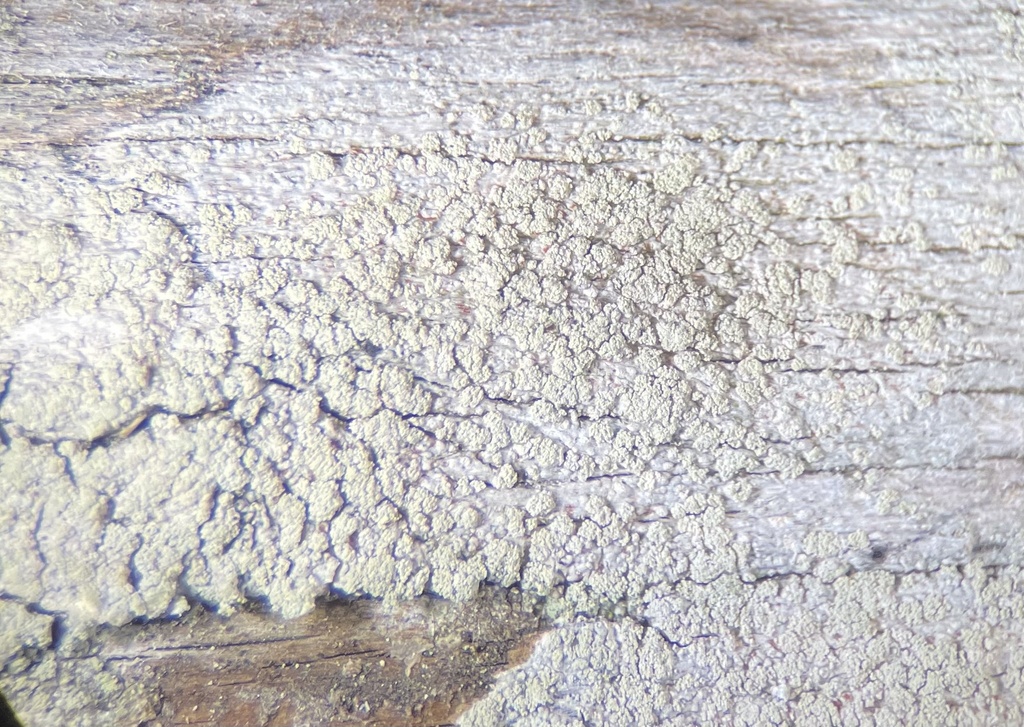
Ramboldia blochiana
Ramboldia blochiana is a species of corticolous (bark-dwelling), crustose lichen in the family Ramboldiaceae. The species is characterized by a sorediate thallus and shares chemical and morphological characteristics with the widespread Ramboldia russula, but it also possesses distinct chemical components and a unique geographical distribution. Though it is found across tropical and subtropical regions of the New World on various substrates, its distribution might be wider than currently known due to collection biases against sterile, asexually reproducing crustose lichens.
From the article Ramboldia blochiana on Wikipedia (CC BY-SA), quoted section by section
Description
Ramboldia blochiana features a superficial thallus that ranges in color from creamy white to dark gray and can be thin and continuous or thicker with irregular areoles. This thallus, unique among its counterparts, is sorediate, with soredia stemming from pustular soralia. The species' apothecia are biatorine and bright red, becoming irregular in shape as they mature. Its ascospores are hyaline, narrowly ellipsoid, and non-halonate. Lichexanthone, fumarprotocetraric acid, secalonic acid, and russulone are chemical substances present in this lichen species. Ramboldia blochiana is considered the sorediate counterpart to Ramboldia russula, sharing the same chemistry and apothecial morphology. There are only three known members of the Ramboldia russula group that produce asexual propagules, R. arandensis, R. cinnabarina, and R. subcinnabarina. However, Ramboldia blochiana stands apart from these species by its unique chemical composition, and geographical distribution.
Range & habitat
This lichen species grows on a diverse range of corticolous substrates including Pinus, Vellozia, Vaccinium, and wood. It is dispersed across the tropical and subtropical regions of the New World, with known collections in Brazil, Venezuela, the Dominican Republic, Haiti, southeastern Coastal Plain and southern Appalachian Mountains in the US, and Mexico. The authors suggest that the actual distribution of Ramboldia blochiana may be broader, as sterile asexually reproducing crustose lichens often face collection bias and thus there is often insufficient data to determine their full range.
== References ==
Wikipedia: “Habitat and distribution”
Where it lives
Recorded sightings
—
geo-referenced records in GBIF, from museums, herbaria and field observers.
Drag the globe to turn it. Dots are where records exist, not a range map; darker means more records.
In the stacks
Searching the stacks…
Every page naming Ramboldia blochiana in the Biodiversity Heritage Library →
This page is assembled live from iNaturalist, GBIF, Wikipedia, the Source Library and the Internet Archive. It is not yet part of the hand-edited codex. iNaturalist taxon 463967.