- Animals
- ›Arthropods
- ›Hexapods
- ›Insects
- ›Winged and Once-winged Insects
- ›Grasshoppers, Crickets, and Katydids
- ›Katydids, Crickets, and Allies
- ›Katydids, wētā, and allies
- ›Tettigonioidea
- ›Katydids
- ›Coneheads and Meadow Katydids
- ›Common Meadow Katydids
- ›Conocephalus
- ›Anisoptera
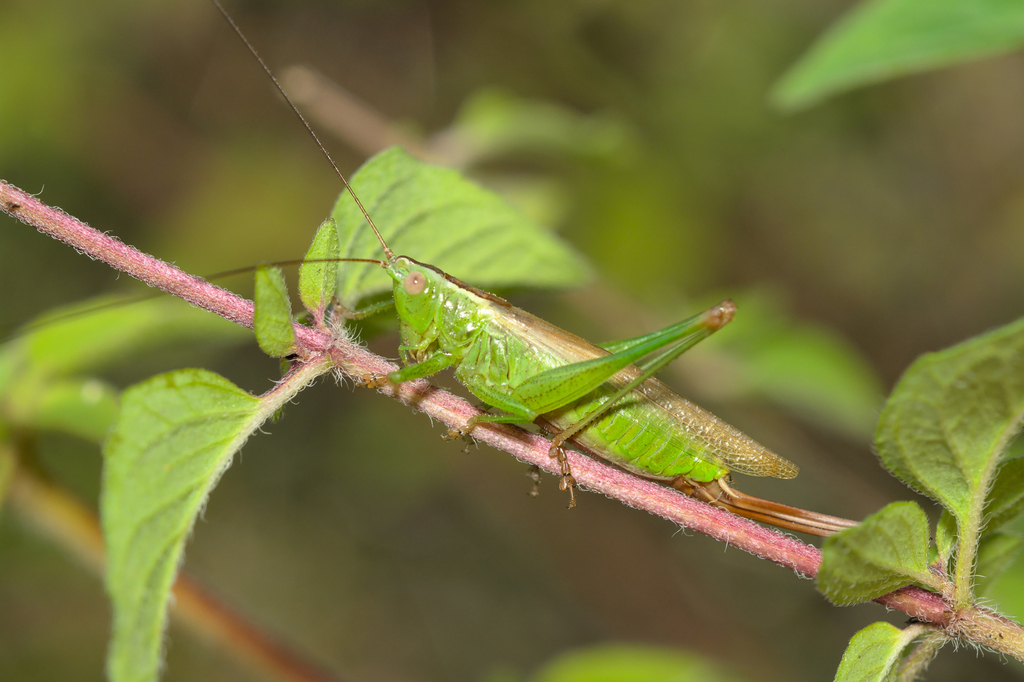
Long-winged Conehead
Conocephalus fuscus
Conocephalus fuscus, the long-winged conehead, is a member of the family Tettigoniidae, the bush-crickets and is distributed through much of Europe and temperate Asia. This bush-cricket is native to the British Isles where it may confused with the short-winged conehead (Conocephalus dorsalis). These two species are phenotypically similar; however, the distinguishing factor between the two is the fully developed set of wings the long-winged conehead possesses that allows for flight. In the short-winged coneheads the hind wings are shorter than the abdomen, causing the wings to be vestigial and the species is incapable of flight. For this reason it is hard to discriminate between the two species during the early stages of their life cycle before the wings have fully developed. The colouration of the conehead is typically a grass green with a distinctive brown stripe down its back, though there are some brown phenotypes.
From the article Conocephalus fuscus on Wikipedia (CC BY-SA), quoted section by section
Description
The body of bush-crickets is covered by a protective exoskeleton and is divided into three parts: the head, thorax, and abdomen. The topmost segment of the thorax, the pronotum, is shaped like a saddle and is primarily used for protection. Bush-crickets are also equipped with large hind legs for jumping and biting mouth parts for grip and protection. The phenotypic aspects that are characteristic to this family of insects are the antennae, which typically exceed the length of their body, and the straight sword shaped ovipositor that the females use for laying eggs. The body of C. fuscus is 16–22 millimetres (0.63–0.87 in) when it reaches maturity. Its hind wings are longer than its forewings, and they both reach beyond the tip of the abdomen. A distinctive dorsal stripe runs down the thorax, covering its head and pronotum, which is 12–17 millimetres (0.47–0.67 in) long. Adults have a slender grass-green body, brown wings, brown ovipositor, a reddish-brown abdomen, and a dark-brown stripe that edges white near the thorax. Nymphs differ slightly in colouration with a light-green body and a white-margined black stripe. C. fuscus is a wing polymorphic species. Most wing-dimorphic tettigoniids have a brachypterous (short-winged) form and a macropterous (long-winged) form. However, since C. …
Range & habitat
C. fuscus can be found in parts of France, Italy, and the Netherlands, but it has made is biggest appearance in the United Kingdom. When the species was first discovered in Britain in the 1940s it was confined to the South Coast but in the 1980s there was dramatic population growth and its range expanded more than 150 miles in 20 years. Today the long-winged conehead can be found in northwestern parts of the country beyond the River Thames and as far west as Wales. The increase in the global climate over the past few decades has had a significant impact on the spread of this species. The northward range expansion coincides with the worldwide increase in temperature due to the greenhouse effect. Universally, species respond to fluctuations in climate by increasing or contracting their breeding ranges. If the opportunity arises for a species to expand its realised niche due to favourable conditions that have become available, it is advantageous for them to do so. In the 1950s the climate began to cool in the northern hemisphere, causing longer winters in southern Europe. This kept the long-winged coneheads in the southern part of the UK, where they were first sited, for a period of time. …
Wikipedia: “Distribution and habitat”
What it does
This species is omnivorous, though its diet is mostly vegetarian. The long-winged conehead feeds primarily on grasses as well as small invertebrates such as aphids and caterpillars.
Wikipedia: “Feeding”
Listen
Looking for field recordings…
Where it lives
Recorded sightings
—
geo-referenced records in GBIF, from museums, herbaria and field observers.
Drag the globe to turn it. Dots are where records exist, not a range map; darker means more records.
In the stacks
Searching the stacks…
Every page naming Conocephalus fuscus in the Biodiversity Heritage Library →
This page is assembled live from iNaturalist, GBIF, Wikipedia, the Source Library and the Internet Archive. It is not yet part of the hand-edited codex. iNaturalist taxon 466317.