- Plants
- ›Vascular Plants
- ›flowering plants
- ›Dicots
- ›pinks, cactuses, and allies
- ›Amaranth family
- ›saltbush subfamily
- ›Chenopodieae
- ›Chenopodium
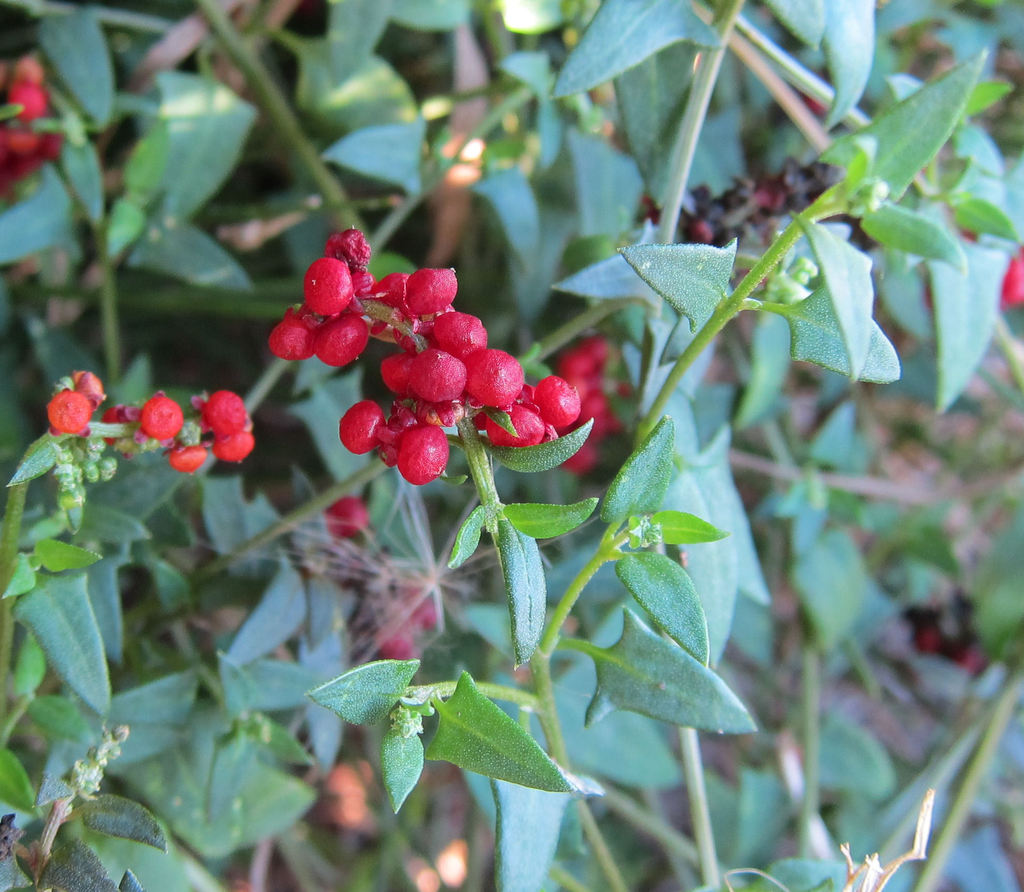
Climbing saltbush
Chenopodium nutans
Chenopodium nutans (Syn Einadia nutans, Rhagodia nutans), known by its common name of climbing saltbush or nodding saltbush, is a climbing groundcover native to Australia.
Plants form a blanket on the surface, climbing over logs and up trees to a height of around 1 metre. Each plant grows to around one metre in diameter. The small leaves are semi-succulent, and have a distinctive arrowhead shape. They grow along long, vine-like branches spreading out form the centre of the plant. Both the leaves and the branches are of a light green colour.
From the article Chenopodium nutans on Wikipedia (CC BY-SA), quoted section by section
At the table
The plant was boiled along with other species of saltbush for use as a greens substitute by early European settlers in the Adelaide region. The plant is easily propagated, making it a particularly attractive and useful plant for revegetation projects. It has recently been enjoying increasing popularity as a garden plant, for its low maintenance, low water usage properties.
== References ==
Wikipedia: “Human uses”
Where it lives
Recorded sightings
—
geo-referenced records in GBIF, from museums, herbaria and field observers.
Drag the globe to turn it. Dots are where records exist, not a range map; darker means more records.
In the stacks
Searching the stacks…
Every page naming Chenopodium nutans in the Biodiversity Heritage Library →
This page is assembled live from iNaturalist, GBIF, Wikipedia, the Source Library and the Internet Archive. It is not yet part of the hand-edited codex. iNaturalist taxon 467323.