- Plants
- ›Vascular Plants
- ›flowering plants
- ›Dicots
- ›Sunflowers, Bellflowers, Fanflowers, and Allies
- ›Sunflowers, Daisies, Asters, and Allies
- ›chicories, dandelions, and allies
- ›Lettuce, Chicory, Dandelion and Salsify Tribe
- ›Warioniinae
- ›Warionia
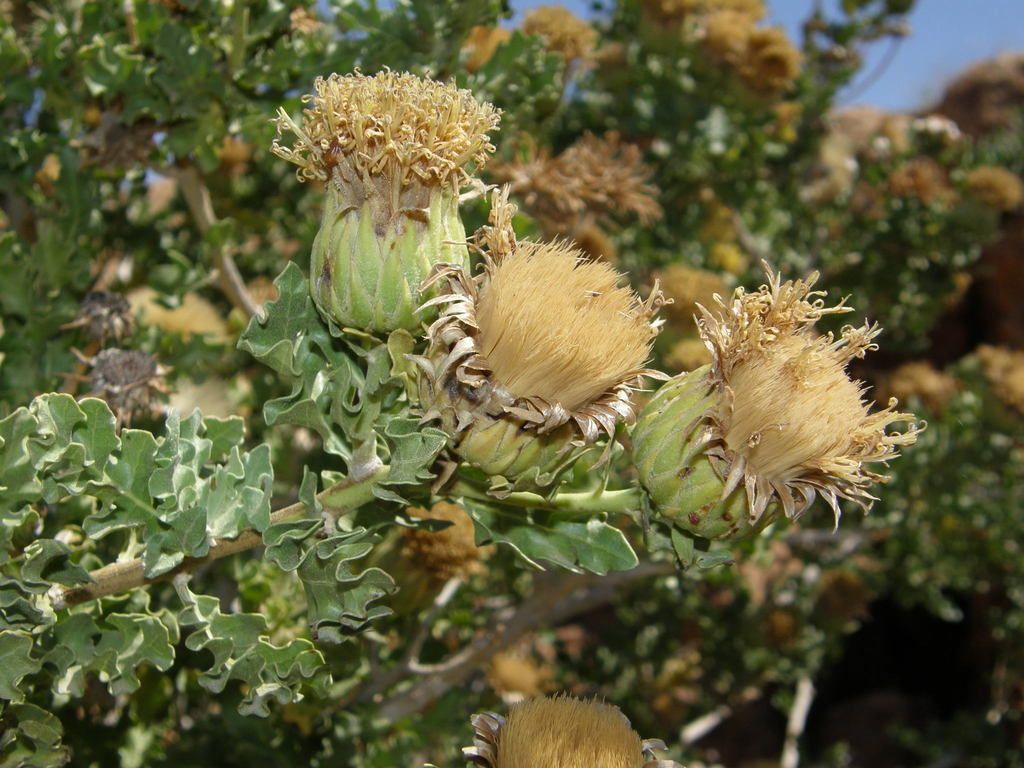
Warionia saharae
Warionia is a genus in the tribe Cichorieae within the family Asteraceae. The only known species is Warionia saharae, an endemic of Algeria and Morocco, and it is locally known in the Berber language as afessas, abessas or tazart n-îfiss. It is an aromatic, thistle-like shrub of ½–2 m high, that contains a white latex, and has fleshy, pinnately divided, wavy leaves. It is not thorny or prickly. The aggregate flower heads contain yellow disk florets. It flowers from April till June. Because Warionia is deviant in many respects from any other Asteraceae, different scholars have placed it hesitantly in the Cardueae, Gundelieae, Mutisieae, but now genetic analysis positions it as the sister group to all other Cichorieae.
From the article Warionia on Wikipedia (CC BY-SA), quoted section by section
Description
Wariona is an aromatic shrub, usually between ½–2 m, occasionally only 15 cm or up to 3 m high, that has a network of latex-carrying canals throughout the plant with sticky, white, milky latex. It also has oil canals. It carries glandular hairs that consist of two parallel series of a few cells on top of each other (or biserial). It has thirty-four chromosomes (2n = 34).
Root, stem and leaf. Warionia saharae has a light brown taproot, reminiscent of a parsnip. The youngest plants consist above ground of a rosette of oblanceolate, dentate leaves. Older plants develop stems, which are initially green but eventually become woody and develop a corky, grey bark. With about 75 μm, the diameter of the wood vessels is at the high end of the range within the Asteraceae. Wood fibers are relatively thick-walled. The wavy, somewhat fleshy leaves are set alternating along the stems, 2–13 cm long and 1–3 cm wide, oblong to oblanceolate. They are sinuate to pinnately partite, while the main vein in each lobe extends into an acute tip. The leaf is pinnately veined. While the leaf blade narrows at the foot, it still extends to the stem. The leaf surface is softly hairy with glandular hairs particularly near the edge.
Inflorescence. The erect flowerheads stand individually at the tip of the stems or with two or three together. Each is 3–4 cm long, 4½–6 cm wide, and contains disk florets only. …
Range & habitat
Warionia saharae is an endemic of Morocco between Tamanar, Ifni, Erfoud and Figuig, and of Algeria, in the Naâma Province and the Béni Ounif District. It grows on slopes of the High Atlas, Anti-Atlas and Saharian Atlas, along the coast of southern Morocco, and in the desert, on mafic and siliceous rock, at altitudes between sea level and 1300 m. At Ifni it was found growing together with Euphorbia echinus, E. obtusifolia and Senecio anteuphorbium. The species loses its leaves when seasonal water availability drops below a threshold in summer, but in cultivation it keeps its leaves as long as it is watered adequately. In the wild it occurs to be pest-free, except for browsing goats which can have a detrimental impact on it. Pollen matures before the styles are fertile and this makes the species dependent on cross-pollination. As individuals usually appear distant from each other and pollinating insects may be scarce, seed fertility may be low.
Wikipedia: “Distribution and ecology”
How it is grown
The species can be grown from seed in free draining compost at 30 °C by day and 15 °C at night. It may grow to 1½ m in its first year, at which stage the stems become woody. In cultivation, whitefly may be a problem and when it is damp, mildew may occur on the leaves.
Wikipedia: “Cultivation”
In human culture
The genus name Warionia is named in honor of Adrien Warion (1837–1880), a French military physician and botanist who made extensive collections while stationed in North Africa. The specific epithet saharae refers to the Sahara desert, in a small part of which this plant naturally occurs.
Wikipedia: “Etymology”
Where it lives
Recorded sightings
—
geo-referenced records in GBIF, from museums, herbaria and field observers.
Drag the globe to turn it. Dots are where records exist, not a range map; darker means more records.
In the stacks
Searching the stacks…
Every page naming Warionia saharae in the Biodiversity Heritage Library →
This page is assembled live from iNaturalist, GBIF, Wikipedia, the Source Library and the Internet Archive. It is not yet part of the hand-edited codex. iNaturalist taxon 467542.