- Plants
- ›Vascular Plants
- ›flowering plants
- ›Dicots
- ›Buttercups, Poppies, and Allies
- ›barberry family
- ›Berberidoideae
- ›Berberideae
- ›Berberis
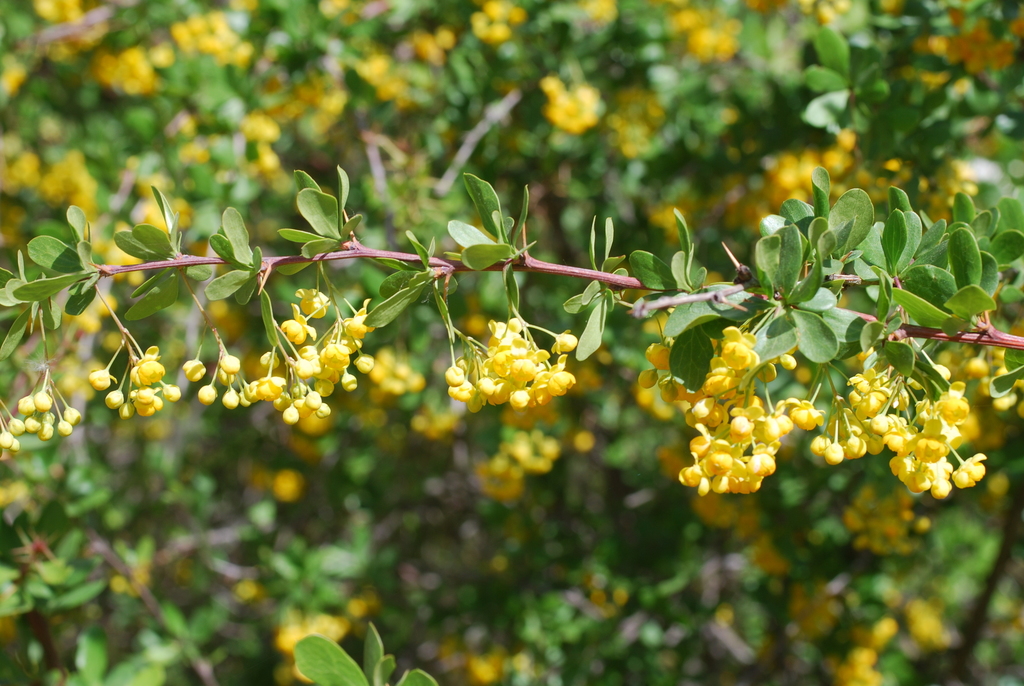
Berberis hispanica
Berberis vulgaris subsp. australis, synonym Berberis hispanica, is a shrub belonging to the family Berberidaceae and the genus Berberis (pronounced bẽr’ber-is). It is a woody plant and parts of the plant are considered toxic, although the berries are edible and juicy.
From the article Berberis vulgaris subsp. australis on Wikipedia (CC BY-SA), quoted section by section
Description
Berberis vulgaris subsp. australis is a deciduous shrub growing up to 3 m (10 ft) high. The stems and young branches are reddish or dark purple. The bark is covered with 3 to 5 branched spines, which are bracts or modified leaves. The central spine is usually larger. The leaves are oval, arranged in fascicles on short peduncles originated in the axils of the spines. The leaves are thick, leathery, similar to the size of the spines, and 1 to 5 cm long. Each leaf is attached to a short petiole. The flowers are yellow. They form raceme inflorescence and make clusters of 3 to 9 flowers attached in a long panicle. Each flower is about 6 mm in diameter. The sepals are oval and entire. The petals are similar to sepals. The interiors of the flowers are filled with nectar at base. The flowers usually contain six stamens. The fruits are oblong lilacs or blue berries. The fruits are 1 cm long and covered with wax. The berries contain two seeds. The flowers are mature from April to June.
Range & habitat
Berberis vulgaris subsp. australis is native southern Spain, Morocco and Algeria. It appears from 1000 m or up to 2000 m in elevation. It is found on hedges of mountains overlooking the Mediterranean.
Wikipedia: “Distribution”
At the table
The root and flowers have been used to extract yellow dyes. The fruits are sweet and sour tastes. The fruits have been used to produce syrups and soft drinks. The fruits are rich in Vitamin C. The bark contains an alkaloid, Berberine. It stimulates the uterus and the intestine. It may cause liver complaints, rheumatism and sciatica. Some species of the genus Berberis are used as ornamental plants. Barberry is often parasitized by the fungus Puccinia graminis and becoming part of the life cycle of the fungus. For this reason, barberry was removed from many places.
== References ==
Wikipedia: “Uses”
Where it lives
Recorded sightings
—
geo-referenced records in GBIF, from museums, herbaria and field observers.
Drag the globe to turn it. Dots are where records exist, not a range map; darker means more records.
In the stacks
Searching the stacks…
Every page naming Berberis hispanica in the Biodiversity Heritage Library →
This page is assembled live from iNaturalist, GBIF, Wikipedia, the Source Library and the Internet Archive. It is not yet part of the hand-edited codex. iNaturalist taxon 467697.