- Plants
- ›Vascular Plants
- ›flowering plants
- ›Dicots
- ›myrtles, evening primroses, and allies
- ›myrtle family
- ›Myrtoideae
- ›Chamelaucieae
- ›Chamelauciinae
- ›Homoranthus
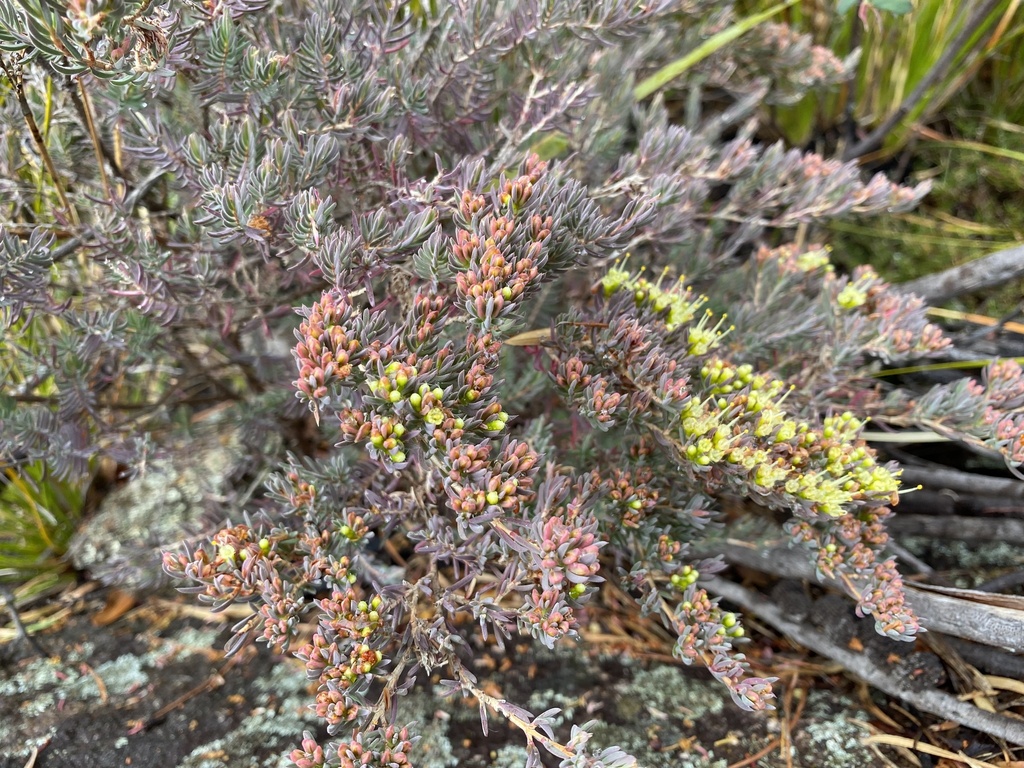
Homoranthus papillatus
Homoranthus papillatus, commonly known as mouse bush, is a flowering plant in the family Myrtaceae and is endemic to a small area in southern Queensland. It is a compact shrub with curved, linear leaves and pale yellow flowers arranged in upper leaf axils.
From the article Homoranthus papillatus on Wikipedia (CC BY-SA), quoted section by section
Description
Homoranthus papiillatus is small, prostrate, spreading shrub to 1 m (3 ft 3 in) high. The leaves are arranged opposite on a short petiole, linear, curved, about 10 mm (0.39 in) long with dense warty protuberances on the surface. The flowers are borne singly in upper leaf axils, light lemon-yellow, calyx tube 4 mm (0.16 in) long, 1 mm (0.039 in) in diameter, smooth, ribbed, five orbicular petals about 1 mm (0.039 in) in diameter, and a protruding style 6–9 mm (0.24–0.35 in) long, pedicel 1–2 mm (0.039–0.079 in) long. The bracts are 5 mm (0.20 in) long, dry and fall off when the flower opens. Flowering occurs from September to November and the dry fruit forms September to December.
Range & habitat
Mouse bush is endemic to Mount Norman in Girraween National Park, Queensland where it grows in heath on skeletal sandy soils among crevices of granite outcrops.
Wikipedia: “Distribution and habitat”
Where it lives
Recorded sightings
—
geo-referenced records in GBIF, from museums, herbaria and field observers.
Drag the globe to turn it. Dots are where records exist, not a range map; darker means more records.
In the stacks
Searching the stacks…
Every page naming Homoranthus papillatus in the Biodiversity Heritage Library →
This page is assembled live from iNaturalist, GBIF, Wikipedia, the Source Library and the Internet Archive. It is not yet part of the hand-edited codex. iNaturalist taxon 468858.