- Plants
- ›Vascular Plants
- ›flowering plants
- ›Dicots
- ›myrtles, evening primroses, and allies
- ›myrtle family
- ›Myrtoideae
- ›Chamelaucieae
- ›Chamelauciinae
- ›Homoranthus
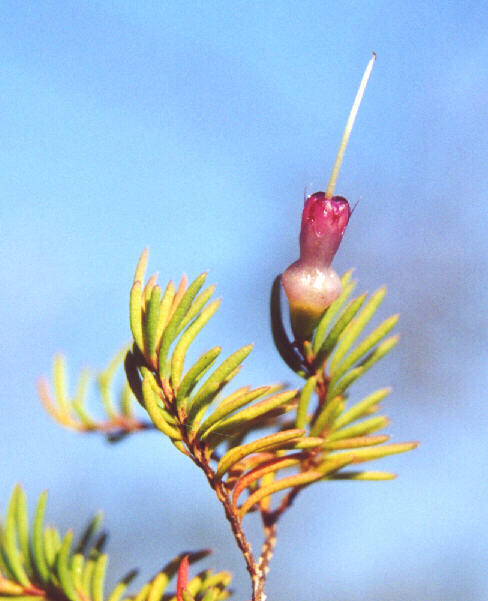
Homoranthus decasetus
Homoranthus decasetus is a plant in the myrtle family Myrtaceae and is endemic to a small area in central Queensland. It has small, thin leaves and flowers that fade to purple as they age.
From the article Homoranthus decasetus on Wikipedia (CC BY-SA), quoted section by section
Description
Homoranthus decasetus is an upright shrub that typically grows to a height of 2 m (6 ft 7 in). The leaves are arranged in opposite pair and are club-shaped, curved, circular in cross-section, up to 12 mm (0.47 in) long and about 1 mm (0.039 in) wide. The flower are arranged singly on short branchlets in leaf axils. The flower buds have bracteoles up to 3 mm (0.12 in) long at their base and that fall off as the flower develops. The calyx tube is urn-shaped, with five ribs on the outside. Each of the five sepals has two bristles up to 4 mm (0.16 in) long on its tip. The petals are round, about 2 mm (0.079 in) in diameter and ten stamens alternate with ten staminodes that are attached to the base of the calyx. As the flowers age they turn from white to red or purple. The fruit is about the same size as the flower and contains a single winged seed. Flowering and fruiting occur sporadically throughout the year.
Range & habitat
Restricted to area between Rolleston, Theodore and Taroom in central Queensland. Grows usually in rocky woodland on shallow sandy soils.
Wikipedia: “Distribution and habitat”
Where it lives
Recorded sightings
—
geo-referenced records in GBIF, from museums, herbaria and field observers.
Drag the globe to turn it. Dots are where records exist, not a range map; darker means more records.
In the stacks
Searching the stacks…
Every page naming Homoranthus decasetus in the Biodiversity Heritage Library →
This page is assembled live from iNaturalist, GBIF, Wikipedia, the Source Library and the Internet Archive. It is not yet part of the hand-edited codex. iNaturalist taxon 468859.