- Animals
- ›Arthropods
- ›Hexapods
- ›Insects
- ›Winged and Once-winged Insects
- ›Beetles
- ›Water, Rove, Scarab, Long-horned, Leaf, and Snout Beetles
- ›Cucujiform Beetles
- ›Leaf Beetles and Allies
- ›Leaf Beetles
- ›Skeletonizing Leaf and Flea Beetles
- ›Flea Beetles
- ›Psylliodes
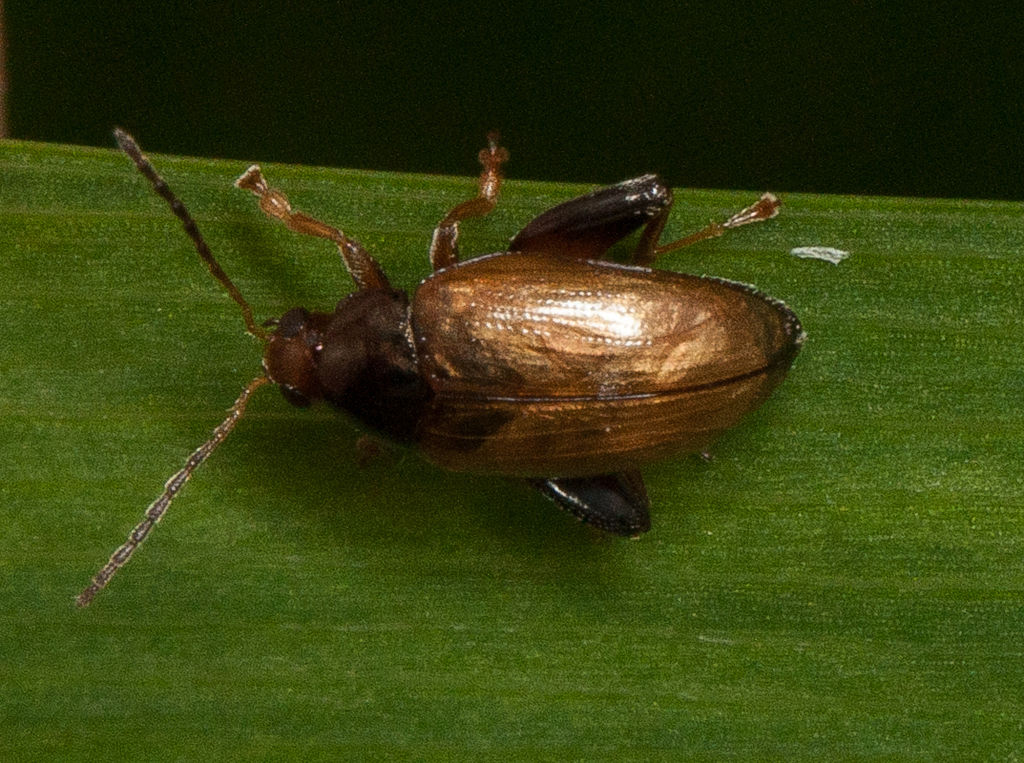
Cabbage-stem flea beetle
Psylliodes chrysocephala
Psylliodes chrysocephala or Psylliodes chrysocephalus, commonly known as the cabbage-stem flea beetle, is a species of leaf beetle situated in the subfamily Galerucinae and the tribe Alticini (flea beetles).
From the article Psylliodes chrysocephala on Wikipedia (CC BY-SA), quoted section by section
Description
P. chrysocephala measures 3.0–4.0 mm in length. It is variably coloured, but most often a dark metallic blue. Like all flea beetles it has large hind femora which it can use to jump. These are orange-red in colour with the hind femora darkened. It is differentiated from other members of the genus through a lack of anterior angles on its pronotum, the punctures on top of the head being as coarse as those on the elytra, and its first front tarsal segment being equal in length to its third.
Range & habitat
It is native to the Western Palaearctic, including Macaronesia, Cape Verde and North Africa and has been introduced into Canada.
Wikipedia: “Distribution”
What it does
P. crysocephala can be found in various habitats, depending on the availability of a host plant. It is particularly associated with wild and cultivated members of the plant family Brassicaceae. It has been directly associated with Brassica napus, B. nigra (black mustard), B. oleracea (cabbages, cauliflowers), B. rapa (turnip rape), Nasturtium officinale (watercress), Raphanus sativus (radish), Sinapis alba (white mustard), S. arvensis (wild mustard), and Tropaeolum majus (common nasturtium).
As an arable pest. It is a serious pest of rape in northern Europe. In central parts of Europe it has a cyclic appearance with peaks in populations at intervals of about seven years. In the UK, it is the most important establishment pest of rape, leading to yield losses of up to 20%.
Wikipedia: “Behaviour and habitat”
Listen
Looking for field recordings…
Where it lives
Recorded sightings
—
geo-referenced records in GBIF, from museums, herbaria and field observers.
Drag the globe to turn it. Dots are where records exist, not a range map; darker means more records.
In the stacks
Searching the stacks…
Every page naming Psylliodes chrysocephala in the Biodiversity Heritage Library →
This page is assembled live from iNaturalist, GBIF, Wikipedia, the Source Library and the Internet Archive. It is not yet part of the hand-edited codex. iNaturalist taxon 468878.