- Animals
- ›Molluscs
- ›Bivalves
- ›Autobranchia
- ›Pteriomorphia
- ›Mytilida
- ›True Mussels
- ›mussels
- ›Crenellinae
- ›Mytella
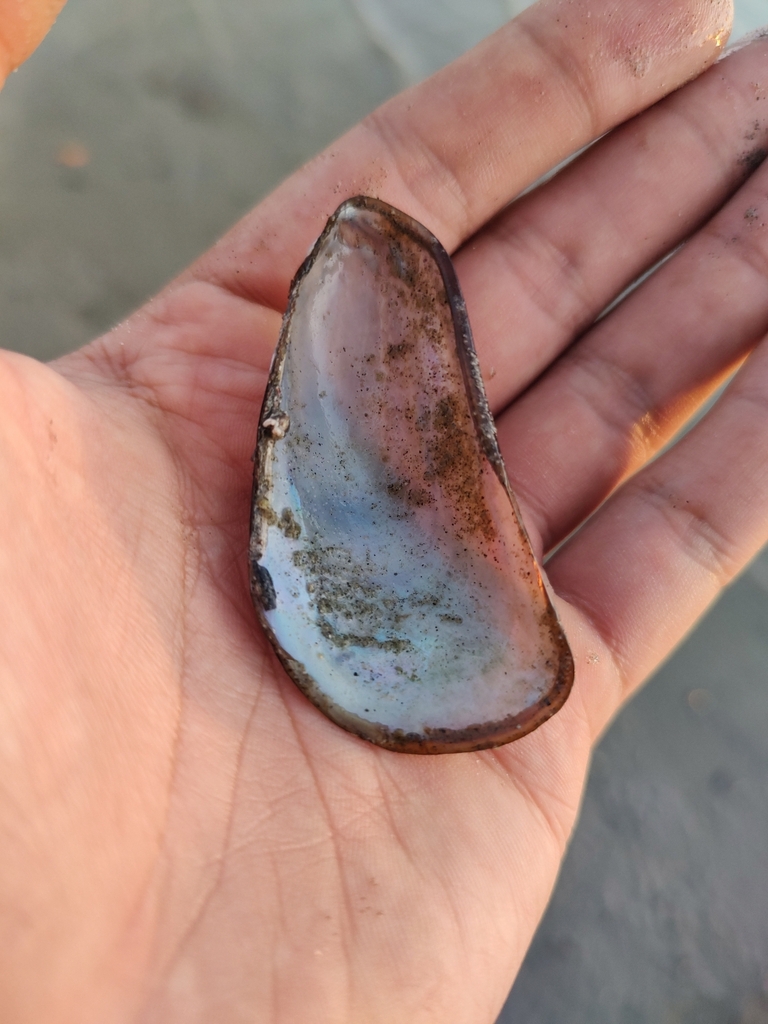
Bicolor Mussel
Mytella guyanensis
Mytella guyanensis is a species of tropical saltwater mussel, marine bivalve molluscs in the family Mytilidae. This species has been referred to colloquially as the “Trinidad Swamp Mussel” —although not formally confirmed as the common name. It was first described in detail by the French naturalist Jean Baptiste Lamarck in 1819.
From the article Mytella guyanensis on Wikipedia (CC BY-SA), quoted section by section
Description
The size of this mussel may vary depending on where an individual organism is found. Originally, sources indicated that shells of this species can reach a length of 50–60 millimetres (2.0–2.4 in). It has since been observed that matured M. guyanensis specimen have been recorded with lengths as small as 18 millimeters (mm), and their maximum lengths can range from 65 - 86.2 mm (Brazil) or 67.8 – 84.3 mm (Costa Rica and Trinidad). The average growth rate of an individual within this species has been observed to be 3.76 to 6.23 mm per month within the first year when growing in the wild, but when cultured can reach an average growth rate of 5.77 mm per month. There has been no significant difference recorded between the size of males or females of M. guyanensis. Shell coloration of this species is consistent between males and females, which both present as dark brown. It has been observed that distinct color patterns can be present in individuals that are shorter than 40mm. The shape of the shells of this organism are widest in the central axis between the dorsal and ventral sides. Shell texture is typically smooth, although older organisms can develop rough shells due to erosive interactions with the substrates found in their environment.
Range & habitat
Lamarck initially observed M. guyanensis in the western region of Trinidad in an area known as the Caroni Swamp, which is a wetland habitat along the Caroni River. This initial record of the species gave rise to the name “Trinidad Swamp Mussel”, although since its discovery in other regions, the name became far less common. This saltwater mussel species has been found residing along the coastline from Baja California to Peru. Additionally, this species has been found thriving along the coastlines of Venezuela and Brazil. This species is thought to be present in Mexico, Brasil, Costa Rica, El Salvador, Australia, Tasmania, Macquarie Island, Jamaica, Panama, Peru and South Carolina. Little is currently known about the population density of this organism, but early estimates range from 1 to 200 mussels per meter squared. The typical sediment characteristics of the habitat in which M. guyanensis include firm, muddy sediment commonly associated with the roots of the Black Mangrove (Avicennia germinans), although this species has been observed to exist with regions of coarser substrates. Sediment type is a distinguishing feature of the habitat for this species considering its burying behavior. M. guyanensis has been found to bury themselves in a vertical position with a portion of their shell protruding from the sediment. …
Wikipedia: “Distribution”
Where it lives
Recorded sightings
—
geo-referenced records in GBIF, from museums, herbaria and field observers.
Drag the globe to turn it. Dots are where records exist, not a range map; darker means more records.
In the stacks
Searching the stacks…
Every page naming Mytella guyanensis in the Biodiversity Heritage Library →
This page is assembled live from iNaturalist, GBIF, Wikipedia, the Source Library and the Internet Archive. It is not yet part of the hand-edited codex. iNaturalist taxon 470497.