- Plants
- ›Vascular Plants
- ›flowering plants
- ›Dicots
- ›magnolias, nutmegs, and allies
- ›bolwarra family
- ›Eupomatia
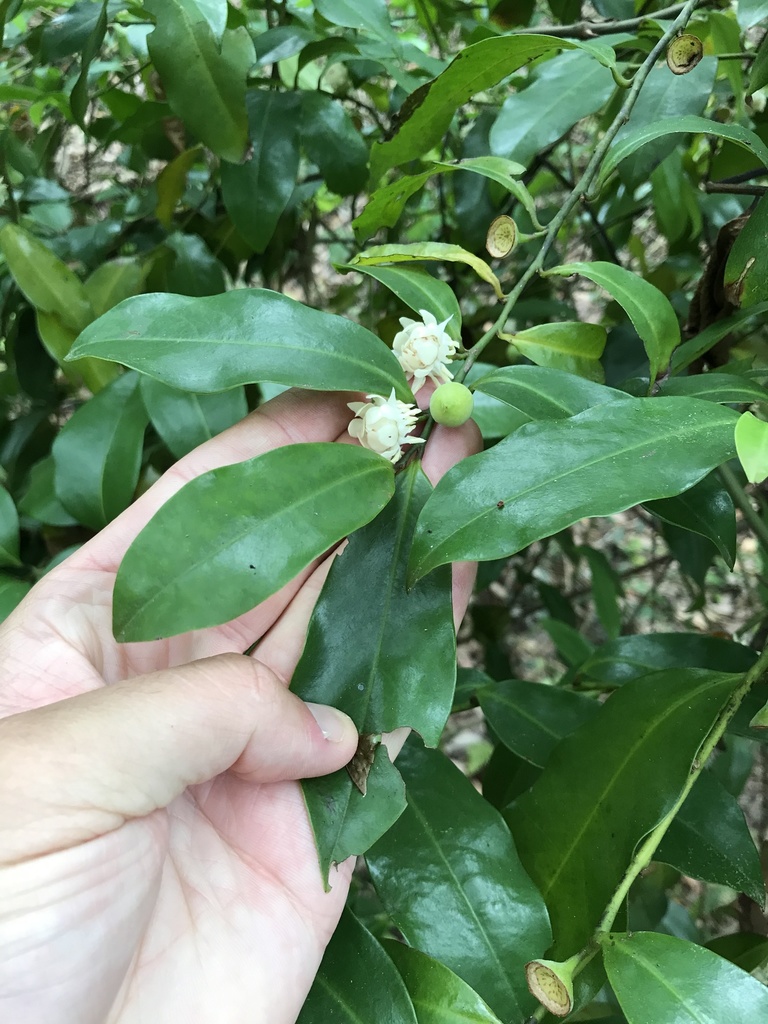
Bolwarra
Eupomatia laurina
Eupomatia laurina, commonly named bolwarra or sometimes native guava or copper laurel is a species of shrubs to small trees, of the Australian continent ancient plant family Eupomatiaceae. They often grow between 3 and 5 m (10 and 16 ft) tall, larger specimens may attain 15 m (50 ft) and a trunk diameter of 30 cm (12 in). They grow naturally in eastern Australia and New Guinea. In Australia, they grow as far south as Nowa Nowa in the humid forests of...
From the article Eupomatia laurina on Wikipedia (CC BY-SA), quoted section by section
Description
It grows to between 3 and 5 m (10 and 16 ft) tall, but larger specimens may attain a height of 15 m (50 ft) and a trunk diameter of 30 cm (12 in). It has glossy, ovate to elliptic leaves, from 5 to 20 cm (2 to 8 in) long. The branches bear globose to urn-shaped fruit which are green in colour and measure 15–20 mm (0.6–0.8 in) in diameter. They yellow when ripe and contain pale-coloured, edible, jelly-like flesh inside, with many non-edible seeds (similar appearance to guava contents).
Range & habitat
In Australia, it is found in humid forests of the east coast, from as far south as Nowa Nowa, Victoria, north through New South Wales and Queensland to Cape York Peninsula. In New Guinea, it is found throughout the island's eastern half (Papua New Guinea). It usually grows as an understory plant in rainforests or humid Eucalyptus forests.
Wikipedia: “Distribution and habitat”
What it does
Flowers are pollinated by small weevils, including Elleschodes hamiltoni and others in the same genus.
Wikipedia: “Ecology”
How it is grown
In cultivation E. laurina is frost sensitive and prefers a protected, semi-shaded site. It can be propagated from seed or cuttings. Cutting propagated trees produce fruit after two years. Seedlings take four to six years to fruit. Cuttings are not advised as a method of regeneration. Germination from fresh seed commences after around three weeks and completes after five weeks, with a high rate of germination.
Wikipedia: “Horticulture”
Where it lives
Recorded sightings
—
geo-referenced records in GBIF, from museums, herbaria and field observers.
Drag the globe to turn it. Dots are where records exist, not a range map; darker means more records.
In the stacks
Searching the stacks…
Every page naming Eupomatia laurina in the Biodiversity Heritage Library →
This page is assembled live from iNaturalist, GBIF, Wikipedia, the Source Library and the Internet Archive. It is not yet part of the hand-edited codex. iNaturalist taxon 470632.