- Animals
- ›Arthropods
- ›Hexapods
- ›Insects
- ›Winged and Once-winged Insects
- ›Mantises
- ›Extant Mantises
- ›Schizomantodea
- ›Hymenopoidea
- ›Flower Mantises
- ›Phyllocraniinae
- ›Phyllocrania
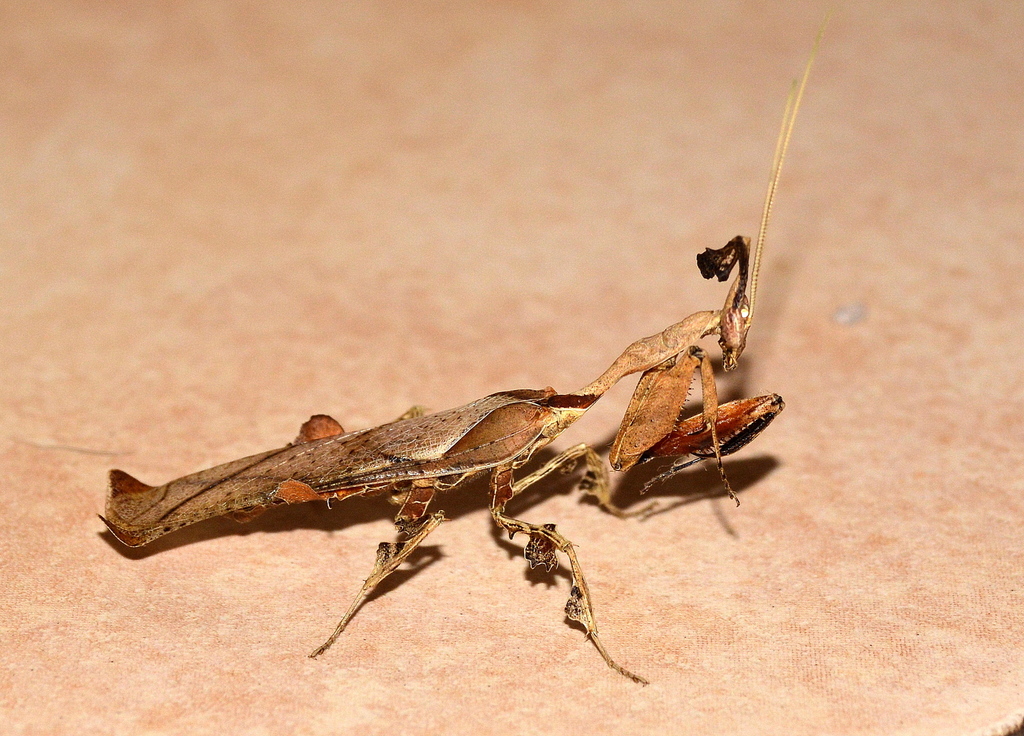
Common Ghost Mantis
Phyllocrania paradoxa
Phyllocrania paradoxa, common name ghost mantis, is a small species of mantis from Africa remarkable for its leaf-like body. It is one of the three species in the genus Phyllocrania. It is known for its distinct and exclusive camouflaged appearance of a dry weathered leaf.
From the article Phyllocrania paradoxa on Wikipedia (CC BY-SA), quoted section by section
Description
Compared to many other praying mantises, the ghost mantis is a "miniature species", growing to only about 45 to 50 mm (1.8 to 2.0 in) long. It occurs in various brownish shades from very dark brown (almost black) to greenish gray. An individual's colors change between molts and are also dependent on light and humidity levels. Phyllocrania paradoxa is camouflaged so as to appear as dead, dried-up leaf material. It has an elongated head, a flattened, extended prothorax, and leaf-like protrusions from its limbs. This mantis also has a forewing that looks like a desiccated leaf, and the "creases" in the wings are actually shadings of pigment. In the wild, the ghost praying mantis effectively blends in against dead leaves. Predators such as birds tend to overlook insects that resemble their background, and by staying still, the ghost praying mantis can go unnoticed. If threatened, big nymphs and adult females adopt thanatosis, i.e. they play dead, whereas adult males run or fly away. P. paradoxa oothecae can hatch out up to 36 young. First- and second-instar nymphs of this species are dark colored and use ant mimicry as a defense.
Sexual dimorphism. As with most or all species of mantises, P. paradoxa is sexually dimorphic, with females being larger than males. Females have six abdominal segments. Males are shorter, narrower, and have eight-segmented abdomens. …
Range & habitat
P. paradoxa has a wide range across the African continent and its islands and can be found in Angola, Cameroon, Cape Province, Congo Basin, Ethiopia, Ghana, Guinea, Ivory Coast, Kenya, Malawi, Madagascar, Mozambique, Namibia, Somalia, South Africa, Sudan, Tanzania, Togo, Transvaal, Uganda, and Zimbabwe.
Habitat. Ghost mantises inhabit dry areas, bushes, shrubs, and trees in the open.
Wikipedia: “Range”
Listen
Looking for field recordings…
Where it lives
Recorded sightings
—
geo-referenced records in GBIF, from museums, herbaria and field observers.
Drag the globe to turn it. Dots are where records exist, not a range map; darker means more records.
In the stacks
Searching the stacks…
Every page naming Phyllocrania paradoxa in the Biodiversity Heritage Library →
This page is assembled live from iNaturalist, GBIF, Wikipedia, the Source Library and the Internet Archive. It is not yet part of the hand-edited codex. iNaturalist taxon 474010.