- Plants
- ›Vascular Plants
- ›flowering plants
- ›Dicots
- ›Mints, Plantains, Olives, and Allies
- ›Acanthus Family
- ›Acanthoideae
- ›Ruellieae
- ›Strobilanthinae
- ›Strobilanthes
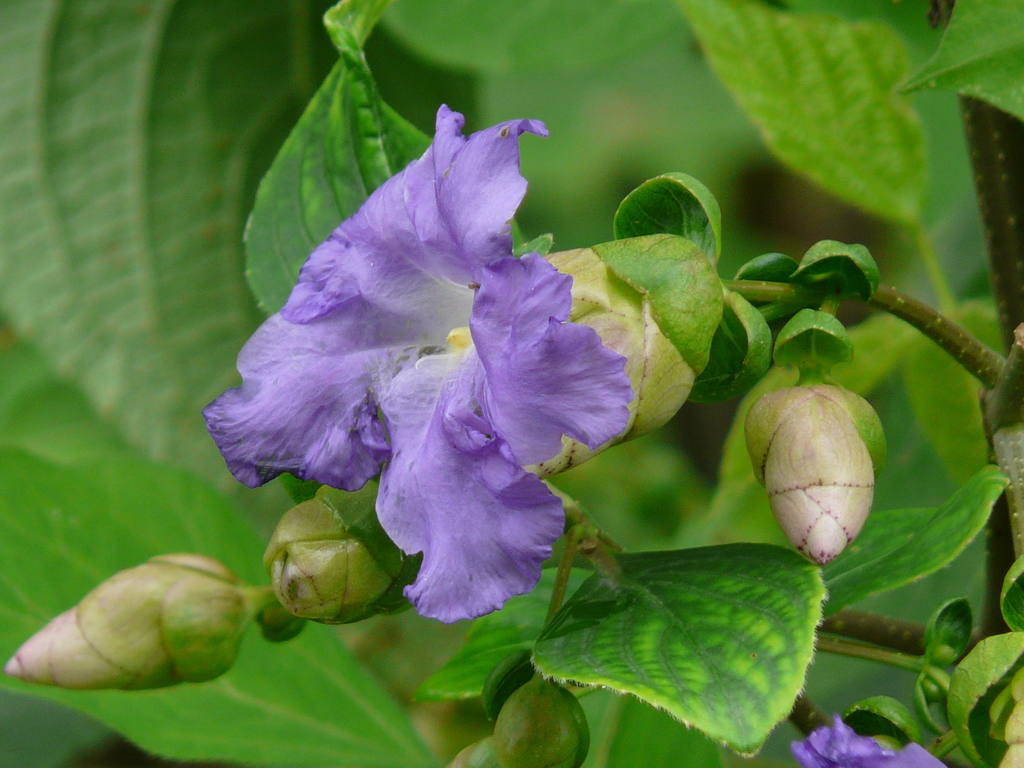
Karvi
Strobilanthes callosa
Strobilanthes callosa (Synonym: Carvia callosa (Nees) Bremek) is a shrub found mainly in the low lying hills of the Western Ghats, all along the west coast of India. Its standardized Hindi name is maruadona (मरुआदोना) which it is called in the state of Madhya Pradesh where it is also found. In the state of Maharashtra, in the Marathi language, and other local dialects and in the neighboring state of Karnataka, the shrub is locally known as karvi (कारवी), sometimes spelled in English as karvy.
This shrub belongs to the genus Strobilanthes which was first scientifically described by Nees in the 19th century. The genus has around 350 species, of which at least 46 are found in India.
From the article Strobilanthes callosa on Wikipedia (CC BY-SA), quoted section by section
Description
It is a large shrub, sometimes attaining 6–20 ft in height and 21⁄2 inches in diameter and flowers between July and September. This plant is recognized for the fact that it takes nearly a decade for the bloom cycle to occur. Its leaves are home to several insects including caterpillars and snails which feed on it. The shrub has an interesting life cycle; It comes alive and green every year with the advent of monsoon, but once the rainy season is over, all that is left is dry and dead-looking stems. This pattern repeats itself for seven years, but in the eighth year the plant bursts into mass flowering. Plants that bloom at long intervals like Strobilanthes callosa are known as plietesials, the term plietesial has been used in reference to perennial monocarpic plants “of the kind most often met with in the Strobilanthinae” (a subtribe of Acanthaceae containing Strobilanthes and allied genera) that usually grow gregariously, flower simultaneously following a long interval, set seed, and die. Other commonly used expressions or terms which apply to part or all of the plietesial life history include gregarious flowering, mast seeding, and supra-annual synchronized semelparity (semelparity = monocarpy). In 1953 Sharfuddin Khan describing the plant in the former Hyderabad State wrote:
Botanical Name - Strobilanthes callosus Strobilanthes, Blume.; F.B.I. IV-429. S. …
Range & habitat
Strobilanthes callosa which is mostly peculiar to the hills of the Western Ghats (Sahyadris) in India can be seen growing wild around Mumbai, Tansa, Khandala, Bhimashankar, Malshej Ghat, Basgadh, Anjaneri, Dhodap, Salher-Mulher (Nashik region), Mulshi, Aurangabad (common on the Kannad and Ajanta ghats), Konkan etc. in the state of Maharashtra, parts of the state of Madhya Pradesh, parts of the state of Gujarat and in large areas of Belagavi and Uttara Kannada Ghats in the state of Karnataka among other places all along the Western Ghat hills on the west coast of India.
Wikipedia: “Distribution”
At the table
While the leaves of Strobilanthes callosa are poisonous, and unfit for human consumption, the plant is used as a traditional medicinal herb by the local adivasi tribals and villagers for the treatment of inflammatory disorders. Its leaves are crushed and the juice obtained is believed to be a sure cure for stomach ailments. The plant has been the subject of scientific research which confirms its use in folk medicine as a valid anti-inflammatory and antimicrobial herbal drug with anti-rheumatic activity. Related species include Strobilanthes cusia BREMEK (大青葉, Da Ching Yeh, タイセイヨウ), used in Chinese and Japanese herbal medicine, and Strobilanthes forrestii Diels (Wei Niu Xi), used in Chinese herbal medicine.
Wikipedia: “Medicinal uses”
Where it lives
Recorded sightings
—
geo-referenced records in GBIF, from museums, herbaria and field observers.
Drag the globe to turn it. Dots are where records exist, not a range map; darker means more records.
In the stacks
Searching the stacks…
Every page naming Strobilanthes callosa in the Biodiversity Heritage Library →
This page is assembled live from iNaturalist, GBIF, Wikipedia, the Source Library and the Internet Archive. It is not yet part of the hand-edited codex. iNaturalist taxon 474029.