 NL·0327
Herbarium of the Nature Library
- Name
- Vultur gryphus
- Family
- Cathartidae
- Native to
- Andes from Venezuela and Colombia to Tierra del Fuego, and adjacent Pacific coasts and Patagonian lowlands
- Habitat
- High Andean grassland (puna), Mountain cliffs, Patagonian steppe, Desert coast
On eBird ↗
Andean Condor
Live sightings near you, the range map, bar charts of when it is seen, and Macaulay Library photos and recordings.
Andean condor
Vultur gryphus
Also calledKuntur (Quechua) · Mallku (Aymara) · Cóndor andino (Spanish) · Condor-dos-andes (Portuguese)
One of the heaviest flying birds on Earth, with a wingspan of over 3 m, it soars over the Andes and Patagonian coast in search of carcasses. It is a national symbol of Bolivia, Chile, Colombia and Ecuador.
The Andean condor is a South American New World vulture and is the only extant member of the genus Vultur. It is found in the Andes mountains and adjacent Pacific coasts of western South America. With a maximum wingspan of 3.3 m and weight of 15 kg (33 lb), the Andean condor is one of the largest flying birds in the world, and is generally considered to be the largest bird of prey in the world. Wikipedia
What it can do
- iWingspan up to about 3.3 m and weight up to about 15 kg
- iiA tracking study found condors flapped only about 1% of their flight time, one bird flying over 170 km in five hours without flapping (Williams et al., PNAS, 2020)
- iiiRides thermals and slope winds to cover over 200 km a day
- ivLays a single egg, usually every two years
In the field
Field marks
- aBlack plumage with a white neck ruff
- bLarge white panels on the upper wing (secondaries)
- cBare grey-red head; male with a dark fleshy comb (caruncle)
- dLong, broad wings with deeply 'fingered' primaries
- Voice
- Almost silent; lacking a syrinx-driven song, it hisses and clucks at carcasses and roosts.
- Not to be confused with
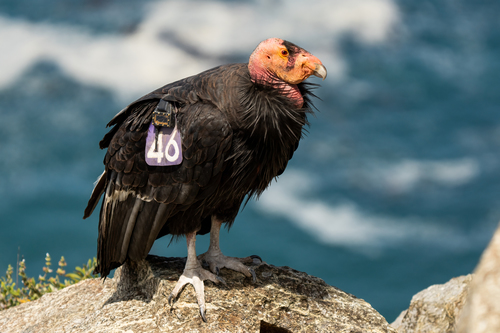
- California Condor (no range overlap) has white underwing linings rather than upper-wing panels and lacks the white ruff. Black Vulture and Turkey Vulture are far smaller.
- Where to see it
- Cruz del Cóndor, Colca Canyon (Peru); Torres del Paine (Chile); Quebrada del Condorito (Argentina); the Antisana reserve (Ecuador).
- When
- Resident year-round; Colca viewing best in the morning, Jun–Oct
Listen
Looking for field recordings…
Life & habits
- Diet
- Carrion of large mammals — llamas, guanacos, cattle; marine mammal carcasses on the coast
- Habitat
- Open mountains, high plateaus and coasts with cliffs for roosting and nesting
- Size
- 100–130 cm; wingspan 2.7–3.3 m; 8–15 kg (males larger)
- Lifespan
- Over 50 years; captive birds have exceeded 70
Males are larger than females, unusual among raptors, and carry a fleshy comb on the head.
Where it lives
Recorded sightings
—
geo-referenced records in GBIF, from museums, herbaria and field observers.
Native range
Andes from Venezuela and Colombia to Tierra del Fuego, and adjacent Pacific coasts and Patagonian lowlands
Drag the globe to turn it. Dots are where records exist, not a range map; darker means more records.
In the old herbals & bestiaries
No plate in the Source Library names this exact species, so these show its closest relatives as the old naturalists drew them: same genus, or the same kind of animal. Click a plate to read the page it came from, with translation.

In the stacks
Searching the stacks…
Every page naming Vultur gryphus in the Biodiversity Heritage Library →
Marginalia
For the Inca, the kuntur was a messenger of the upper world (Hanan Pacha), and in the Peruvian Yawar Fiesta a condor was tied to a bull's back to symbolise the struggle of Andean and Spanish cultures.
Curiosity
Its species name gryphus refers to the griffin of legend.
Kinship




Photographs: iNaturalist contributors under the licences shown. Records: GBIF.org. Historical plates: Source Library (CC BY-SA 4.0; originals public domain). Summary text: Nature Library editors and Wikipedia (CC BY-SA). Medicinal and edibility notes are historical and educational, not advice. iNaturalist taxon 4747.