
Sea Anemones and Corals
Anthozoa
Anthozoa is one of the three subphyla of Cnidaria, along with Medusozoa and Endocnidozoa. It includes sessile marine invertebrates and invertebrates of brackish water, such as sea anemones, stony corals, soft corals and sea pens. Almost all adult anthozoans are attached to the seabed, while their larvae exist as zooplankton. The basic unit of the adult is the polyp, an individual animal consisting of a cylindrical column topped by a disc with a central mouth surrounded by tentacles. Sea anemones are mostly solitary, but the majority of corals are colonial, being formed by the budding of new polyps from an original, founding individual. Colonies of stony corals are strengthened by mainly aragonite and other materials, and can take various massive, plate-like, bushy or leafy forms.
Members of Anthozoa possess cnidocytes, a feature shared among other cnidarians such as the jellyfish, box jellies and parasitic Myxozoa and Polypodiozoa. The two classes of Anthozoa are class Hexacorallia, with members that have six-fold symmetry such as stony corals, sea anemones, tube anemones and zoanthids, and class Octocorallia, with members that have eight-fold symmetry, such as soft corals, gorgonians (sea pens, sea fans and sea whips), and sea pansies. Some additional species are also included as incertae sedis until their exact taxonomic position can be ascertained.
3 branches of this class, most-observed first

Hexacorallians
subclassHexacorallia
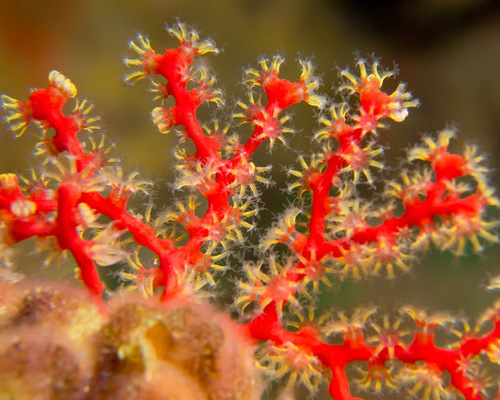
Octocorals
subclassOctocorallia

Tube-dwelling Anemones
subclassCeriantharia
Where it lives
Recorded sightings
—
geo-referenced records in GBIF, from museums, herbaria and field observers.
Drag the globe to turn it. Dots are where records exist, not a range map; darker means more records.
In the stacks
Searching the stacks…
Every page naming Anthozoa in the Biodiversity Heritage Library →
This page is assembled live from iNaturalist, GBIF, Wikipedia, the Source Library and the Internet Archive. It is not yet part of the hand-edited codex. iNaturalist taxon 47533.