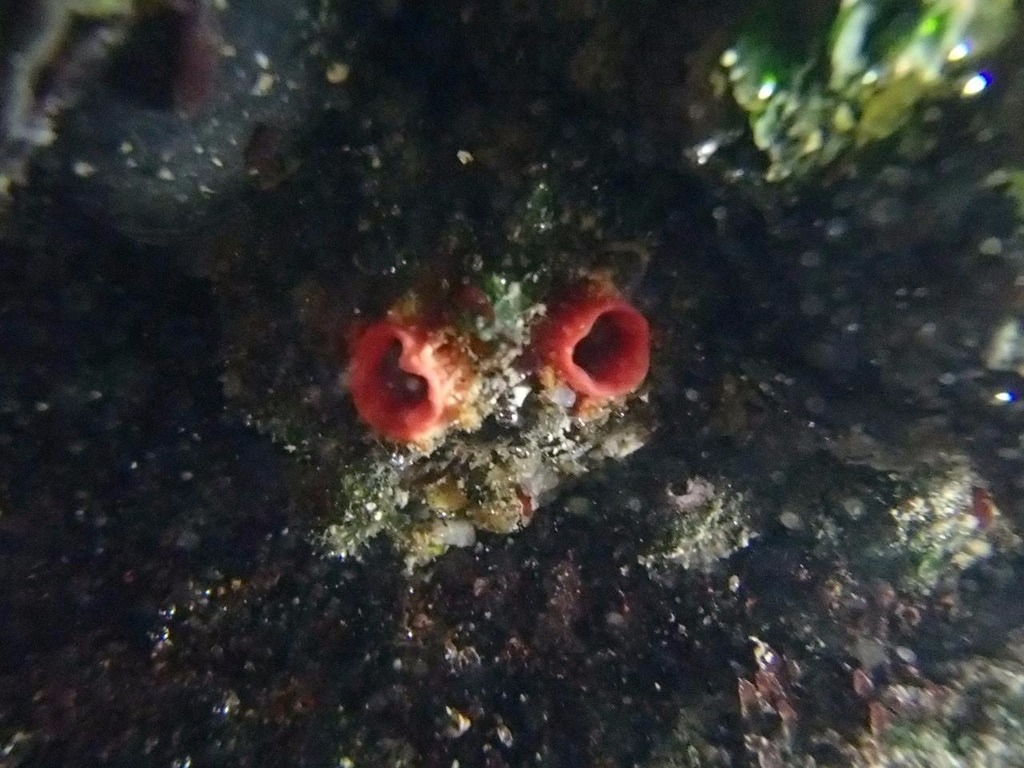
Pyura chilensis
Pyura chilensis, called piure in Spanish and piür or piwü in Mapudungun, is a tunicate of the family Pyuridae. It was described in 1782 by Juan Ignacio Molina.
From the article Pyura chilensis on Wikipedia (CC BY-SA), quoted section by section
Description
Pyura chilensis is a tunicate that somewhat resembles a mass of organs inside a rock. It is often found in dense aggregations in the intertidal and subtidal coast of Chile and Peru. It is a filter feeder that eats by sucking in seawater and filtering out microorganisms. Pyura chilensis has some basic characteristics common to chordates, such as the notochord and a perforated pharynx. It is born male, becomes hermaphroditic at puberty, and reproduces by releasing clouds of sperm and eggs into the surrounding water. If alone, they will procreate by self-fertilization. Its blood is clear and can contain high concentrations of vanadium, which may be ten million times that found in surrounding seawater, although the source and function of this element's concentrations are unknown.
What it does
On Chiloé Island of Chile, women who consumed increased amounts of piure during pregnancy were purported to have had greater incidency of multiple births. However, the veracity of such claims, in light of mechanisms of human reproduction, remain dubious. It is said to possess aphrodisiac properties and to have a significant sildenafil-like effect on men for a period of time after consumption.
== References ==
Wikipedia: “Effects on human reproduction”
At the table
The meat, which has a strong flavor, can be eaten raw or cooked. Its taste has been described as like that of iodine or "something like a sea urchin though less delicate in flavor" and a "slightly bitter, soapy taste". It is usually cut into small pieces, and flavored with chopped onion, cilantro, and lemon. Minced and boiled, it serves as an element of many dishes, particularly arroz con piure picado, or "rice with minced piure". It can also be fried and eaten on bread. A similar edible tunicate in the Mediterranean is Microcosmus sabatieri, also called a sea violet or sea fig. P. chilensis has a high concentration of vanadium, with up to 1.9 mg/kg found in dry blood plasma.
Wikipedia: “Cuisine”
Where it lives
Recorded sightings
—
geo-referenced records in GBIF, from museums, herbaria and field observers.
Drag the globe to turn it. Dots are where records exist, not a range map; darker means more records.
In the stacks
Searching the stacks…
Every page naming Pyura chilensis in the Biodiversity Heritage Library →
This page is assembled live from iNaturalist, GBIF, Wikipedia, the Source Library and the Internet Archive. It is not yet part of the hand-edited codex. iNaturalist taxon 475404.