- Fungi Including Lichens
- ›Ascomycete Fungi
- ›Sac Fungi and Lichens
- ›Operculate Ascomycetes
- ›Pezizales
- ›Helvellaceae
- ›Helvella
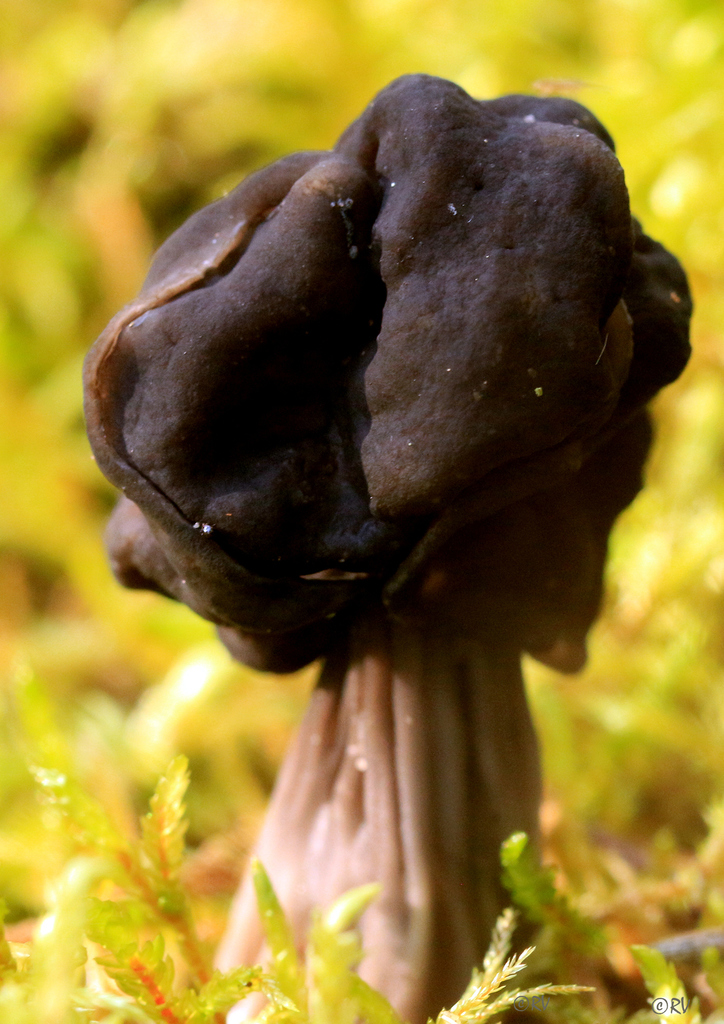
Elfin Saddle
Helvella lacunosa
Helvella lacunosa, known as the slate grey saddle or fluted black elfin saddle in North America, simply as the elfin saddle in Britain, is an ascomycete fungus of the family Helvellaceae. It is one of the most common species in the genus Helvella. The mushroom is readily identified by its irregularly shaped grey cap, fluted stem, and fuzzy undersurfaces. It is usually found in Eastern North America and in Europe, near deciduous and coniferous trees in summer and autumn.
From the article Helvella lacunosa on Wikipedia (CC BY-SA), quoted section by section
Description
Helvella lacunosa not uncommonly appears to be made out of wax. It has an irregularly folded or wrinkled cap which may be shades of slatey grey to black, and measure anywhere from 1 to 10 centimetres (1⁄2 to 4 inches), though usually between 2 and 5 cm (1 and 2 in). The margin can be fused with the wrinkled, ringless stem, which is chambered within, measuring 3–15 cm (1–6 in) high and 1–3 cm wide. The stem may be white when young and darker with age, though may be any shade of grey. The spore print is white, and the oval spores average (12) 15–21 × (9) 11–14 μm. Occasionally, white-capped forms are found. They may be distinguished from the creamy-white coloured Helvella crispa by the latter's furry cap undersurface and inrolled margins when young. Another similar species is H. maculata, which has a brownish cap.
Range & habitat
This species is common in Eastern North America and is also found in Europe, Varsey Rhododendron Sanctuary in Sikkim, Japan, and China. It is frequent in the alpine, and temperate zones of both the northern and southern hemispheres. The species occurs under pine, oak and Douglas fir and nearby parkland and lawns. Fruiting bodies appear in late summer and autumn, though have been recorded in winter in California. It often occurs on burnt ground. Two similar looking species occur in Western North America; Helvella vespertina is associated with conifers and H. dryophila is associated with oak. The European H. lacunosa has been found in Eastern North America, but rarely in the west.
Wikipedia: “Distribution and habitat”
At the table
This species is eaten and regarded highly by some after thorough cooking, though the stems are not eaten. Lightfoot regarded it as edible in 1777, and several guidebooks list it as edible, yet this genus is now regarded with suspicion due to the presence of toxic compounds in several related species. It has been reported to cause gastrointestinal symptoms when eaten raw. It may contain small amounts of the toxin monomethylhydrazine, so cooking is required. Roger Phillips calls it "edible but not worthwhile".
== References ==
Wikipedia: “Edibility”
Where it lives
Recorded sightings
—
geo-referenced records in GBIF, from museums, herbaria and field observers.
Drag the globe to turn it. Dots are where records exist, not a range map; darker means more records.
In the stacks
Searching the stacks…
Every page naming Helvella lacunosa in the Biodiversity Heritage Library →
This page is assembled live from iNaturalist, GBIF, Wikipedia, the Source Library and the Internet Archive. It is not yet part of the hand-edited codex. iNaturalist taxon 475619.