- Plants
- ›Vascular Plants
- ›conifers
- ›conifers
- ›cypress family
- ›Cypresses, Cedars, Junipers, and Allies
- ›Juniperus
- ›Sabina
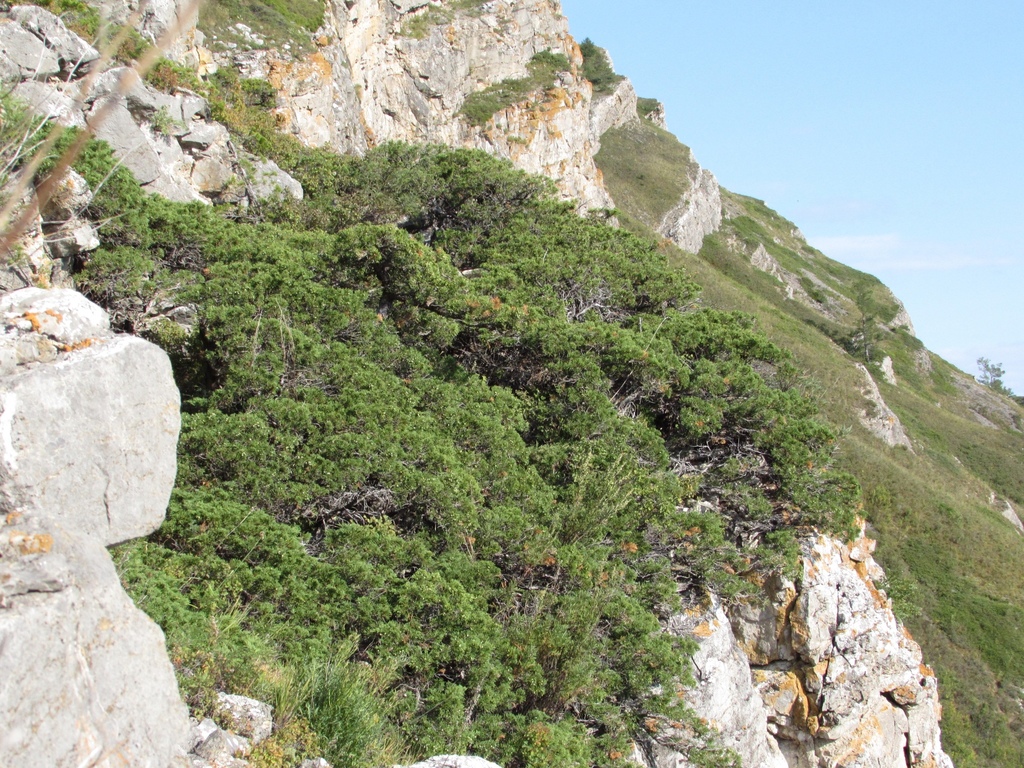
savin juniper
Juniperus sabina
Juniperus sabina, the savin juniper or savin, is a species of juniper native to the mountains of central and southern Europe and western and central Asia, from Spain to eastern Siberia, typically growing at elevations of 1,000–3,300 metres (3,300–10,800 feet).
From the article Juniperus sabina on Wikipedia (CC BY-SA), quoted section by section
Description
The shrub is very variable in shape, up to 1–4 metres (3+1⁄2–13 feet) tall. The leaves are of two forms, juvenile needle-like leaves 5–10 millimetres (1⁄4–3⁄8 inch) long, and adult scale-leaves 1–2 mm long on slender shoots 0.8–1 mm thick. Juvenile leaves are found mainly on seedlings but mature shrubs sometimes continue to bear some juvenile leaves as well as adult, particularly on shaded shoots low in the crown. It is largely dioecious with separate male and female plants, but some individual plants produce both sexes. The cones are berry-like, 5–9 mm in diameter, blue-black with a whitish waxy bloom, and contain 1-3 (rarely 4 or 5) seeds; they are mature in about 18 months. The male cones are 2–4 mm long, and shed their pollen in early spring. All parts of the plant are poisonous due to several toxic compounds including ethereal oils. This plant is the alternate (telial) host of the Pear Rust fungus Gymnosporangium fuscum.
At the table
Juniperus sabina is a popular ornamental shrub in gardens and parks, with numerous named cultivars selected. Savin was used in abortifacient drugs in 19th-century America. In Iran, savin fruit (known as ابهل abhal) are a traditional remedy to alleviate urinary and digestive problems.
Wikipedia: “Uses”
Where it lives
Recorded sightings
—
geo-referenced records in GBIF, from museums, herbaria and field observers.
Drag the globe to turn it. Dots are where records exist, not a range map; darker means more records.
In the old herbals & bestiaries

The Dream of Poliphilus
[Colonna, Francesco] · 1561 · p.306

On the Virtues of Herbs
Macer Floridus (Odo of Meung) · 1090 · p.37

On the Virtues of Herbs
Macer Floridus · 1150 · p.73

Latin Herbal
1484 · p.275

Herbarius
1485 · p.276

Herbarius latinus (with Dutch synonyms)
1486 · p.273

Latin Herbal with German Synonyms
1486 · p.276

Ortus sanitatis
1491 · p.385

Herbal of Virtues
1499 · p.275

Garden of Health
1507 · p.311

The Great Herbary with all the figures of the herbs
1532 · p.280

Notable Commentaries on the History of Plants
Leonhart Fuchs · 1542 · p.184
In the stacks
Searching the stacks…
Every page naming Juniperus sabina in the Biodiversity Heritage Library →
This page is assembled live from iNaturalist, GBIF, Wikipedia, the Source Library and the Internet Archive. It is not yet part of the hand-edited codex. iNaturalist taxon 47572.