- Plants
- ›Vascular Plants
- ›flowering plants
- ›Dicots
- ›Mustards, Capers, and Allies
- ›mustard family
- ›Brassicoideae
- ›Hesperodae
- ›Hesperideae
- ›Hesperis
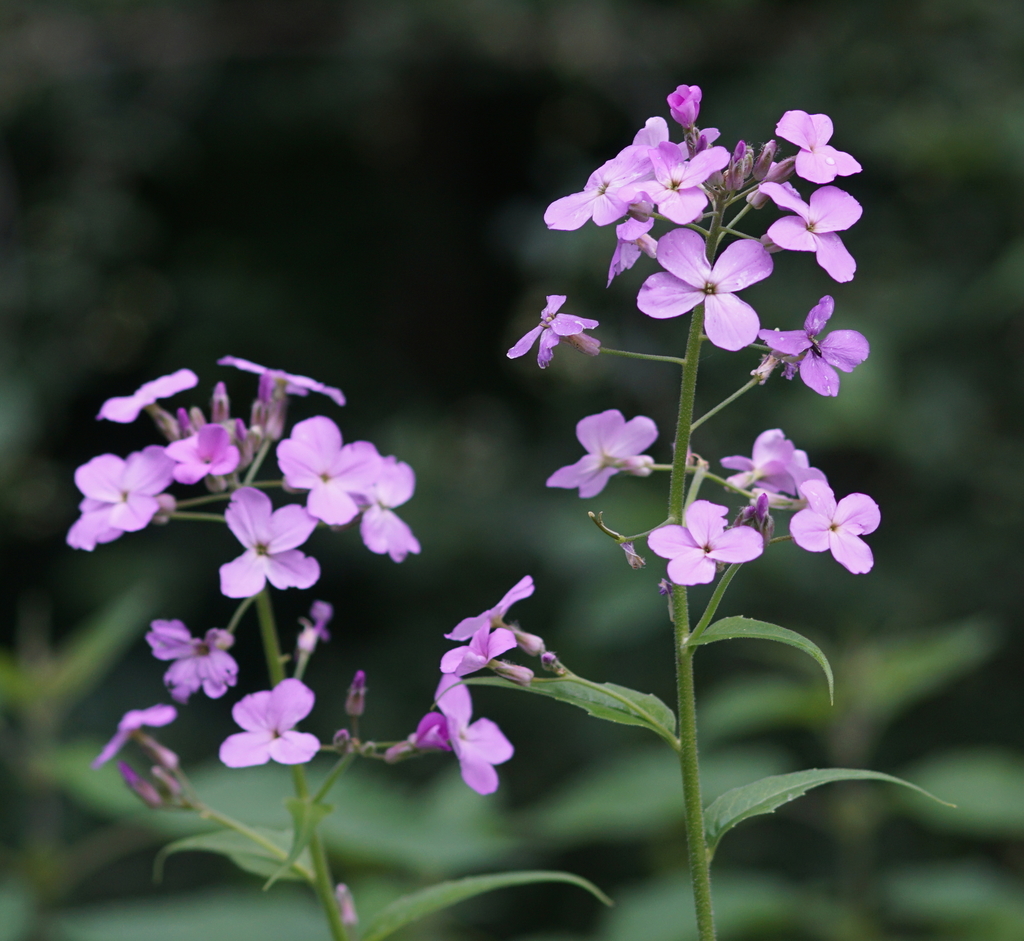
dame's rocket
Hesperis matronalis
Hesperis matronalis is an herbaceous flowering plant species in the family Brassicaceae. It has numerous common names, including dame's rocket, damask-violet, dame's-violet, dames-wort, dame's gilliflower, night-scented gilliflower, queen's gilliflower, rogue's gilliflower, sweet rocket, and mother-of-the-evening.
These plants are biennials or short-lived perennials, native to Eurasia and cultivated in many other areas of the world for their attractive, spring-blooming flowers. In some of those areas, it has escaped from cultivation and become a weed species. The genus name Hesperis was probably given because the scent of the flowers becomes more conspicuous towards evening (Hespera is the Greek word for evening).
From the article Hesperis matronalis on Wikipedia (CC BY-SA), quoted section by section
Description
Hesperis matronalis grows 100 cm or taller, with multiple upright, hairy stems. Typically, the first year of growth produces a mound of foliage, and flowering occurs the second year; the plants are normally biennials, but a number of races can be short-lived perennials. The plants have showy blooms in early to mid spring. The leaves are alternately arranged on upright stems and lanceolate-shaped; they typically have very short petioles (or lack them) and have toothed margins, but sometimes are entire and are widest at the base. The foliage has short hairs on the top and bottom surfaces that give the leaves a somewhat rough feel. The larger leaves are around 12 cm long and over 4 cm wide. In early spring, a thick mound of low-growing foliage is produced; during flowering the lower parts of the stems are generally unbranched and denuded of foliage and the top of the blooming plant might have a few branches that end in inflorescences. The plentiful, fragrant flowers are produced in large, showy, terminal racemes that can be 30+ cm tall and elongate as the flowers of the inflorescence bloom. When stems have both flowers and fruits, the weight sometimes causes the stems to bend. Each flower is large (2 cm across), with four petals. …
Range & habitat
Hesperis matronalis is native to southern Europe from Spain to Turkey, and has been introduced to many other parts of the world with temperate climates. H. matronalis is found in many areas of Ireland, including Belfast, as a garden escape. Dame's rocket was brought to North America in the 17th century and has since become naturalized there, now growing throughout most of the US and Canada. The US Department of Agriculture website has a map showing states and provinces in which the plant has been found. In Europe, it is host to the caterpillars of several butterfly species, including the orange tip (Anthocharis cardamines), large white (Pieris brassicae), small white (Pieris rapae), and moths, such as Plutella porrectella.
Wikipedia: “Distribution”
At the table
Young leaves are high in vitamin C, slightly bitter, and can be eaten in salads or cooked. They are available in the winter months in temperate climates, when few other greens are available. The tender shoots of the plant during the spring-time, when cooked, are considered an excellent vegetable. The flower buds are eaten as well, and the flowers used for their spicy flavor and bright color. Additionally, the seeds of the plant can be sprouted and eaten in salads.
Wikipedia: “Culinary use”
How it is grown
Hesperis matronalis has been a cultivated species for a long time, and grows best in full sun to partial shade where soils are moist with good drainage. It is undemanding and self-seeds quickly, forming dense stands. Extensive monotypic stands of dame's rocket are visible from great distances; these dense collections of plants have the potential to crowd out native species when growing outside of cultivated areas. The successful spread of dame's rocket in North America is attributed to its prolific seed production and because the seeds are often included in prepackaged "wildflower seed" mixes sold for "naturalizing". The plants typically produce a low-lying rosette of foliage the first year; in subsequent years, blooming and seed production occurs in tandem throughout the blooming season. This species is commonly found in roadside ditches, dumps and in open woodland settings, where it is noticed when in bloom. Although it makes an attractive, hardy garden plant, it has been found to be ecologically invasive in North America. Hesperis matronalis is propagated by seeds, but desirable individuals, including the double-flowering forms, are propagated from cuttings or division of the clumps.
Wikipedia: “Cultivation”
Where it lives
Recorded sightings
—
geo-referenced records in GBIF, from museums, herbaria and field observers.
Drag the globe to turn it. Dots are where records exist, not a range map; darker means more records.
In the old herbals & bestiaries

Notable Commentaries on the History of Plants
Leonhart Fuchs · 1542 · p.347

Notable Commentaries on the History of Plants
Leonhart Fuchs · 1542 · p.348

Notable Commentaries on the History of Plants
Leonhart Fuchs · 1542 · p.349

Notable Commentaries on the History of Plants
Leonhart Fuchs · 1549 · p.347

Notable Commentaries on the History of Plants
Leonhart Fuchs · 1549 · p.346

Notable Commentaries on the History of Plants
Leonhart Fuchs · 1549 · p.345

Florum et coronariarum historia
Rembert Dodoens · 1568 · p.28

Six Groups of the History of Plants
Rembert Dodoens · 1583 · p.181
In the stacks
Searching the stacks…
Every page naming Hesperis matronalis in the Biodiversity Heritage Library →
This page is assembled live from iNaturalist, GBIF, Wikipedia, the Source Library and the Internet Archive. It is not yet part of the hand-edited codex. iNaturalist taxon 47697.