Snakeflies
Raphidioptera
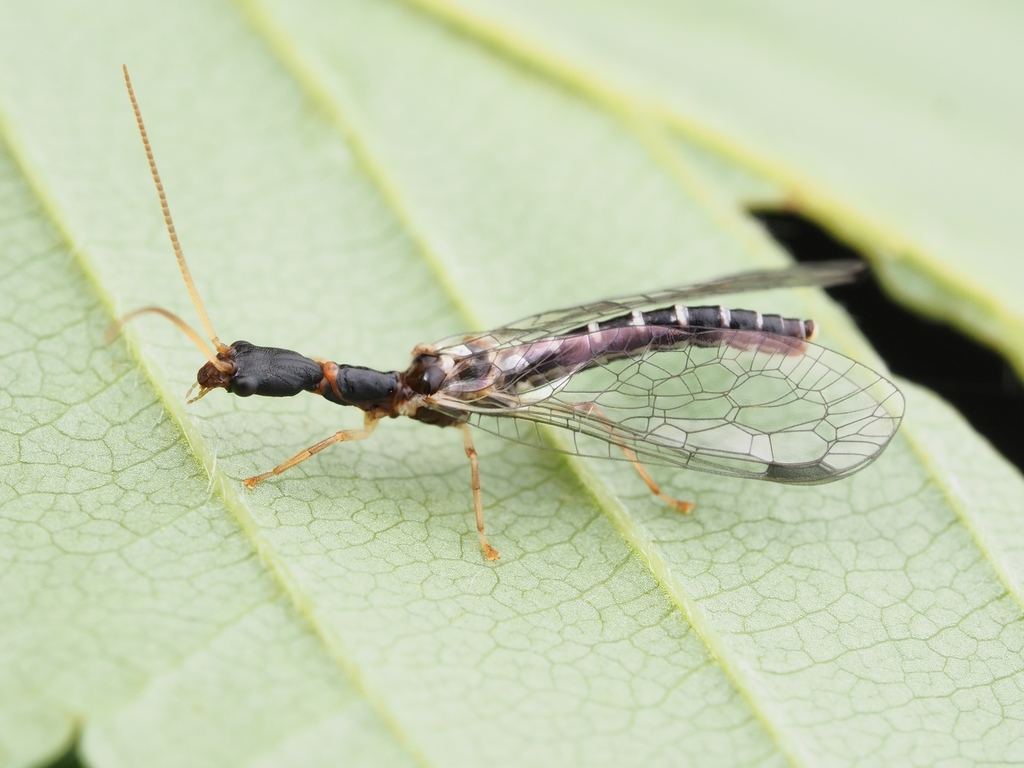
Snakeflies are a group of predatory insects comprising the order Raphidioptera, from Ancient Greek ῥαφίς (rhaphís), meaning "needle", and πτερόν (pterón), meaning "wing", with two extant families: Raphidiidae and Inocelliidae, consisting of roughly 260 species. In the past, the group had a much wider distribution than it does now; snakeflies are found in temperate regions worldwide but are absent from the tropics and the Southern Hemisphere. Recognizable representatives of the group first appeared during the Early Jurassic. They are a relict group, having reached their apex of diversity during the Cretaceous before undergoing substantial decline.
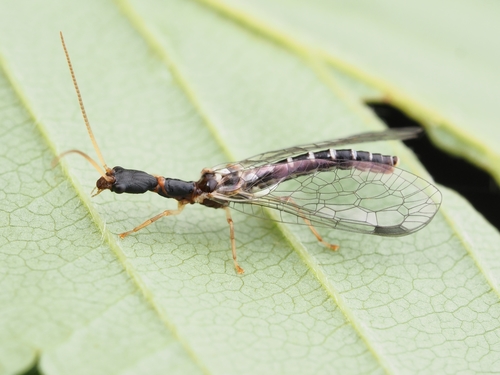
An adult snakefly resembles a lacewing in appearance but has a notably elongated thorax which, together with the mobile head, gives the group their common name. The body is long and slender and the two pairs of long, membranous wings are prominently veined. Females have a large and sturdy ovipositor which is used to deposit eggs in some concealed location. They are holometabolous insects with a four-stage life cycle consisting of eggs, larvae, pupae and adults. In most species, the larvae develop under the bark of trees. They may take several years before they undergo metamorphosis, requiring a period of chilling before pupation takes place. Both adults and larvae are predators of soft-bodied arthropods.
2 branches of this order, most-observed first
See this branch on the Wheel of Life →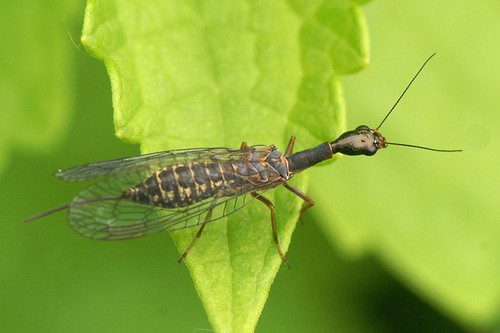
Where it lives
Recorded sightings
—
geo-referenced records in GBIF, from museums, herbaria and field observers.
Drag the globe to turn it. Dots are where records exist, not a range map; darker means more records.
In the stacks
Searching the stacks…
Every page naming Raphidioptera in the Biodiversity Heritage Library →
This page is assembled live from iNaturalist, GBIF, Wikipedia, the Source Library and the Internet Archive. It is not yet part of the hand-edited codex. iNaturalist taxon 47794.