On eBird ↗
Slate-colored Coot
Live sightings near you, the range map, bar charts of when it is seen, and Macaulay Library photos and recordings.
Slate-colored Coot
Fulica ardesiaca
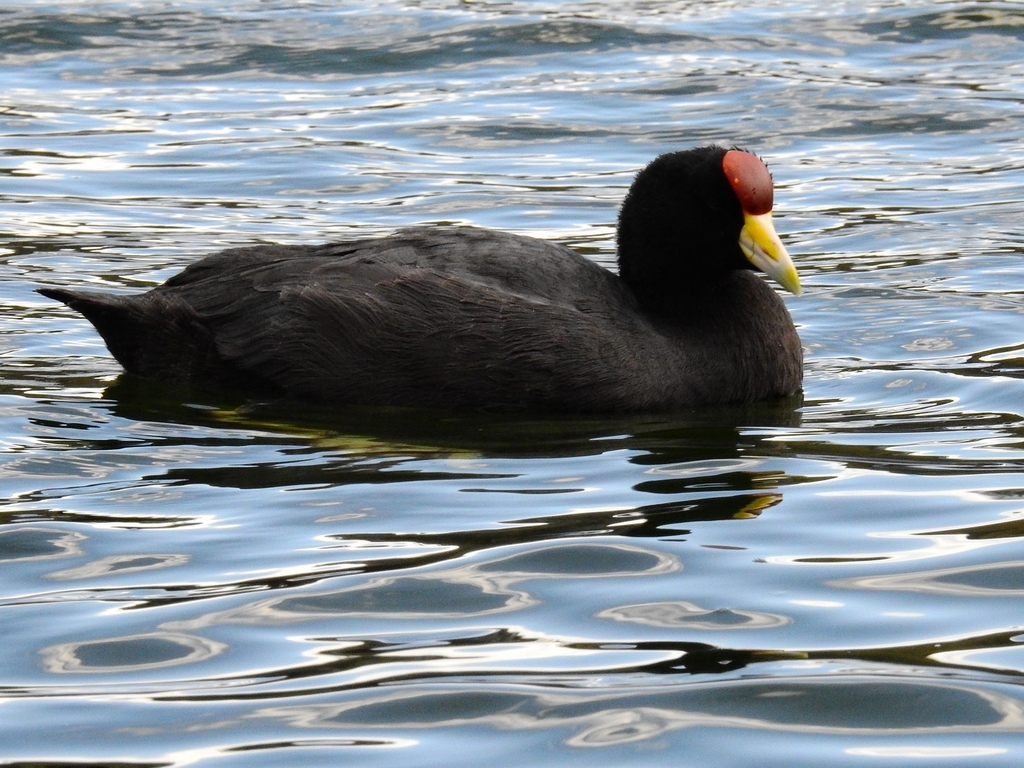
The Andean coot (Fulica ardesiaca), also known as the slate-colored coot, is a species of bird in the family Rallidae. It is found in the Andes from far southwestern Colombia to northwestern Argentina. Its natural habitats are swamps and freshwater lakes.
From the article Andean coot on Wikipedia (CC BY-SA), quoted section by section
Description
The Andean coot is 40 to 43 cm (16 to 17 in) long. It has two color morphs that are present in both subspecies. Both morphs are mostly slaty gray that is blacker on the head and neck. Their secondaries usually have white tips. One morph has a chrome yellow bill that is paler yellow and sometimes green on the tip, a deep chesnut frontal shield, and green legs and feet. The other has a white bill, a white to orange-yellow frontal shield, and slaty legs and feet. Independent of the color morphs, the subspecies differ only in the color of their undertail coverts: The nominate's are white and those of F. a. atrura are almost black.
Range & habitat
The nominate subspecies of Andean coot is found in the Andes from northern Peru south through western Bolivia into northern Chile as far as the Antofagasta Region and into northwestern Argentina as far as Catamarca Province. F. a. atrura is found from the Andes of southern Colombia through Ecuador into far northern Peru and also in coastal Peru. Fossils tentatively assigned to this species are known from the Laguna de Tagua Tagua formation of Chile. The Andean coot mostly inhabits large lakes with heavily vegetated shallows, though it also is found in sparsely vegetated lakes and in ponds, marshes, and rivers. Red-fronted birds tend to dominate in vegetated lakes and white-fronted ones in the less vegetated higher elevation ones. The nominate subspecies is found at elevations between 2,100 and 4,700 m (6,900 and 15,400 ft). F. a. atrura is found between 2,200 and 3,600 m (7,200 and 11,800 ft) in Colombia and at lower elevations in Ecuador and Peru.
Wikipedia: “Distribution and habitat”
What it does
The Andean coot's diet is mostly aquatic vegetation. Chara is a main component, especially in higher elevation lakes, but others include Myriophyllum and Elodea. It feeds by diving as deep as 5 m (20 ft) and also by walking on floating vegetation. It is gregarious when not breeding and often feeds with other species of coots.
Wikipedia: “Feeding”
Listen
Looking for field recordings…
Where it lives
Recorded sightings
—
geo-referenced records in GBIF, from museums, herbaria and field observers.
Drag the globe to turn it. Dots are where records exist, not a range map; darker means more records.
In the stacks
Searching the stacks…
Every page naming Fulica ardesiaca in the Biodiversity Heritage Library →
This page is assembled live from iNaturalist, GBIF, Wikipedia, the Source Library and the Internet Archive. It is not yet part of the hand-edited codex. iNaturalist taxon 479.