- Animals
- ›Arthropods
- ›Hexapods
- ›Insects
- ›Winged and Once-winged Insects
- ›Flies
- ›Brachyceran Flies
- ›Cyclorrhaphan Flies
- ›Schizophoran Flies
- ›Calyptrate Flies
- ›Bot Flies, Blow Flies, and Allies
- ›Tachinid Flies
- ›Tachininae
- ›Ormiini
- ›Ormia
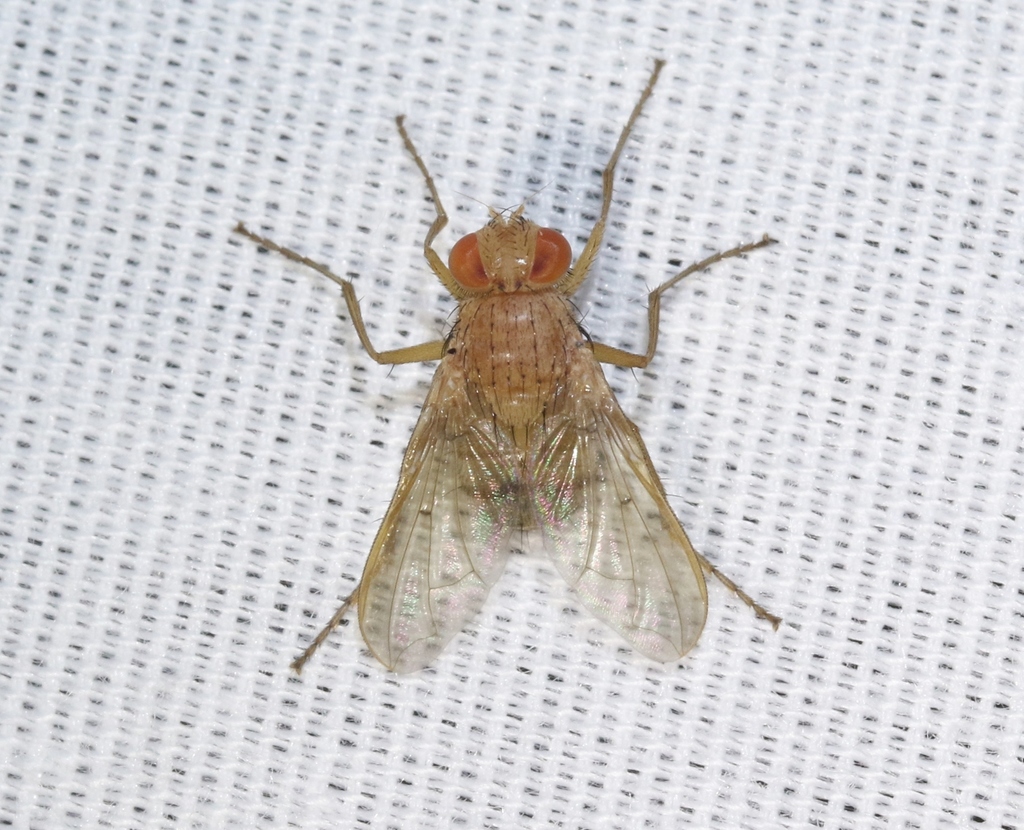
Ormia ochracea
Ormia ochracea is a small yellow nocturnal fly in the family Tachinidae. It is notable for its parasitism of crickets and its exceptionally acute directional hearing. The female is attracted to the song of the male cricket and deposits larvae on or around him, as was discovered in 1975 by the zoologist William H. Cade.
Ormia ochracea is a model organism in sound localization experiments because of its unique "ears", which are complex structures inside the fly's prothorax near the bases of its front legs. The fly is too small for the time difference of sound arriving at the two ears to be calculated in the usual way, yet it can determine the direction of sound sources with exquisite precision. The tympanic membranes of opposite ears are directly connected mechanically, allowing resolution of nanosecond time differences and requiring a new neural coding strategy. Various research groups have designed low-noise differential microphones inspired by O. ochracea’s directionally sensitive hearing system.
From the article Ormia ochracea on Wikipedia (CC BY-SA), quoted section by section
Range & habitat
Ormia ochracea is native to the southeastern United States, including states such as Texas and Florida. O. ochracea is also found throughout North America, South America, and the Caribbean, though its exact range is not known.
Wikipedia: “Distribution”
What it does
O. ochracea infestation has been shown to affect the behavior and reproduction of host field crickets. Early in the infestation period, non-reproductive behavior is largely unimpaired because the parasitic larvae do not consume the digestive system or central nervous system of the host. After the larvae migrate to the host's abdomen, the host's mating, egg-laying, and fighting ability decline, most likely due to tissue damage caused by the larvae. Additionally, infestation of female crickets alters their mating preferences. Gryllus lineaticeps females normally prefer to respond to male songs with intermediate chirp rates over those with slow chirp rates, but females parasitized by O. ochracea show no preference between chirp rates. Reduced selectivity in infested female G. lineaticeps may be adaptive, as a female may be more likely to reproduce before being killed by the parasitoids if they are less selective.
Wikipedia: “Effects of infestation on host behavior”
At the table
O. ochracea is a parasitoid known to prey on several species of Gryllus field crickets including Gryllus integer, Gryllus rubens, Gryllus texensis, and Gryllus firmus. Flies have been observed responding to various cricket songs, but seem to be limited to the family Gryllidae. The natural host of the fly may vary by location. Larvae of O. ochracea exhibit highest survival in its natural host and limited survival in other potential host species.
Host-finding. In 1975, William H. Cade experimentally demonstrated that Ormia ochracea uses the mating call of the field cricket as a means to locate its host. Cade placed dead crickets on top of speakers playing cricket songs and various control sounds and recorded the amount of time the fly spent on either the control or test speaker. He found that flies spent more time on the speakers playing cricket songs and observed that the flies would always deposit larvae on and around the speaker which was playing cricket songs.
Learning. O. ochracea have been shown to adjust their preference for host songs after exposure to different songs in the laboratory. In a 2011 study, flies that were previously exposed to the G. lineaticeps song chose the G. lineaticeps song over the G. integer song, and vice versa. This preference was very short term. O. …
Wikipedia: “Food resources”
In human culture
Ormia ochracea has the full life cycle of egg, larvae, pupa, and adult. Once a female fly finds a suitable host, she deposits planidia (first instar larvae) which then quickly burrow into the host. The planidia develop within the body of the field cricket host, embedding initially in muscle before migrating into the abdomen. The larvae molt within the host's abdomen and feed primarily on the host's muscle and fat. O. ochracea larvae typically complete development and emerge after about 7 days, which subsequently kills the host. The larvae pupate and emerge as adult flies approximately 2 weeks after emerging from the host.
Wikipedia: “Life history”
Listen
Looking for field recordings…
Where it lives
Recorded sightings
—
geo-referenced records in GBIF, from museums, herbaria and field observers.
Drag the globe to turn it. Dots are where records exist, not a range map; darker means more records.
In the stacks
Searching the stacks…
Every page naming Ormia ochracea in the Biodiversity Heritage Library →
This page is assembled live from iNaturalist, GBIF, Wikipedia, the Source Library and the Internet Archive. It is not yet part of the hand-edited codex. iNaturalist taxon 480371.