- Fungi Including Lichens
- ›Ascomycete Fungi
- ›Sac Fungi and Lichens
- ›Common Lichens
- ›Shield Lichens, Sunburst Lichens, Rosette Lichens, and Allies
- ›button lichens, rosette lichens, and allies
- ›Button and Allied Lichens
- ›Buellia
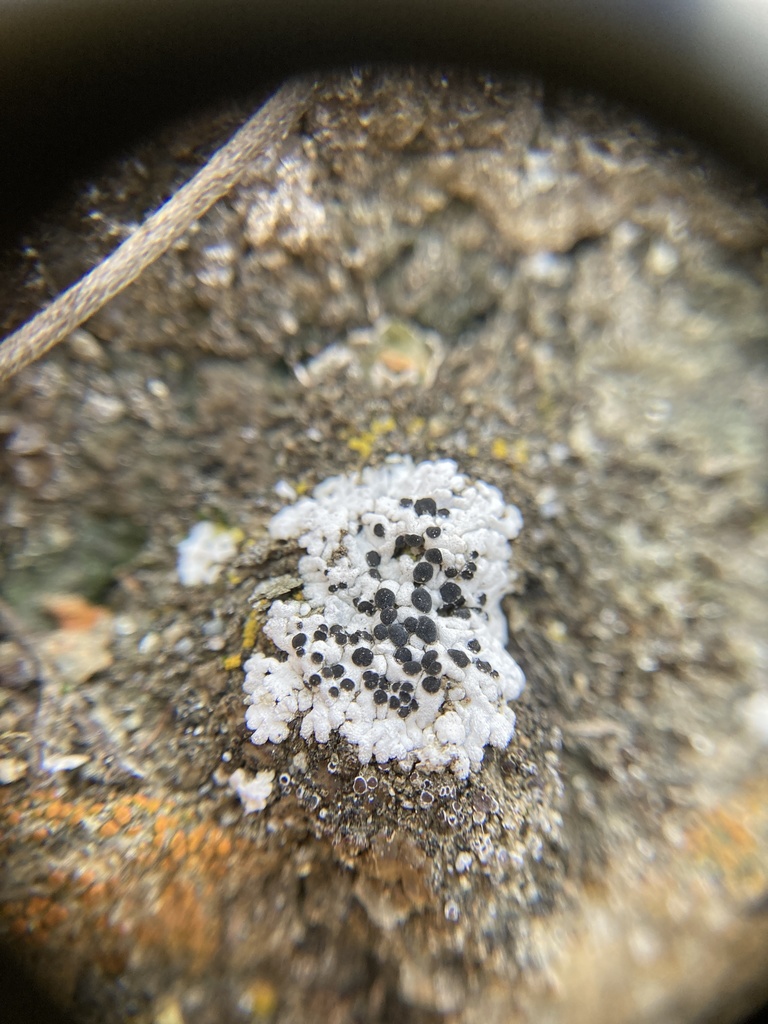
Starry Breck Lichen
Buellia asterella
Buellia asterella, commonly referred to as the starry breck lichen, is a rare, black and white lichen in the family Caliciaceae. Once found all across the central European grasslands, it was described as new to science in 1974. Today, it is classified by the IUCN Red List as Critically Endangered and only found in select regions in Norway and Germany.
From the article Buellia asterella on Wikipedia (CC BY-SA), quoted section by section
Description
Buellia asterella is a white and black lichen, growing on the surface of the soil where it is found. The white section of this lichen is the thallus and the black discs found on top are its fruiting structure. These black discs produce their asci, which only contain 4 spores per asci. This is very uncharacteristic for the phylum of Ascomycota as many are found with 8 spores in their asci. Their spores also do not have any internal wall thickening.
Range & habitat
Buellia asterella was originally endemic to all of the central European grasslands. They were particularly found in Norway, Great Britain, France, Germany, Switzerland, and Northern Italy. When they were extant in Great Britain, they resided in the Breckland and Sussex Coast. Today, they can only be found in select areas of Norway and Germany. The majority of its observations today are in the German lowlands. They are typically found at lower elevations under 900m, and in isolated dry grasslands. This lichen can be found growing on dry, basic soils like limestone, dolomite, or gypsum
Wikipedia: “Habitat and distribution”
What it does
Buellia asterella is found on the ground of soils in Europe, making grasses and shrubs their main competitor. It is believed that this competition and encroachment by the grasses and shrubs have contributed to their threatened population in their endemic ranges. It is also frequently grazed by rabbits, sheep, and goats that are native to its range. It is also grazed by human-introduced livestock, which also contributed to its endangered status
Wikipedia: “Ecology”
Where it lives
Recorded sightings
—
geo-referenced records in GBIF, from museums, herbaria and field observers.
Drag the globe to turn it. Dots are where records exist, not a range map; darker means more records.
In the stacks
Searching the stacks…
Every page naming Buellia asterella in the Biodiversity Heritage Library →
This page is assembled live from iNaturalist, GBIF, Wikipedia, the Source Library and the Internet Archive. It is not yet part of the hand-edited codex. iNaturalist taxon 481585.